Search
Invitrogen
EBF2 Polyclonal Antibody
{{$productOrderCtrl.translations['antibody.pdp.commerceCard.promotion.promotions']}}
{{$productOrderCtrl.translations['antibody.pdp.commerceCard.promotion.promocode']}}: {{promo.promoCode}} {{promo.promoTitle}} {{promo.promoDescription}}. {{$productOrderCtrl.translations['antibody.pdp.commerceCard.promotion.learnmore']}}
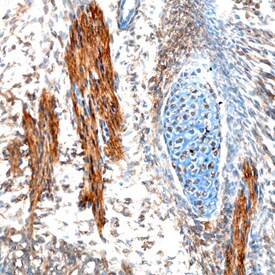
图: 1 / 3
EBF2 Antibody (PA5-47890) in IHC (F)
Immunohistochemical analysis of EBF2 in immersion fixed frozen sections of mouse embryo (15 d.p.c.). Samples were incubated in EBF2 polyclonal antibody (Product # PA5-47890) using a dilution of 10 µg/mL overnight at 4 °C. Tissue was stained using the Anti-Sheep HRP-DAB Cell & Tissue Staining Kit (brown) and counterstained with hematoxylin (blue). Specific staining was localized to developing muscle cells.
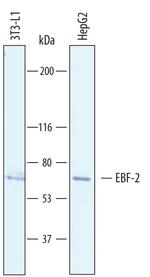
Please note: We are reviewing Western blot images included in the antibody testing data in our catalog, including those provided by third parties. Unless expressly labeled or annotated as “raw-unedited”, Western blot images included in the antibody testing data in our catalog may have been edited, optimized or otherwise adjusted for presentation.


产品信息
PA5-47890
应用
建议稀释比
已发表文章
产品规格
种属反应
Human,
Mouse
已发表种属
Sheep
宿主/亚型
Sheep
/ IgG
分类
Polyclonal
类型
Antibody
抗原
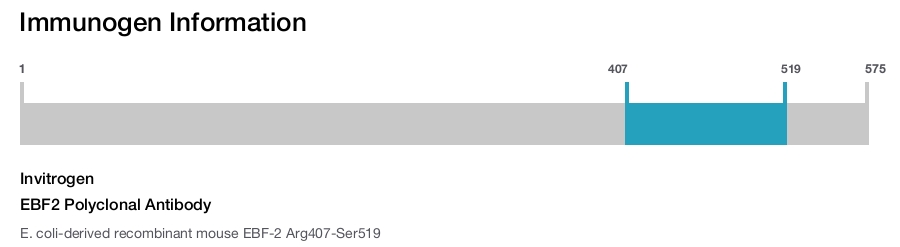
E. coli-derived recombinant mouse EBF-2 Arg407-Ser519
偶联物
Unconjugated
Unconjugated
Unconjugated
形式
Lyophilized
浓度
0.2 mg/mL
规格
100 µg
纯化类型
Antigen affinity chromatography
保存液
PBS with 5% trehalose
内含物
No Preservative
保存条件
-20°C, Avoid Freeze/Thaw Cycles
运输条件
Ambient (domestic); Wet ice (international)
RRID
产品详细信息
In direct ELISAs, less than 1% cross-reactivity with recombinant mouse (rm) EBF-1 and rmEBF-3 is observed.
Reconstitute in sterile PBS to a final concentration of 0.2 mg/mL.
靶标信息
Early B-cell factor 2 (EBF2) is a gene located on chromosome 8p11.23, encoding a transcription factor involved in the regulation of gene expression during neural and adipose tissue development. EBF2 belongs to the COE family of transcription factors and plays a pivotal role in cellular differentiation processes. In the nervous system, EBF2 is essential for the development and function of neurons, particularly in regions like the olfactory system. Additionally, EBF2 is involved in adipogenesis, where it regulates genes responsible for the differentiation of brown adipocytes, contributing to thermogenesis and energy metabolism. Dysfunction or altered expression of EBF2 can impact neurological function and metabolic homeostasis, potentially influencing conditions such as obesity, diabetes, and neurodevelopmental disorders. Research into EBF2 is exploring its role in these physiological contexts and the implications of its regulatory mechanisms, offering insights into potential therapeutic approaches.
仅用于科研。不用于诊断过程。未经明确授权不得转售。
生物信息学
蛋白别名: Collier, Olf and EBF 2; Collier, Olf and EBF transcription factor 2; early B cell factor 2; helix-loop-helix domain protein; HLH transcription factor; MET-mesencephalon-olfactory TF1; MET-mesencephalon-olfactory transcription factor 1; metencephalon-mesencephalnon-olfactory transcription factor 1; metencephalon-mesencephalon-olfactory transcription factor 1; OLF-1/EBF-LIKE 3; unnamed protein product
基因别名: COE2; D14Ggc1e; EBF-2; Mmot1; O/E-3; OE-3
UniProt ID: (Human) Q9HAK2, (Mouse) O08792
Entrez Gene ID: (Human) 64641, (Mouse) 13592
RNA polymerase II core promoter proximal region sequence-specific DNA binding
RNA polymerase II transcription factor activity, sequence-specific DNA binding
transcriptional activator activity, RNA polymerase II transcription regulatory region sequence-specific binding
DNA binding
chromatin binding
transcription factor activity, sequence-specific DNA binding
protein binding
cell fate determination
regulation of transcription, DNA-templated
regulation of transcription from RNA polymerase II promoter
positive regulation of transcription, DNA-templated
positive regulation of transcription from RNA polymerase II promoter
brown fat cell differentiation
adipose tissue development
positive regulation of cold-induced thermogenesis
Disclaimer

Clicking the images or links will redirect you to a website hosted by BenchSci that provides third-party scientific content. Neither the content nor the BenchSci technology and processes for selection have been evaluated by us; we are providing them as-is and without warranty of any kind, including for use or application of the Thermo Fisher Scientific products presented.

