Search
Invitrogen
ECE1 Polyclonal Antibody
{{$productOrderCtrl.translations['antibody.pdp.commerceCard.promotion.promotions']}}
{{$productOrderCtrl.translations['antibody.pdp.commerceCard.promotion.promocode']}}: {{promo.promoCode}} {{promo.promoTitle}} {{promo.promoDescription}}. {{$productOrderCtrl.translations['antibody.pdp.commerceCard.promotion.learnmore']}}
{{$ctrl.translations['antibody.pdp.skuNotes.additionalInformation']}}:
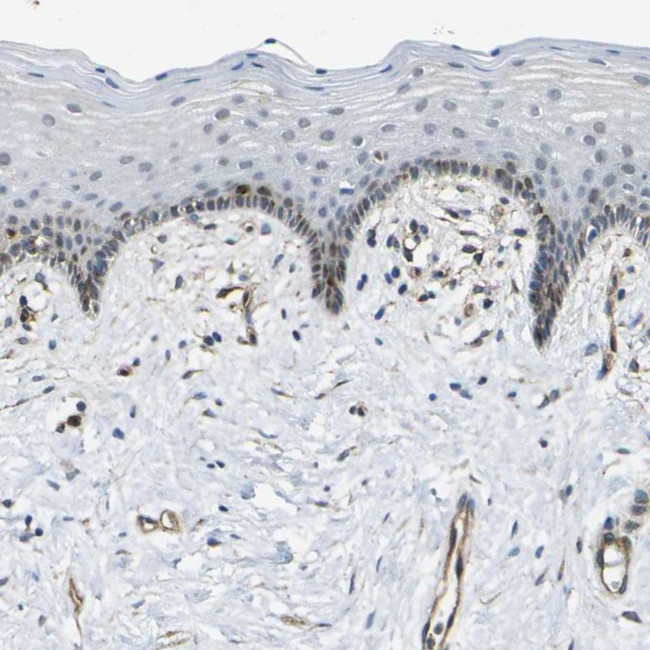
Please note: We are reviewing Western blot images included in the antibody testing data in our catalog, including those provided by third parties. Unless expressly labeled or annotated as “raw-unedited”, Western blot images included in the antibody testing data in our catalog may have been edited, optimized or otherwise adjusted for presentation.

产品信息
PA5-110784
产品规格
种属反应
Human
宿主/亚型
Rabbit
/ IgG
分类
Polyclonal
类型
Antibody
抗原
偶联物
Unconjugated
Unconjugated
Unconjugated
形式
Liquid
浓度
0.1 mg/mL
规格
10 µg
纯化类型
Antigen affinity chromatography
保存液
PBS, pH 7.2, with 40% glycerol
内含物
0.02% sodium azide
保存条件
Store at 4°C short term. For long term storage, store at -20°C, avoiding freeze/thaw cycles.
运输条件
Ambient (domestic); Wet ice (international)
RRID
产品详细信息
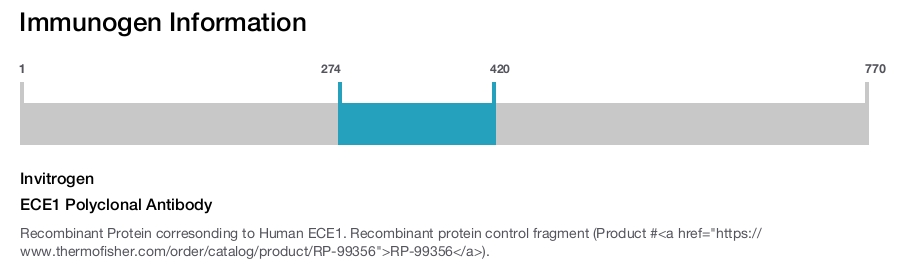
Immunogen sequence: NEKVLTGYLN YMVQLGKLLG GGDEEAIRPQ MQQILDFETA LANITIPQEK RRDEELIYHK VTAAELQTLA PAINWLPFLN TIFYPVEINE SEPIVVYDKE YLEQISTLIN TTDRCLLNNY MIWNLVRKTS SFLDQRFQDA DEKFMEV
Highest antigen sequence indentity to the following orthologs: Rat - 95%, Mouse - 96%.
靶标信息
Endothelin-converting enzyme 1 (ECE1) is located on chromosome 1p36.12 and encodes a zinc metalloprotease involved in the maturation of endothelin peptides, which are critical for vascular tone regulation and blood pressure control. ECE1 processes precursor proteins into active endothelins, particularly endothelin-1, the most potent vasoconstrictor known. This enzyme is expressed in multiple tissues, including endothelial cells, smooth muscle cells, and the central nervous system, where it participates in diverse physiological processes such as vasoconstriction, cell proliferation, and hormone secretion. Beyond its cardiovascular functions, ECE1 is implicated in neural development and neural crest cell migration. Dysregulation of ECE1 activity or endothelin signaling is associated with several pathologies, including hypertension, heart failure, and cancer progression due to its role in controlling vascular dynamics. Research into ECE1 aims to explore its therapeutic potential in managing cardiovascular disorders and its broader implications in systemic pathophysiology.
仅用于科研。不用于诊断过程。未经明确授权不得转售。
篇参考文献 (0)
您是否在文献中引用过该产品?请点击下方按钮邮件告知我们。
生物信息学
蛋白别名: ECE 1; ECE-1; unnamed protein product
基因别名: ECE
UniProt ID: (Human) P42892
Entrez Gene ID: (Human) 1889
positive regulation of receptor recycling
regulation of systemic arterial blood pressure by endothelin
proteolysis
signal transduction
G-protein coupled receptor signaling pathway
axon guidance
heart development
anatomical structure morphogenesis
gene expression
substance P catabolic process
bradykinin catabolic process
calcitonin catabolic process
protein processing
peptide hormone processing
regulation of vasoconstriction
neuron projection development
endothelin maturation
embryonic heart tube development
hormone catabolic process
embryonic digit morphogenesis
ear development
axonogenesis involved in innervation
semaphorin-plexin signaling pathway
sympathetic neuron axon guidance
Disclaimer

Clicking the images or links will redirect you to a website hosted by BenchSci that provides third-party scientific content. Neither the content nor the BenchSci technology and processes for selection have been evaluated by us; we are providing them as-is and without warranty of any kind, including for use or application of the Thermo Fisher Scientific products presented.

