Search
Agrisera
EF-G1/elongation factor G1 Polyclonal Antibody
{{$productOrderCtrl.translations['antibody.pdp.commerceCard.promotion.promotions']}}
{{$productOrderCtrl.translations['antibody.pdp.commerceCard.promotion.viewpromo']}}
{{$productOrderCtrl.translations['antibody.pdp.commerceCard.promotion.promocode']}}: {{promo.promoCode}} {{promo.promoTitle}} {{promo.promoDescription}}. {{$productOrderCtrl.translations['antibody.pdp.commerceCard.promotion.learnmore']}}
Additional Information:
{{banner.description}}
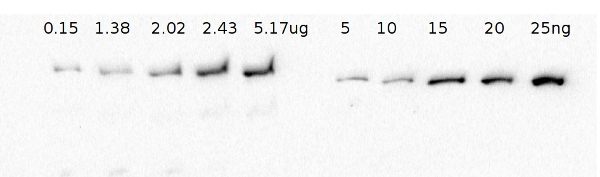
图: 1 / 1
EF-G1/elongation factor G1 Antibody (AS13-2652) in WB
Left panel: from 0.15 to 5.17 µg of total protein from Synechocystis PCC 6803 extracted with SDS-sample buffer and recombinant EF-G 1 (right panel) were separated on 10% SDS-PAGE and blotted 1 h to PVDF. Blots were blocked with 5% milk powder in TBS-T for 30 min. at room temperature (RT) with agitation. Blot was incubated in the primary antibody at a dilution of 1:4 000 for 1 h at RT with agitation. The ant... View More

产品信息
AS13-2652
产品规格
种属反应
Bacteria
宿主/亚型
Rabbit
分类
Polyclonal
类型
Antibody
抗原
Recombinant EF-G1 protein from Synechocystis.
偶联物
Unconjugated
Unconjugated
Unconjugated
形式
Lyophilized
保存液
whole serum
内含物
no preservative
保存条件
-20°C, Avoid Freeze/Thaw Cycles
运输条件
Ambient (domestic); Wet ice (international)
产品详细信息
Store lyophilized/reconstituted at -20°C; once reconstituted make aliquots to avoid repeated freeze-thaw cycles. Please remember to spin the tubes briefly prior to opening them to avoid any losses that might occur from material adhering to the cap or sides of the tube.
For reconstitution add 50 µL of sterile water.
Specific Species Reactivity: Streptococcus pneumoniae, Synechocystis sp. PCC6803
靶标信息
EFG1 encodes a sequence-specific DNA-binding transcription factor that functions primarily in the nucleus to coordinate transcriptional programs underlying morphogenesis and host-associated traits in the opportunistic fungal pathogen Candida albicans. The Efg1 protein is an APSES-family regulator with a central conserved DNA-binding region that includes a basic helix-loop-helix (bHLH)-like motif and surrounding APSES sequences required for DNA binding and normal morphogenetic outputs; additional low-complexity regions, including polyglutamine-rich segments, contribute to protein stability and context-dependent regulatory activity. Functionally, Efg1 is essential for hyphal development under many inducing conditions and directly binds E-box-type DNA elements, acting as both activator and repressor to modulate expression of morphology- and cell-surface/cell-wall-associated genes (including hypha-specific and yeast-associated transcripts), thereby influencing filamentation, cell wall dynamics, and broader virulence-linked behaviors such as biofilm-associated phenotypes and interactions with host-relevant substrates.
仅用于科研。不用于诊断过程。未经明确授权不得转售。
篇参考文献 (0)
您是否在文献中引用过该产品?请点击下方按钮邮件告知我们。
生物信息学
蛋白别名: COXPD1; EFG; EFGM; EGF1; GFM; hEFG1; mtEF-G1
Disclaimer

Clicking the images or links will redirect you to a website hosted by BenchSci that provides third-party scientific content. Neither the content nor the BenchSci technology and processes for selection have been evaluated by us; we are providing them as-is and without warranty of any kind, including for use or application of the Thermo Fisher Scientific products presented.

