Search
Abnova
EPDR1 Polyclonal Antibody, MaxPab™
{{$productOrderCtrl.translations['antibody.pdp.commerceCard.promotion.promotions']}}
{{$productOrderCtrl.translations['antibody.pdp.commerceCard.promotion.viewpromo']}}
{{$productOrderCtrl.translations['antibody.pdp.commerceCard.promotion.promocode']}}: {{promo.promoCode}} {{promo.promoTitle}} {{promo.promoDescription}}. {{$productOrderCtrl.translations['antibody.pdp.commerceCard.promotion.learnmore']}}
Additional Information:
{{banner.description}}
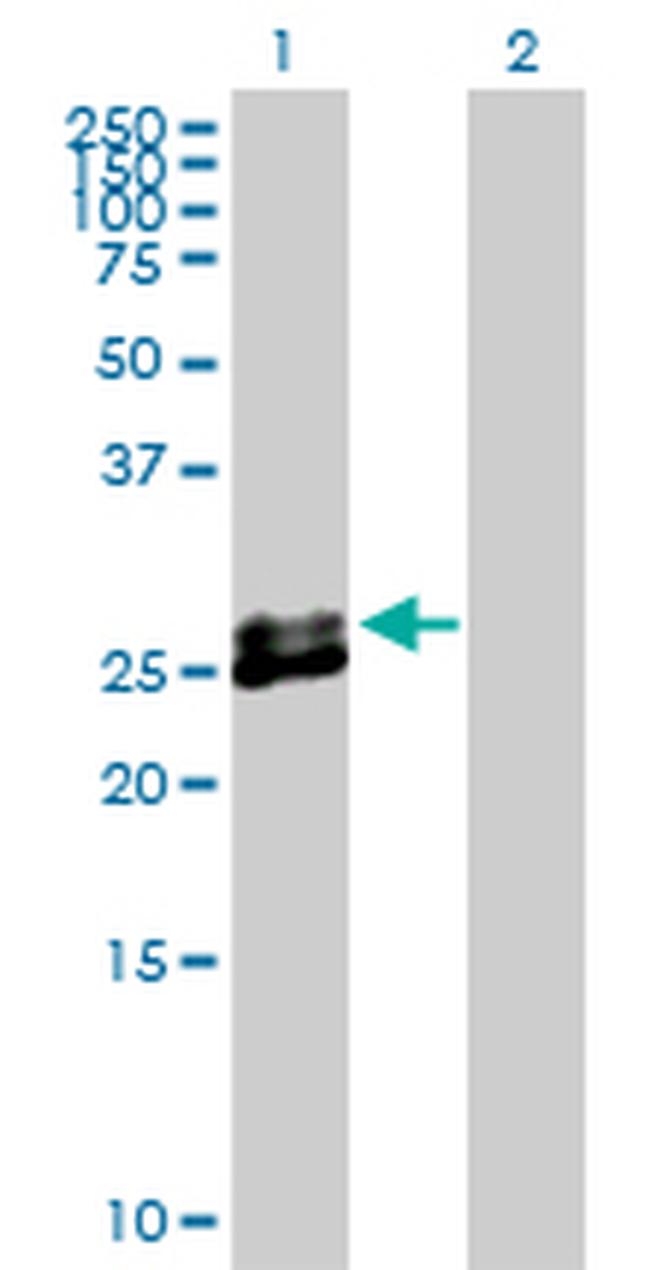
图: 1 / 2
EPDR1 Antibody (H00054749-D01P) in WB
Western Blot analysis of EPDR1 expression in transfected 293T cell line (H00054749-T02) by EPDR1 MaxPab polyclonal antibody.
Lane 1: EPDR1 transfected lysate(25.40 KDa).
Lane 2: Non-transfected lysate.
Lane 1: EPDR1 transfected lysate(25.40 KDa).
Lane 2: Non-transfected lysate.


产品信息
H00054749-D01P
产品规格
宿主/亚型
Rabbit
/ IgG
分类
Polyclonal
类型
Antibody
抗原
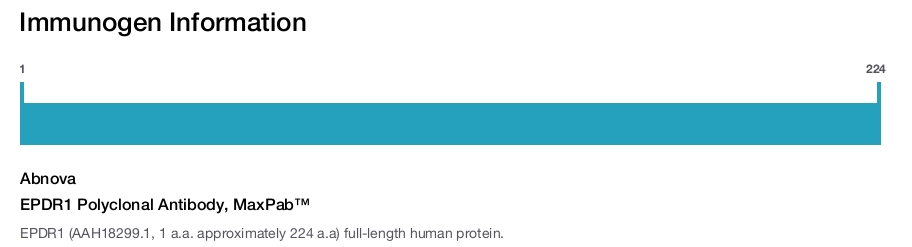
EPDR1 (AAH18299.1, 1 a.a. approximately 224 a.a) full-length human protein.
偶联物
形式
Liquid
浓度
See Label
规格
100 µg
保存条件
-20°C, Avoid Freeze/Thaw Cycles
运输条件
Ambient (domestic); Wet ice (international)
产品详细信息
Sequence of this protein is as follows: MPGRAPLRTV PGALGAWLLG GLWAWTLCGL CSLGAVGAPR PCQAPQQWEG RQVMYQQSSG RNSRALLSYD GLNQRVRVLD ERKALIPCKR LFEYILLYKD GVMFQIDQAT KQCSKMTLTQ PWDPLDIPQN STFEDQYSIG GPQEQITVQE WSDRKSARSY ETWIGIYTVK DCYPVQETFT INYSVILSTR FFDIQLGIKD PSVFTPPSTC QMAQLEKMSE DCSW
靶标信息
The protein encoded by this gene is a type II transmembrane protein that is similar to two families of cell adhesion molecules, the protocadherins and ependymins. This protein may play a role in calcium-dependent cell adhesion. This protein is glycosylated, and the orthologous mouse protein is localized to the lysosome. Alternative splicing results in multiple transcript variants. A related pseudogene has been identified on chromosome 8.
仅用于科研。不用于诊断过程。未经明确授权不得转售。
篇参考文献 (0)
您是否在文献中引用过该产品?请点击下方按钮邮件告知我们。
Disclaimer

Clicking the images or links will redirect you to a website hosted by BenchSci that provides third-party scientific content. Neither the content nor the BenchSci technology and processes for selection have been evaluated by us; we are providing them as-is and without warranty of any kind, including for use or application of the Thermo Fisher Scientific products presented.

