Search
Abnova
ERH Monoclonal Antibody (4A10)
{{$productOrderCtrl.translations['antibody.pdp.commerceCard.promotion.promotions']}}
{{$productOrderCtrl.translations['antibody.pdp.commerceCard.promotion.viewpromo']}}
{{$productOrderCtrl.translations['antibody.pdp.commerceCard.promotion.promocode']}}: {{promo.promoCode}} {{promo.promoTitle}} {{promo.promoDescription}}. {{$productOrderCtrl.translations['antibody.pdp.commerceCard.promotion.learnmore']}}
Additional Information:
{{banner.description}}
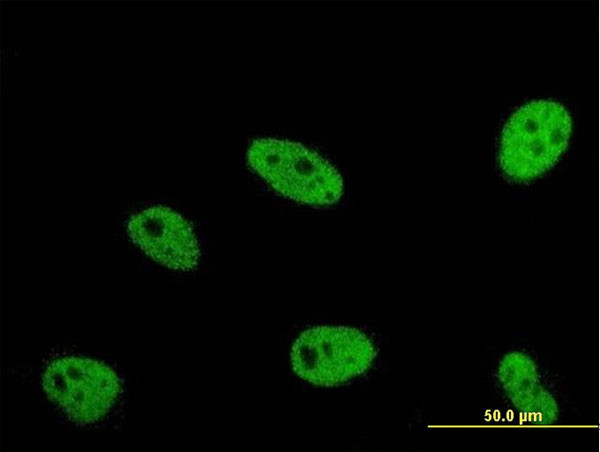

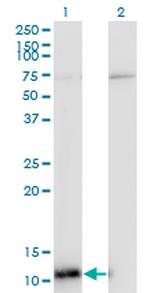
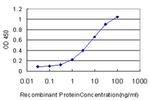


产品信息
H00002079-M14
应用
建议稀释比
已发表文章
产品规格
宿主/亚型
Mouse
/ IgG1, kappa
分类
Monoclonal
类型
Antibody
克隆号
4A10
抗原
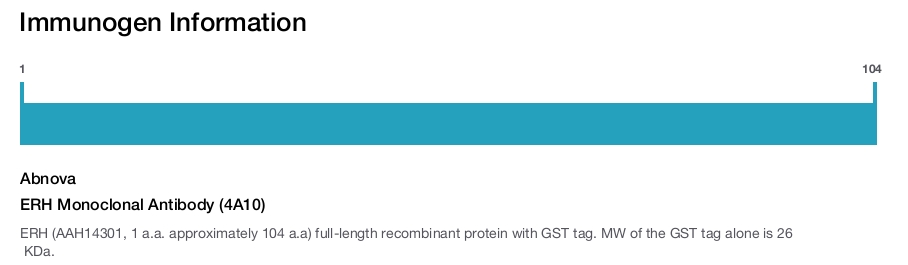
ERH (AAH14301, 1 a.a. approximately 104 a.a) full-length recombinant protein with GST tag. MW of the GST tag alone is 26 KDa.
偶联物
Unconjugated
Unconjugated
Unconjugated
形式
Liquid
浓度
See Label
规格
100 µg
保存条件
-20°C, Avoid Freeze/Thaw Cycles
运输条件
Ambient (domestic); Wet ice (international)
产品详细信息
Sequence of this protein is as follows: MSHTILLVQP TKRPEGRTYA DYESVNECME GVCKMYEEHL KRMNPNSPSI TYDISQLFDF IDDLADLSCL VYRADTQTYQ PYNKDWIKEK IYVLLRRQAQ QAGK
靶标信息
The Enhancer of Rudimentary Homolog (ERH) is a highly conserved protein with significant roles in the regulation of gene expression and cell cycle control. Structurally, ERH forms homodimers, characterized by a crystal structure resolving at 2.0 A, which reveals its ability to bind specific protein regions via a hydrophobic groove. Functionally, ERH interacts with various cellular components, notably integrating into the Microprocessor complex where it facilitates microRNA maturation by binding with the N-terminus of DGCR8 at a 2:2 stoichiometry. This interaction underscores ERH's role in gene silencing, contributing to the biogenesis of small interfering RNAs (siRNAs). Additionally, ERH is implicated in transcriptional regulation and has been associated with DNA replication, suggesting its involvement in broader genomic functions. Despite its diverse roles, ERH operates in a plug-and-play manner, allowing its interaction with different cellular factors to fulfill pleiotropic functions across metazoans.
仅用于科研。不用于诊断过程。未经明确授权不得转售。
篇参考文献 (0)
您是否在文献中引用过该产品?请点击下方按钮邮件告知我们。
Disclaimer

Clicking the images or links will redirect you to a website hosted by BenchSci that provides third-party scientific content. Neither the content nor the BenchSci technology and processes for selection have been evaluated by us; we are providing them as-is and without warranty of any kind, including for use or application of the Thermo Fisher Scientific products presented.

