Search
Abnova
EXT1 Monoclonal Antibody (5A5)
{{$productOrderCtrl.translations['antibody.pdp.commerceCard.promotion.promotions']}}
{{$productOrderCtrl.translations['antibody.pdp.commerceCard.promotion.promocode']}}: {{promo.promoCode}} {{promo.promoTitle}} {{promo.promoDescription}}. {{$productOrderCtrl.translations['antibody.pdp.commerceCard.promotion.learnmore']}}
{{$ctrl.translations['antibody.pdp.skuNotes.additionalInformation']}}:
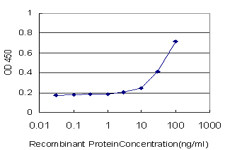
Please note: We are reviewing Western blot images included in the antibody testing data in our catalog, including those provided by third parties. Unless expressly labeled or annotated as “raw-unedited”, Western blot images included in the antibody testing data in our catalog may have been edited, optimized or otherwise adjusted for presentation.

产品信息
H00002131-M01
产品规格
种属反应
Human
宿主/亚型
Mouse
/ IgG2a, kappa
分类
Monoclonal
类型
Antibody
克隆号
5A5
抗原
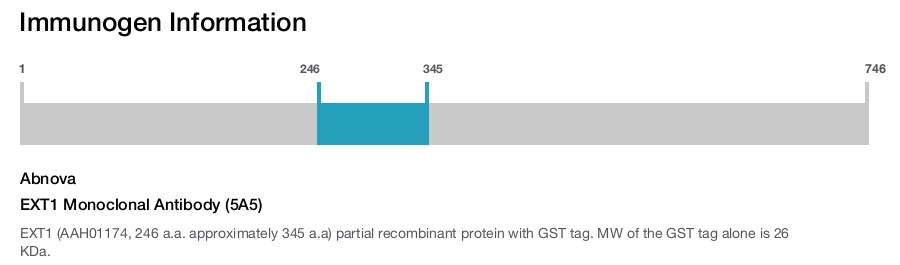
EXT1 (AAH01174, 246 a.a. approximately 345 a.a) partial recombinant protein with GST tag. MW of the GST tag alone is 26 KDa.
偶联物
Unconjugated
Unconjugated
Unconjugated
形式
Liquid
浓度
See Label
规格
100 µg
纯化类型
Affinity chromatography
保存液
PBS, pH 7.4
内含物
no preservative
保存条件
-20°C, Avoid Freeze/Thaw Cycles
运输条件
Ambient (domestic); Wet ice (international)
产品详细信息
Sequence of this protein is as follows: GERGFLKFNT IPPLRKYMLV FKGKRYLTGI GSDTRNALYH VHNGEDVVLL TTCKHGKDWQ KHKDSRCDRD NTEYEKYDYR EMLHNATFCL VPRGRRLGSF
靶标信息
Hereditary multiple exostoses (HME) is an autosomal dominant disorder characterized by the formation of exostoses (EXT), which are cartilage-capped bony protuberances mainly located on long bones. Two proteins associated with EXT, EXT1 and EXT2, form homo/heteromeric complexes in vivo, which leads to the accumulation of both proteins in the Golgi apparatus. EXT1 and EXT2 are endoplasmic reticulum-localized type II transmembrane glycoproteins that possess, or are tightly associated with, glycosyltransferase activities involved in the polymerization of the glycosaminoglycan, heparan sulfate (HS). EXT2 is a protein that harbors the D-glucuronyl (GlcA) and N-acetyl-D-glucosaminyl (GlcNAc) transferase activities required for biosynthesis of HS. EXT1 rescues defective HS biosynthesis and elevates low GlcA and GlcNAc transferase levels in mutated cells.
仅用于科研。不用于诊断过程。未经明确授权不得转售。
篇参考文献 (0)
您是否在文献中引用过该产品?请点击下方按钮邮件告知我们。
生物信息学
蛋白别名: exostoses (multiple) 1; Glucuronosyl-N-acetylglucosaminyl-proteoglycan 4-alpha-N- acetylglucosaminyltransferase; glucuronosyl-N-acetylglucosaminyl-proteoglycan/N-acetylglucosaminyl-proteoglycan 4-alpha-N-acetylglucosaminyltransferase; heparan sulfate co-polymerase subunit EXT1; Langer-Giedion syndrome chromosome region; multiple exostoses protein 1; N-acetylglucosaminyl-proteoglycan 4-beta-glucuronosyltransferase; putative tumor suppressor protein EXT1; putative tumour suppressor/hereditary multiple exostoses candidate gene; unnamed protein product
基因别名: EXT; LGCR; LGS; TRPS2; TTV
UniProt ID: (Human) Q16394
Entrez Gene ID: (Human) 2131
protein binding
acetylglucosaminyltransferase activity
glucuronosyltransferase activity
transferase activity, transferring glycosyl groups
heparan sulfate N-acetylglucosaminyltransferase activity
protein homodimerization activity
protein heterodimerization activity
glucuronosyl-N-acetylglucosaminyl-proteoglycan 4-alpha-N-acetylglucosaminyltransferase activity
N-acetylglucosaminyl-proteoglycan 4-beta-glucuronosyltransferase activity
Disclaimer

Clicking the images or links will redirect you to a website hosted by BenchSci that provides third-party scientific content. Neither the content nor the BenchSci technology and processes for selection have been evaluated by us; we are providing them as-is and without warranty of any kind, including for use or application of the Thermo Fisher Scientific products presented.

