Search
Invitrogen
Emerin Monoclonal Antibody (CL0201)
{{$productOrderCtrl.translations['antibody.pdp.commerceCard.promotion.promotions']}}
{{$productOrderCtrl.translations['antibody.pdp.commerceCard.promotion.promocode']}}: {{promo.promoCode}} {{promo.promoTitle}} {{promo.promoDescription}}. {{$productOrderCtrl.translations['antibody.pdp.commerceCard.promotion.learnmore']}}
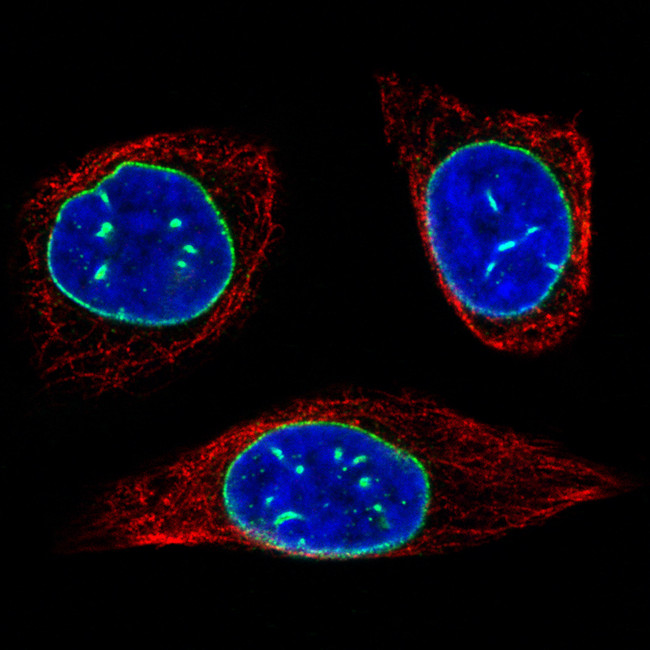
图: 1 / 7
Emerin Antibody (MA5-31327) in ICC/IF
Immunofluorecent analysis of Emerin in PC-3 cells using Emerin Monoclonal Antibody (CL0201) (Product # MA5-31327). Staining shows specific staining in the nuclear membrane in green. Microtubule- and nuclear probes are visualized in red and blue, respectively (where available).

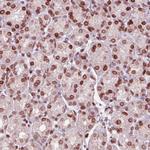
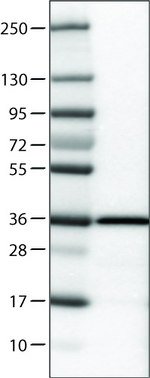
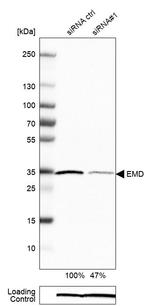
Please note: We are reviewing Western blot images included in the antibody testing data in our catalog, including those provided by third parties. Unless expressly labeled or annotated as “raw-unedited”, Western blot images included in the antibody testing data in our catalog may have been edited, optimized or otherwise adjusted for presentation.


产品信息
MA5-31327
应用
建议稀释比
已发表文章
产品规格
种属反应
Human
宿主/亚型
Mouse
/ IgG2a
分类
Monoclonal
类型
Antibody
克隆号
CL0201
抗原
Recombinant protein fragment of Human EMD (Product #RP-91926).
偶联物
Unconjugated
Unconjugated
Unconjugated
形式
Liquid
浓度
1 mg/mL
规格
100 µg
纯化类型
Protein A
保存液
PBS, pH 7.2, with 40% glycerol
内含物
0.02% sodium azide
保存条件
Store at 4°C short term. For long term storage, store at -20°C, avoiding freeze/thaw cycles.
运输条件
Ambient (domestic); Wet ice (international)
RRID
产品详细信息
Immunogen sequence: ASSYSFSDLN STRGDADMYD LPKKEDALLY QSKGYNDDYY EESYFTTRTY GEPESAGPSR AVRQSVTSFP DADAFHHQVH DDDLLSSSEE ECKDRERPMY GRDSACQSIT HY
Highest antigen sequence indentity to the following orthologs: Rat - 73%, Mouse - 71%.
靶标信息
Xeroderma pigmentosum type G (XPG) is a human genetic disease exhibiting extreme sensitivity to sunlight. The XPG protein, a member of the flap endonuclease 1 (FEN-1) structure-specific DNA repair endonuclease family, is an enzyme essential for DNA repair of the major kinds of solar ultraviolet (UV)-induced DNA damages. Human XPG nuclease makes the 3' incision during nucleotide excision repair of DNA. The enzyme cleaves model DNA bubble structures specifically near the junction of unpaired DNA with a duplex region. A 29-amino acid region of human XPG (residues 981-1009) contains the PCNA binding activity. A conserved arginine in XPG (Arg992) is crucial for its PCNA binding activity. Replication Protein A (RPA) binds specifically and directly to two excision repair proteins, the xeroderma pigmentosum damage-recognition protein XPA and the endonuclease XPG.
仅用于科研。不用于诊断过程。未经明确授权不得转售。
篇参考文献 (0)
您是否在文献中引用过该产品?请点击下方按钮邮件告知我们。
生物信息学
蛋白别名: EMD; LEM domain containing 5
基因别名: CMD3C; EDMD; LEMD5; STA
UniProt ID: (Human) P50402
Entrez Gene ID: (Human) 2010
muscle contraction
muscle organ development
positive regulation of protein export from nucleus
negative regulation of fibroblast proliferation
regulation of canonical Wnt signaling pathway
cellular response to growth factor stimulus
nuclear membrane organization
negative regulation of canonical Wnt signaling pathway
amyloid fibril formation
Disclaimer

Clicking the images or links will redirect you to a website hosted by BenchSci that provides third-party scientific content. Neither the content nor the BenchSci technology and processes for selection have been evaluated by us; we are providing them as-is and without warranty of any kind, including for use or application of the Thermo Fisher Scientific products presented.

