Search
Invitrogen
Eotaxin Recombinant Rabbit Monoclonal Antibody (9H3L1)
{{$productOrderCtrl.translations['antibody.pdp.commerceCard.promotion.promotions']}}
{{$productOrderCtrl.translations['antibody.pdp.commerceCard.promotion.viewpromo']}}
{{$productOrderCtrl.translations['antibody.pdp.commerceCard.promotion.promocode']}}: {{promo.promoCode}} {{promo.promoTitle}} {{promo.promoDescription}}. {{$productOrderCtrl.translations['antibody.pdp.commerceCard.promotion.learnmore']}}
Additional Information:
{{banner.description}}
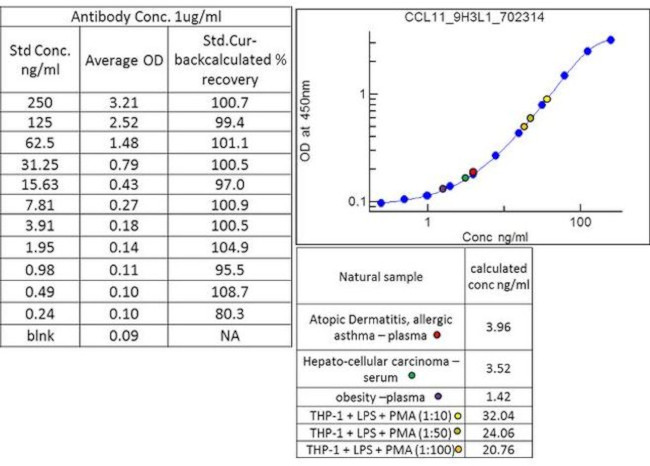
图: 1 / 1
Eotaxin Antibody (702314) in ELISA
Indirect ELISA analysis of Anti-CCL11 Recombinant Rabbit Monoclonal Antibody (Product # 702314) was performed by coating recombinant human CCL11 protein standard at concentrations ranging from 0.24 ng/mL to 250 ng/mL onto a plate. The coated protein was bound by Anti-CCL11 Recombinant Rabbit Monoclonal Antibody at 1 µg/mL and was detected using Goat anti-Rabbit IgG (H+L) secondary antibody, HRP-conjugate (Product # G-21234, 1:5000 dilution). The plate was developed using stabilized chromogen solution, TMB+H2O2 (Product # SB01). The plate w... View More

产品信息
702314
产品规格
种属反应
Human
宿主/亚型
Rabbit
/ IgG
Expression System
Expi293
分类
Recombinant Monoclonal
类型
Antibody
克隆号
9H3L1
抗原
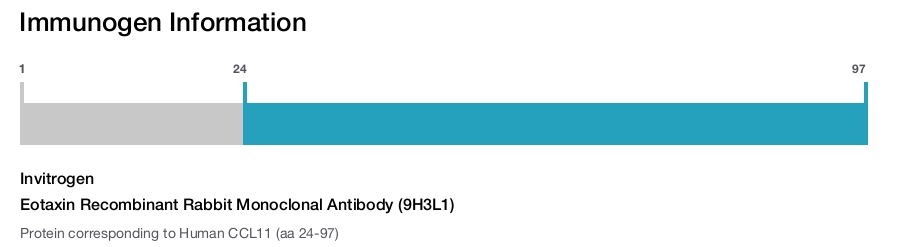
Protein corresponding to Human CCL11 (aa 24-97)
偶联物
Unconjugated
Unconjugated
Unconjugated
形式
Liquid
浓度
0.5 mg/mL
规格
100 µg
纯化类型
Protein A
保存液
PBS, pH 7.4
内含物
0.09% sodium azide
保存条件
Store at 4°C short term. For long term storage, store at -20°C, avoiding freeze/thaw cycles.
运输条件
Wet ice
RRID
产品详细信息
This antibody is predicted to react with Monkey, rabbit and horse.
Recombinant rabbit monoclonal antibodies are produced using in vitro expression systems. The expression systems are developed by cloning in the specific antibody DNA sequences from immunoreactive rabbits. Then, individual clones are screened to select the best candidates for production. The advantages of using recombinant rabbit monoclonal antibodies include: better specificity and sensitivity, lot-to-lot consistency, animal origin-free formulations, and broader immunoreactivity to diverse targets due to larger rabbit immune repertoire.
靶标信息
This gene is one of several Cys-Cys (CC) cytokine genes clustered on the q-arm of chromosome 17. Cytokines are a family of secreted proteins involved in immunoregulatory and inflammatory processes. The CC cytokines are proteins characterized by two adjacent cysteines. The cytokine encoded by this gene displays chemotactic activity for eosinophils, but not mononuclear cells or neutrophils. This eosinophil specific chemokine assumed to be involved in eosinophilic inflammatory diseases such as atopic dermatitis, allergic rhinitis, asthma and parasitic infections.
仅用于科研。不用于诊断过程。未经明确授权不得转售。
篇参考文献 (0)
您是否在文献中引用过该产品?请点击下方按钮邮件告知我们。
生物信息学
蛋白别名: C-C motif chemokine 11; CCL11; chemokine (C-C motif) ligand 11; Eosinophil Chemotactic Factor; Eosinophil chemotactic protein; Eotaxin; Eotaxin 1; eotaxin-1; Eotaxin1; MGC22554; small inducible cytokine subfamily A (Cys-Cys), member 11 (eotaxin); Small-inducible cytokine A11
基因别名: CCL11; SCYA11
UniProt ID: (Human) P51671
Entrez Gene ID: (Human) 6356
positive regulation of endothelial cell proliferation
chronic inflammatory response
mast cell chemotaxis
protein phosphorylation
cellular calcium ion homeostasis
chemotaxis
inflammatory response
immune response
cytoskeleton organization
actin filament organization
cell adhesion
signal transduction
learning or memory
regulation of cell shape
response to radiation
response to virus
positive regulation of cell migration
positive regulation of actin filament polymerization
killing of cells of other organism
response to interleukin-13
positive regulation of angiogenesis
eosinophil chemotaxis
negative regulation of neurogenesis
branching involved in mammary gland duct morphogenesis
mammary duct terminal end bud growth
antimicrobial humoral immune response mediated by antimicrobial peptide
chemokine-mediated signaling pathway
ERK1 and ERK2 cascade
response to interleukin-4
Disclaimer

Clicking the images or links will redirect you to a website hosted by BenchSci that provides third-party scientific content. Neither the content nor the BenchSci technology and processes for selection have been evaluated by us; we are providing them as-is and without warranty of any kind, including for use or application of the Thermo Fisher Scientific products presented.

