Search
Invitrogen
FAS (soluble) Polyclonal Antibody, Biotin, PeproTech®
{{$productOrderCtrl.translations['antibody.pdp.commerceCard.promotion.promotions']}}
{{$productOrderCtrl.translations['antibody.pdp.commerceCard.promotion.viewpromo']}}
{{$productOrderCtrl.translations['antibody.pdp.commerceCard.promotion.promocode']}}: {{promo.promoCode}} {{promo.promoTitle}} {{promo.promoDescription}}. {{$productOrderCtrl.translations['antibody.pdp.commerceCard.promotion.learnmore']}}
Additional Information:
{{banner.description}}
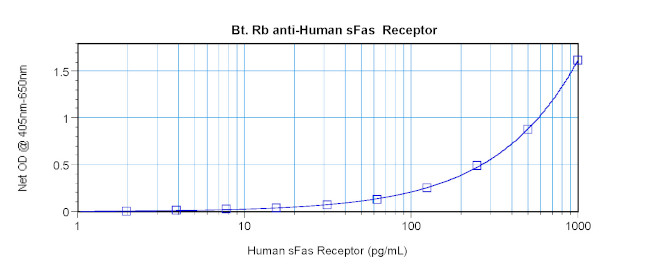
图: 1 / 3
FAS (soluble) Antibody (500-P295BT-25UG) in ELISA
Sandwich ELISA: To detect Human sFas Receptor by sandwich ELISA (using 100 mL/well) a concentration of 0.25-1.0 µg/mL of FAS (soluble) Polyclonal Antibody, Biotin (Product # 500-P295BT-500UG) is required. This biotinylated polyclonal antibody, in conjunction with PeproTech FAS (soluble) Polyclonal Antibody (Product # 500-P295-1MG) as a capture antibody, allows the detection of at least 0.2-0.4 ng/well of Recombinant Human sFas Receptor.


产品信息
500-P295BT-25UG
产品规格
种属反应
Human
宿主/亚型
Rabbit
分类
Polyclonal
类型
Antibody
抗原
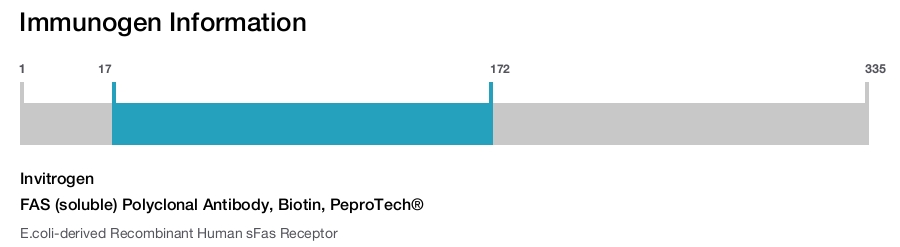
E.coli-derived Recombinant Human sFas Receptor
偶联物
Biotin
Biotin
Biotin
形式
Lyophilized
浓度
0.1-1.0 mg/mL
规格
25 µg
纯化类型
Antigen affinity chromatography
保存液
PBS
内含物
no preservative
保存条件
-20°C
运输条件
Ambient
RRID
产品详细信息
AA Sequence of recombinant protein: MRLSSKSVNA QVTDINSKGL ELRKTVTTVE TQNLEGLHHD GQFCHKPCPP GERKARDCTV NGDEPDCVPC QEGKEYTDKA HFSSKCRRCR LCDEGHGLEV EINCTRTQNT KCRCKPNFFC NSTVCEHCDP CTKCEHGIIK ECTLTSNTKC KEEGSRS.
Preparation: Produced from sera of rabbits immunized with highly pure Recombinant Human sFas Receptor. Anti-Human sFas Receptor-specific antibody was purified by affinity chromatography and then biotinylated.
Sandwich ELISA: To detect Human sFas Receptor by sandwich ELISA (using 100 mL/well) a concentration of 0.25-1.0 µg/mL of this antibody is required. This biotinylated polyclonal antibody, in conjunction with PeproTech Polyclonal Anti- Human sFas Receptor (500-P295) as a capture antibody, allows the detection of at least 0.2-0.4 ng/well of Recombinant Human sFas Receptor.
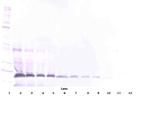
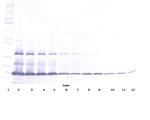
Western Blot: To detect Human sFas Receptor by Western Blot analysis this antibody can be used at a concentration of 0.1-0.2 mg/mL. When used in conjunction with compatible development reagents the detection limit for Recombinant Human sFas Receptor is 1.5-3.0 ng/lane, under either reducing or non-reducing conditions.
500-P295BT-1MG will be provided as 2 x 500 µg
靶标信息
CD95, also known as Fas or APO-1, is a 46 kDa transmembrane glycoprotein that functions as a cell death receptor in the tumor necrosis factor receptor (TNFR) superfamily. It is expressed by a wide range of hematopoietic and non-hematopoietic cells, including monocytes, neutrophils, lymphocytes, and fibroblasts. CD95 also exists in a soluble form weighing approximately 26 kDa. The interaction of CD95 with its ligand, FasL, induces apoptosis, playing a crucial role in peripheral tolerance and anti-viral immune responses. Upon stimulation, CD95 leads to the aggregation of its intracellular Fas-associated death domains (FADD), formation of the death-inducing signaling complex (DISC), and activation of caspases. This cascade results in apoptosis. CD95 is also involved in activating NF-kappaB, MAPK3/ERK1, and MAPK8/JNK, and transduces proliferative signals in normal diploid fibroblasts and T cells. There are at least eight alternatively spliced transcript variants encoding seven distinct isoforms of CD95. Isoforms lacking the transmembrane domain may negatively regulate apoptosis mediated by the full-length isoform. The Fas/Fas ligand system is implicated in several human diseases, including AIDS, hepatitis, and cancer, highlighting its importance in immune regulation and disease pathology.
仅用于科研。不用于诊断过程。未经明确授权不得转售。
篇参考文献 (0)
您是否在文献中引用过该产品?请点击下方按钮邮件告知我们。
生物信息学
蛋白别名: 774delG; 943dupG; Apo-1 antigen; APO-1 cell surface antigen; Apo-1 Fas; Apo1 antigen; apoptosis antigen 1; apoptosis signaling receptor FAS; Apoptosis-mediating surface antigen FAS; CD95; CD95 antigen; FAS; Fas (TNF receptor superfamily, member 6); Fas AMA; FAS9; FASLG receptor; mutant tumor necrosis receptor superfamily member 6; OTTHUMP00000020045; OTTHUMP00000020046; OTTHUMP00000020051; OTTHUMP00000059646; TNF receptor superfamily member 6; TNFRSF6; Tumor necrosis factor receptor superfamily member 6; tumor necrosis factor receptor superfamily, member 6; unnamed protein product
基因别名: ALPS1A; APO-1; APT1; CD95; FAS; FAS1; FASTM; TNFRSF6
UniProt ID: (Human) P25445
Entrez Gene ID: (Human) 355
apoptotic process
activation-induced cell death of T cells
immune response
signal transduction
extrinsic apoptotic signaling pathway via death domain receptors
regulation of stress-activated MAPK cascade
tumor necrosis factor-mediated signaling pathway
cellular response to amino acid starvation
Fas signaling pathway
regulation of apoptotic process
positive regulation of apoptotic process
negative regulation of apoptotic process
protein-containing complex assembly
cellular response to mechanical stimulus
cellular response to hyperoxia
motor neuron apoptotic process
extrinsic apoptotic signaling pathway
necroptotic signaling pathway
positive regulation of reactive oxygen species biosynthetic process
positive regulation of apoptotic signaling pathway
Disclaimer

Clicking the images or links will redirect you to a website hosted by BenchSci that provides third-party scientific content. Neither the content nor the BenchSci technology and processes for selection have been evaluated by us; we are providing them as-is and without warranty of any kind, including for use or application of the Thermo Fisher Scientific products presented.

