Search
Invitrogen
FCRL2/FCRL5 Monoclonal Antibody (296902)
{{$productOrderCtrl.translations['antibody.pdp.commerceCard.promotion.promotions']}}
{{$productOrderCtrl.translations['antibody.pdp.commerceCard.promotion.promocode']}}: {{promo.promoCode}} {{promo.promoTitle}} {{promo.promoDescription}}. {{$productOrderCtrl.translations['antibody.pdp.commerceCard.promotion.learnmore']}}
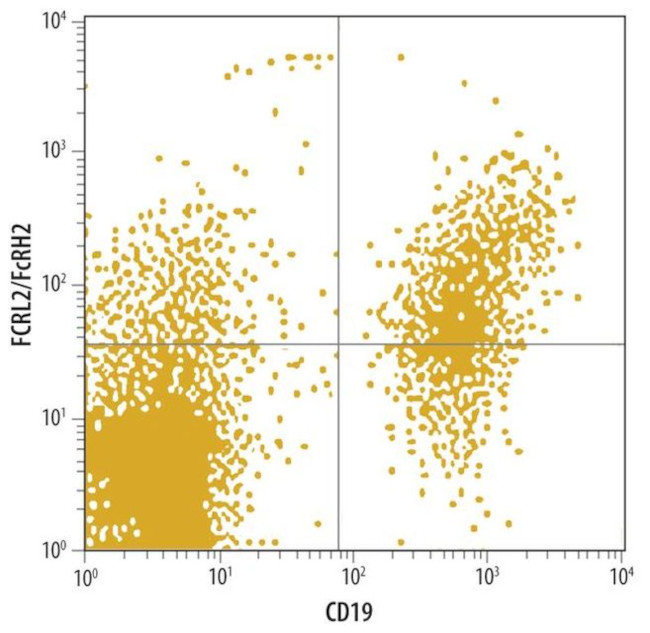
图: 1 / 1
FCRL2/FCRL5 Antibody (MA5-24005) in Flow
Flow cytometric analysis of human peripheral blood monocytes (PBMC) were labeled with Mouse Anti-Human FCRL2/FCRL5 Monoclonal Antibody (Product # MA5-24005) followed by Allophycocyanin-conjugated Anti-Mouse IgG F (ab')2 Secondary Antibody. Quadrant markers were set based on control antibody staining.
Please note: We are reviewing Western blot images included in the antibody testing data in our catalog, including those provided by third parties. Unless expressly labeled or annotated as “raw-unedited”, Western blot images included in the antibody testing data in our catalog may have been edited, optimized or otherwise adjusted for presentation.

产品信息
MA5-24005
产品规格
种属反应
Human
宿主/亚型
Mouse
/ IgG1
分类
Monoclonal
类型
Antibody
克隆号
296902
抗原
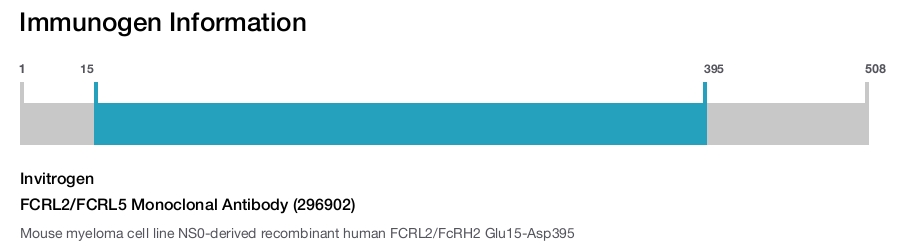
Mouse myeloma cell line NS0-derived recombinant human FCRL2/FcRH2 Glu15-Asp395
偶联物
Unconjugated
Unconjugated
Unconjugated
形式
Lyophilized
浓度
0.5 mg/mL
规格
100 µg
纯化类型
Protein A/G
保存液
PBS with 5% trehalose
内含物
No Preservative
保存条件
-20°C, Avoid Freeze/Thaw Cycles
运输条件
Ambient (domestic); Wet ice (international)
RRID
产品详细信息
Detects human FCRL2/FcRH2 and FCRL5/FcRH5 in Western blots. In Western blots, approximately 25% cross-reactivity with recombinant human FCRL1, FCRL3, and FCRL4 is observed.
Reconstitute at 0.5 mg/mL in sterile PBS.
靶标信息
Fc receptor homologs, also known as IRTA2 proteins, are transmembrane proteins with sequence homology to classical Fc receptor families. FcRH2 (FCRL2) may have a regulatory role in normal and neoplastic B cell development. FcRH5 (FCRL5) expression is deregulated in multiple myeloma and Burkitt lymphoma cell lines with 1q21 abnormalities. FCRL5 may be involved in B-cell development and differentiation in peripheral lymphoid organs and may be useful markers of B-cell stages. It also may have an immunoregulatory role in marginal zone B-cells.
仅用于科研。不用于诊断过程。未经明确授权不得转售。
篇参考文献 (0)
您是否在文献中引用过该产品?请点击下方按钮邮件告知我们。
生物信息学
蛋白别名: fc receptor homolog 2; fc receptor homolog 5; fcR-like protein 5; IFGP family protein 4; Ig-like superfamily receptor; immune receptor translocation-associated protein 2; immune receptor translocation-associated protein 4; immunoglobulin receptor translocation-associated protein 4; immunoglobulin superfamily Fc receptor, gp42; immunoglobulin superfamily receptor translocation associated 2 (IRTA2); immunoglobulin-like domain and ITIM motif-containing receptor; IRTA2a; IRTA2b; IRTA2c; IRTA2d; IRTA4; FcRH2; membrane receptor; SH2 domain containing phosphatase anchor protein 1; SPAP1a; SPAP1b; SPAP1c; unnamed protein product
基因别名: BXMAS1; CD307; CD307b; CD307e; FCRH2; FCRH5; IFGP4; IRTA2; IRTA4; PRO820; SPAP1; SPAP1A; SPAP1B; SPAP1C
UniProt ID: (Human) Q96LA5, (Human) Q96RD9
Entrez Gene ID: (Human) 79368, (Human) 83416
Disclaimer

Clicking the images or links will redirect you to a website hosted by BenchSci that provides third-party scientific content. Neither the content nor the BenchSci technology and processes for selection have been evaluated by us; we are providing them as-is and without warranty of any kind, including for use or application of the Thermo Fisher Scientific products presented.

