Search
Disclaimer

Clicking the images or links will redirect you to a website hosted by BenchSci that provides third-party scientific content. Neither the content nor the BenchSci technology and processes for selection have been evaluated by us; we are providing them as-is and without warranty of any kind, including for use or application of the Thermo Fisher Scientific products presented.
Invitrogen
FGFR4 Polyclonal Antibody
{{$productOrderCtrl.translations['antibody.pdp.commerceCard.promotion.promotions']}}
{{$productOrderCtrl.translations['antibody.pdp.commerceCard.promotion.viewpromo']}}
{{$productOrderCtrl.translations['antibody.pdp.commerceCard.promotion.promocode']}}: {{promo.promoCode}} {{promo.promoTitle}} {{promo.promoDescription}}. {{$productOrderCtrl.translations['antibody.pdp.commerceCard.promotion.learnmore']}}
产品信息
PA5-47282
产品规格
种属反应
Mouse
宿主/亚型
Goat
/ IgG
分类
Polyclonal
类型
Antibody
抗原
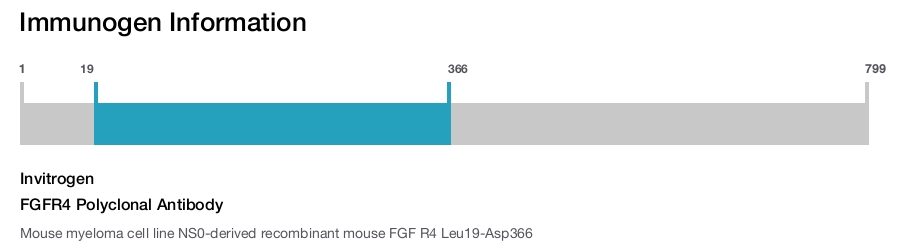
Mouse myeloma cell line NS0-derived recombinant mouse FGF R4 Leu19-Asp366
偶联物
形式
Lyophilized
浓度
0.2 mg/mL
纯化类型
Antigen affinity chromatography
保存液
PBS with 5% trehalose
内含物
No Preservative
保存条件
-20°C, Avoid Freeze/Thaw Cycles
运输条件
Ambient (domestic); Wet ice (international)
RRID
产品详细信息
In direct ELISAs, approximately 15% cross-reactivity with recombinant human (rh) FGF R4 is observed, 5% cross-reactivity with rhFGF R1 alpha (IIIb), rhFGF R1 alpha (IIIc), and rhFGF R1 beta (IIIb) is observed, and less than 1% cross-reactivity with recombinant mouse (rm) FGF R2 alpha (IIIb), rmFGF R2 beta (IIIb), rmFGF R2 beta (IIIc), rmFGF R3 alpha (IIIb), rmFGF R3 alpha (IIIc), rmFGF R5, and rmFGF R5 beta is observed.
Reconstitute at 0.2 mg/mL in sterile PBS.
Endoxin level is <0.10 EU per 1 µg of the antibody by the LAL method.
靶标信息
FGFR4 is a member of the FGFR family of receptor tyrosine kinases. This family is known to regulate a host of cellular functions including angiogenesis, mitogenesis, osteogenesis, myogenesis, carcinogenesis, cellular differentiation, and tissue repair after injury. The FGFR family has also been implicated in a number of diseases including cancer, rheumatoid arthritis, and diabetic retinopathy. FGFR4 is required for normal down-regulation of the expression of CYP7A1, the rate-limiting enzyme in bile acid synthesis, in response to FGF19. FGFR4 plays a role in postnatal lung development and may be involved in the development of skeletal muscle cell lineages.
仅用于科研。不用于诊断过程。未经明确授权不得转售。
篇参考文献 (0)
您是否在文献中引用过该产品?请点击下方按钮邮件告知我们。
生物信息学
蛋白别名: CD334; CTLA-2-beta protein; FGF Receptor; FGF Receptor 4; FGFR; FGFR-4; Fibroblast growth factor receptor 4; fibroblast growth factor receptor 4 16 minus form; MGC20292; Protein-tyrosine kinase receptor MPK-11
基因别名: Fgfr-4; Fgfr4; Mpk-11
UniProt ID: (Mouse) Q03142
Entrez Gene ID: (Mouse) 14186
nucleotide binding
protein kinase activity
protein tyrosine kinase activity
transmembrane receptor protein tyrosine kinase activity
fibroblast growth factor-activated receptor activity
protein binding
ATP binding
heparin binding
kinase activity
transferase activity
transferase activity, transferring phosphorus-containing groups
fibroblast growth factor binding
transmembrane signal receptor
organ induction
protein phosphorylation
positive regulation of cell proliferation
fibroblast growth factor receptor signaling pathway
positive regulation of gene expression
regulation of extracellular matrix disassembly
phosphorylation
cell migration
peptidyl-tyrosine phosphorylation
regulation of lipid metabolic process
lung development
glucose homeostasis
positive regulation of catalytic activity
positive regulation of proteolysis
protein autophosphorylation
phosphate ion homeostasis
alveolar secondary septum development
positive regulation of ERK1 and ERK2 cascade
regulation of bile acid biosynthetic process
regulation of cholesterol homeostasis
positive regulation of DNA biosynthetic process

