Search
Invitrogen
FUZ Polyclonal Antibody
{{$productOrderCtrl.translations['antibody.pdp.commerceCard.promotion.promotions']}}
{{$productOrderCtrl.translations['antibody.pdp.commerceCard.promotion.promocode']}}: {{promo.promoCode}} {{promo.promoTitle}} {{promo.promoDescription}}. {{$productOrderCtrl.translations['antibody.pdp.commerceCard.promotion.learnmore']}}
{{$ctrl.translations['antibody.pdp.skuNotes.additionalInformation']}}:
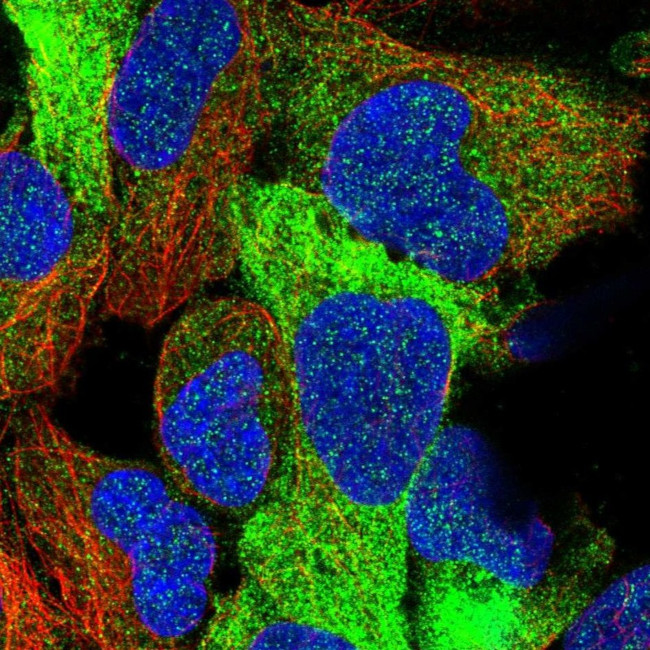
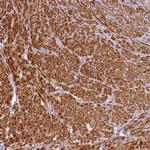
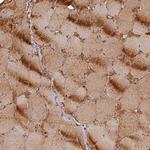
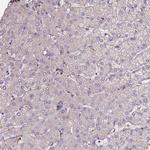
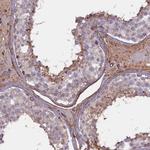
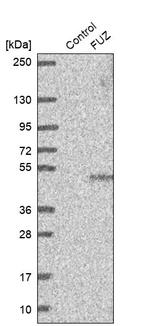
Please note: We are reviewing Western blot images included in the antibody testing data in our catalog, including those provided by third parties. Unless expressly labeled or annotated as “raw-unedited”, Western blot images included in the antibody testing data in our catalog may have been edited, optimized or otherwise adjusted for presentation.


产品信息
PA5-59724
应用
建议稀释比
已发表文章
产品规格
种属反应
Human
宿主/亚型
Rabbit
/ IgG
分类
Polyclonal
类型
Antibody
抗原
偶联物
Unconjugated
Unconjugated
Unconjugated
形式
Liquid
浓度
0.1 mg/mL
规格
10 µg
纯化类型
Antigen affinity chromatography
保存液
PBS, pH 7.2, with 40% glycerol
内含物
0.02% sodium azide
保存条件
Store at 4°C short term. For long term storage, store at -20°C, avoiding freeze/thaw cycles.
运输条件
Ambient (domestic); Wet ice (international)
RRID
产品详细信息
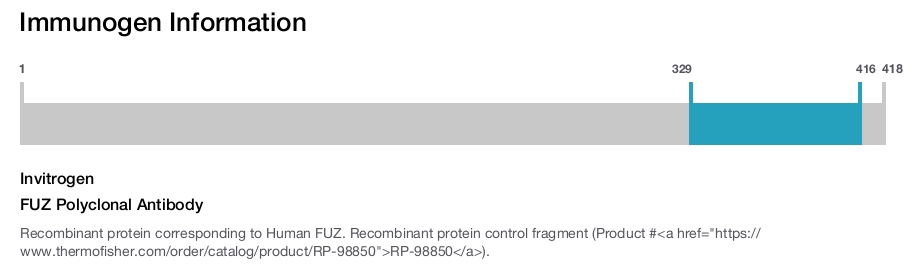
Immunogen sequence: LLRNFYTLVT STHFPPEPGP PEKTEDEVYQ AQLPRACYLV LGTEEPGTGV RLVALQLGLR RLLLLLSPQS PTHGLRSLAT HTLHALTP
Highest antigen sequence identity to the following orthologs: Mouse - 78%, Rat - 78%.
靶标信息
FUZ is the human homolog of Drosophila fy protein and belongs to the fuzzy family. The fy gene of Drosophila encodes a novel four-pass transmembrane protein that plays two roles in the development of hairs on the Drosophila wing. The first is to specify the correct orientation of the hair by restricting its initiation to the distal vertex of the cell. The second role is to permit the development of just a single cell hair by maintaining the integrity of the F-actin and microtubule arrays that are required for hair development. In humans, the protein is involved in cytoskeleton function and cell polarity in epithelial cells. The human fuz gene is localized on chromosome 19q13.33.
仅用于科研。不用于诊断过程。未经明确授权不得转售。
篇参考文献 (0)
您是否在文献中引用过该产品?请点击下方按钮邮件告知我们。
生物信息学
蛋白别名: ciliogenesis and planar polarity effector 3; ciliogenesis and planar polarity effector complex subunit 3; fuzzy homolog; unnamed protein product
基因别名: CPLANE3; FY; NTD
UniProt ID: (Human) Q9BT04
Entrez Gene ID: (Human) 80199
establishment of planar polarity
neural tube closure
hair follicle development
negative regulation of cell proliferation
regulation of smoothened signaling pathway
embryonic body morphogenesis
vesicle-mediated transport
neural tube development
negative regulation of cell migration
intraciliary transport
positive regulation of cilium assembly
embryonic skeletal system morphogenesis
cilium morphogenesis
negative regulation of canonical Wnt signaling pathway
negative regulation of neural crest formation
regulation of cilium assembly
non-motile cilium assembly
Disclaimer

Clicking the images or links will redirect you to a website hosted by BenchSci that provides third-party scientific content. Neither the content nor the BenchSci technology and processes for selection have been evaluated by us; we are providing them as-is and without warranty of any kind, including for use or application of the Thermo Fisher Scientific products presented.

