Search
Agrisera
GOX/Glycolate oxidase 1,2,3 Polyclonal Antibody
{{$productOrderCtrl.translations['antibody.pdp.commerceCard.promotion.promotions']}}
{{$productOrderCtrl.translations['antibody.pdp.commerceCard.promotion.viewpromo']}}
{{$productOrderCtrl.translations['antibody.pdp.commerceCard.promotion.promocode']}}: {{promo.promoCode}} {{promo.promoTitle}} {{promo.promoDescription}}. {{$productOrderCtrl.translations['antibody.pdp.commerceCard.promotion.learnmore']}}
Additional Information:
{{banner.description}}
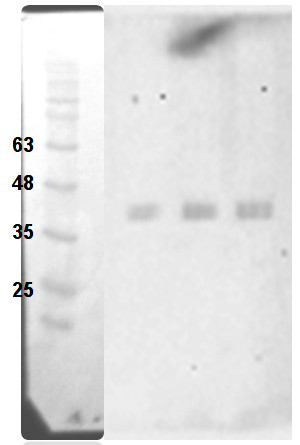
图: 1 / 1
GOX/Glycolate oxidase 1,2,3 Antibody (AS14-2772) in WB
15 µg of total protein from Arabidopsis thaliana leaves extracted with 50 m M Tris-HCl (p H 7.8), 0.2% Tritin X-100,0.1 m M EDTA and proteases inhibitors, were separated on 12% SDS-PAGE and blotted 1 h to PVDF using semi-dry or tank transfer. Blots were blocked with TBST containing 3% milk powder for 1 h at room temperature (RT) and overnight at 4º with agitation. Blot was incubated in the primary antibody ... View More

产品信息
AS14-2772
产品规格
种属反应
Plant
宿主/亚型
Rabbit
分类
Polyclonal
类型
Antibody
抗原
KLH-conjugated peptide derived from Arabidopsis thaliana GOX1, GOX2, and GOX3.
偶联物
Unconjugated
Unconjugated
Unconjugated
形式
Lyophilized
规格
50 µg
纯化类型
Antigen affinity chromatography
保存液
PBS, pH 7.4
内含物
no preservative
保存条件
-20°C, Avoid Freeze/Thaw Cycles
运输条件
Ambient (domestic); Wet ice (international)
产品详细信息
Store lyophilized/reconstituted at -20°C; once reconstituted make aliquots to avoid repeated freeze-thaw cycles. Please remember to spin the tubes briefly prior to opening them to avoid any losses that might occur from material adhering to the cap or sides of the tube.
For reconstitution add 50 µL of sterile water.
Specific Species Reactivity: Arabidopsis thaliana, Cyanthobasis fruticulosa, Lupinus albus, Oryza sativa, Petrosimonia nigdeensis, Pisum sativum, Salsola grandis, Salsola tragus
靶标信息
GOX usually refers to glycolate oxidase in plants, a peroxisomal enzyme of photorespiration that converts glycolate to glyoxylate while producing hydrogen peroxide. It works with chloroplast and mitochondrial steps to recycle 2 phosphoglycolate formed by Rubisco, thereby maintaining carbon balance and protecting photosynthesis under ambient oxygen. GOX activity influences redox status via hydrogen peroxide generation, requiring catalase and peroxidases for detoxification, and it helps coordinate signaling linked to stress and development. Multiple GOX isoforms can show tissue specific expression and kinetic differences, adjusting photorespiratory flux under varying light, CO2, and environmental conditions. Perturbation of GOX affects growth, chlorophyll content, and resilience, highlighting its central role in photorespiration and peroxisomal metabolism.
仅用于科研。不用于诊断过程。未经明确授权不得转售。
篇参考文献 (0)
您是否在文献中引用过该产品?请点击下方按钮邮件告知我们。
生物信息学
蛋白别名: GLO; GOX; HAOX; L-2-HAOX
Disclaimer

Clicking the images or links will redirect you to a website hosted by BenchSci that provides third-party scientific content. Neither the content nor the BenchSci technology and processes for selection have been evaluated by us; we are providing them as-is and without warranty of any kind, including for use or application of the Thermo Fisher Scientific products presented.

