Search
Invitrogen
GPR160 Polyclonal Antibody
{{$productOrderCtrl.translations['antibody.pdp.commerceCard.promotion.promotions']}}
{{$productOrderCtrl.translations['antibody.pdp.commerceCard.promotion.promocode']}}: {{promo.promoCode}} {{promo.promoTitle}} {{promo.promoDescription}}. {{$productOrderCtrl.translations['antibody.pdp.commerceCard.promotion.learnmore']}}
{{$ctrl.translations['antibody.pdp.skuNotes.additionalInformation']}}:
Please note: We are reviewing Western blot images included in the antibody testing data in our catalog, including those provided by third parties. Unless expressly labeled or annotated as “raw-unedited”, Western blot images included in the antibody testing data in our catalog may have been edited, optimized or otherwise adjusted for presentation.

Product Details
PA5-32806
Applications
Tested Dilution
Publications
Product Specifications
Species Reactivity
Human
Host/Isotype
Rabbit
/ IgG
Class
Polyclonal
Type
Antibody
Immunogen
Synthetic 20 amino acid peptide from 3rd cytoplasmic domain of human GPR160.
Conjugate
Unconjugated
Unconjugated
Unconjugated
Form
Liquid
Concentration
1 mg/mL
Amount
50 µg
Purification
Antigen affinity chromatography
Storage buffer
PBS
Contains
0.1% sodium azide
Storage conditions
Store at 4°C short term. For long term storage, store at -20°C, avoiding freeze/thaw cycles.
Shipping conditions
Ambient (domestic); Wet ice (international)
RRID
Product Specific Information
Percent identity with other species by BLAST analysis: Human, Gorilla, Gibbon (100%); Monkey (95%); Marmoset (85%); Rabbit (80%).
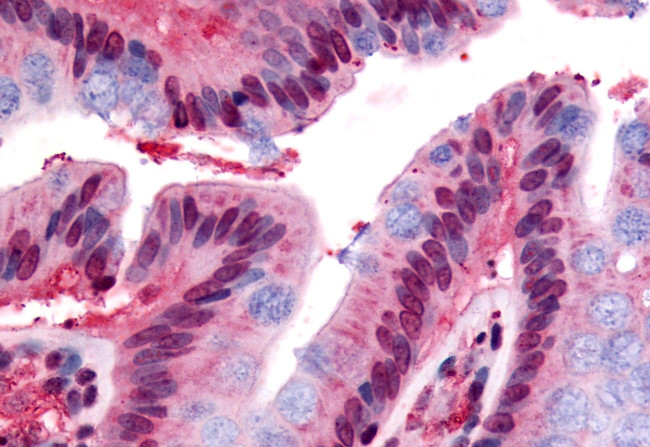
For IHC(P), use heat induced antigen retrieval in pH 6.0 citrate buffer. After incubation with the primary antibody, slides were incubated with biotinylated secondary antibody, followed by alkaline phosphatase-streptavidin and chromogen.
Target Information
GPR160, part of the Class A family of G protein-coupled receptors (GPCRs), is prominently expressed in mouse embryonic stem cells and has been associated with various human solid tumors, particularly prostate cancer. The gene's expression contributes to the self-renewal and pluripotency of stem cells by participating in critical signaling pathways, including the JAK/STAT pathway, which is crucial for maintaining the stem cell cycle. High levels of GPR160 expression are observed in prostate cancer, though its role in disease progression is independent of the CARTp-mediated signaling pathway. Investigations into GPR160 have revealed its potential as a biomarker for prostate cancer. Additionally, it regulates mycobacteria entry into macrophages, implicating its functionality in immune responses. The gene's mechanisms of action, especially within cancer contexts, are subjects of ongoing research aimed at understanding its precise contributions to cellular proliferation and disease phenotypes.
For Research Use Only. Not for use in diagnostic procedures. Not for resale without express authorization.
References (0)
Have you cited this product in a publication?
Let us know so we can reference it here.
Bioinformatics
Protein Aliases: G-protein coupled receptor GPCR1; hGPCR1; putative G protein-coupled receptor
Gene Aliases: GPCR1; GPCR150
UniProt ID: (Human) Q9UJ42
Entrez Gene ID: (Human) 26996
Disclaimer

Clicking the images or links will redirect you to a website hosted by BenchSci that provides third-party scientific content. Neither the content nor the BenchSci technology and processes for selection have been evaluated by us; we are providing them as-is and without warranty of any kind, including for use or application of the Thermo Fisher Scientific products presented.

Performance Guarantee
If an Invitrogen™ antibody doesn't perform as described on our website or datasheet,we'll replace the product at no cost to you, or provide you with a credit for a future purchase.*
Learn more
We're here to help
Get expert recommendations for common problems or connect directly with an on staff expert for technical assistance related to applications, equipment and general product use.
Contact tech support