Search
Invitrogen
GPR37 Recombinant Rabbit Monoclonal Antibody (K01_1R88)
{{$productOrderCtrl.translations['antibody.pdp.commerceCard.promotion.promotions']}}
{{$productOrderCtrl.translations['antibody.pdp.commerceCard.promotion.viewpromo']}}
{{$productOrderCtrl.translations['antibody.pdp.commerceCard.promotion.promocode']}}: {{promo.promoCode}} {{promo.promoTitle}} {{promo.promoDescription}}. {{$productOrderCtrl.translations['antibody.pdp.commerceCard.promotion.learnmore']}}
Additional Information:
{{banner.description}}
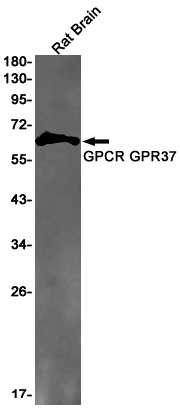
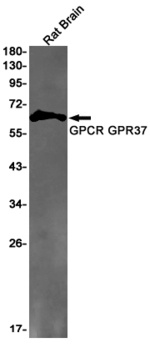
Please note: We are reviewing Western blot images included in the antibody testing data in our catalog, including those provided by third parties. Unless expressly labeled or annotated as “raw-unedited”, Western blot images included in the antibody testing data in our catalog may have been edited, optimized or otherwise adjusted for presentation.

产品信息
MA567848
产品规格
种属反应
Rat
宿主/亚型
Rabbit
/ IgG
Expression System
HEK293F
分类
Recombinant Monoclonal
类型
Antibody
克隆号
K01_1R88
抗原
A synthetic peptide of human GPCR GPR37.
偶联物
Unconjugated
Unconjugated
Unconjugated
形式
Liquid
浓度
1 mg/mL
规格
100 µg
纯化类型
Protein A/G
保存液
50mM tris glycine, pH 7.4, with 40% glycerol, 0.05% BSA, 150mM NaCl
内含物
0.01% sodium azide
保存条件
Store at 4°C short term. For long term storage, store at -20°C, avoiding freeze/thaw cycles.
运输条件
Ambient (domestic); Wet ice (international)
靶标信息
Parkinson is the second most common neurodegenerative disease after Alzheimers. About 1 percent of people over the age of 65 and 3 percent of people over the age of 75 are affected by the disease. The mutation is the most common cause of Parkinson disease identified to date. The function of Park2 is not well-known; however, it may play a role in the ubiquitin-mediated proteolytic pathway. Mutations in this gene are known to cause autosomal recessive juvenile parkinsonism. Alternative splicing of this gene produces three known products of undetermined function. Panneuronal expression of Parkin substrate Pael-R causes age-dependent selective degeneration of Drosophila dopaminergic (DA) neurons; coexpression of Parkin degrades Pael-R and suppresses its toxicity.
仅用于科研。不用于诊断过程。未经明确授权不得转售。
篇参考文献 (0)
您是否在文献中引用过该产品?请点击下方按钮邮件告知我们。
生物信息学
蛋白别名: G protein-coupled receptor 37 (endothelin receptor type B-like); G-protein coupled receptor CNS1; Gpcr/cns1; Het-b-r-lp; Pael receptor; probable G-protein coupled receptor 37
基因别名: Ednrbl
UniProt ID: (Rat) Q9QYC6
Entrez Gene ID: (Rat) 117549
G-protein coupled receptor signaling pathway
adenylate cyclase-inhibiting G-protein coupled receptor signaling pathway
neuropeptide signaling pathway
dendrite development
locomotion involved in locomotory behavior
cellular response to reactive oxygen species
dopamine biosynthetic process
positive regulation of MAPK cascade
positive regulation of dopamine metabolic process
Disclaimer

Clicking the images or links will redirect you to a website hosted by BenchSci that provides third-party scientific content. Neither the content nor the BenchSci technology and processes for selection have been evaluated by us; we are providing them as-is and without warranty of any kind, including for use or application of the Thermo Fisher Scientific products presented.

