Search
Alomone Labs, LTD
GPR68 (OGR1) (extracellular) Polyclonal Antibody
{{$productOrderCtrl.translations['antibody.pdp.commerceCard.promotion.promotions']}}
{{$productOrderCtrl.translations['antibody.pdp.commerceCard.promotion.promocode']}}: {{promo.promoCode}} {{promo.promoTitle}} {{promo.promoDescription}}. {{$productOrderCtrl.translations['antibody.pdp.commerceCard.promotion.learnmore']}}
{{$ctrl.translations['antibody.pdp.skuNotes.additionalInformation']}}:
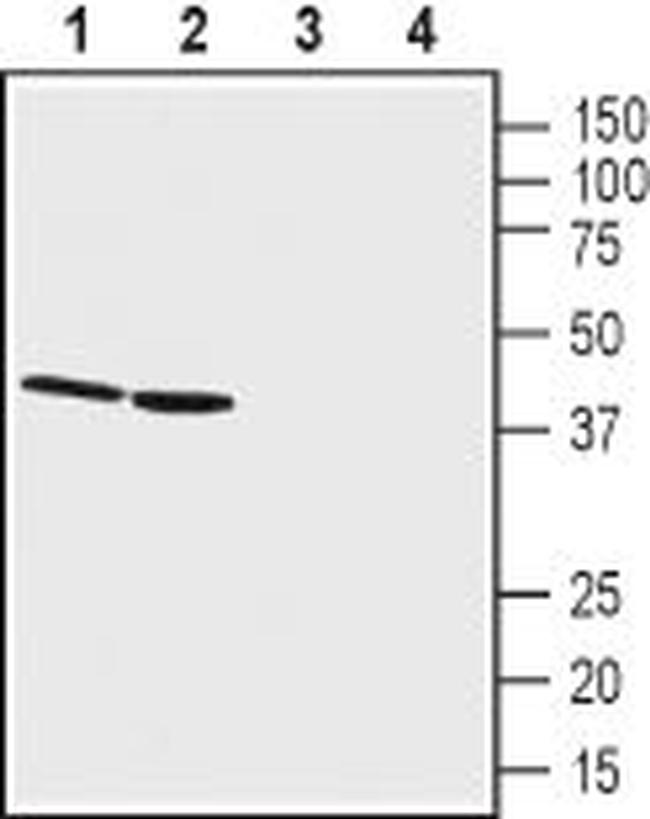
图: 1 / 3
GPR68 (OGR1) (extracellular) Antibody (AGR-042-200UL) in WB
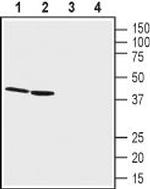
Western blot analysis of rat kidney lysates (lanes 1 and 3) and mouse kidney membranes (lanes 2 and 4): - 1,2. Anti-GPR68 (OGR1) (extracellular) Antibody (#AGR-042), (1:200).3,4. Anti-GPR68 (OGR1) (extracellular) Antibody , preincubated with GPR68/OGR1 (extracellular) Blocking Peptide (#BLP-GR042).
Please note: We are reviewing Western blot images included in the antibody testing data in our catalog, including those provided by third parties. Unless expressly labeled or annotated as “raw-unedited”, Western blot images included in the antibody testing data in our catalog may have been edited, optimized or otherwise adjusted for presentation.


产品信息
AGR-042-200UL
产品规格
种属反应
Human,
Mouse,
Rat
宿主/亚型
Rabbit
/ IgG
分类
Polyclonal
类型
Antibody
抗原
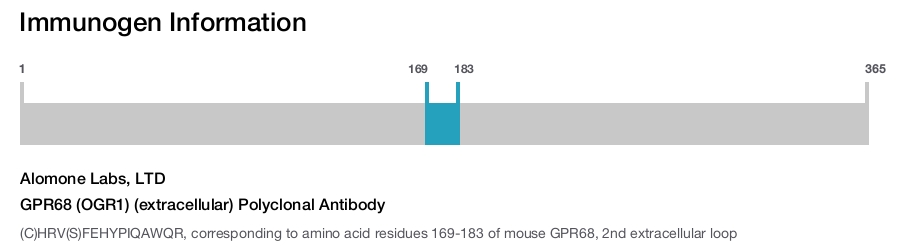
(C)HRV(S)FEHYPIQAWQR, corresponding to amino acid residues 169-183 of mouse GPR68, 2nd extracellular loop
偶联物
Unconjugated
Unconjugated
Unconjugated
形式
Lyophilized
浓度
0.8 mg/mL once reconstituted
规格
160 µg
纯化类型
Antigen affinity chromatography
保存液
PBS, pH 7.4, with 1% BSA
内含物
0.05% sodium azide
保存条件
-20°C, Avoid Freeze/Thaw Cycles
运输条件
Ambient (domestic); Wet ice (international)
产品详细信息
Reconstitution: 25 µL, 50 µL or 0.2 mL double distilled water (DDW), depending on the sample size. The antibody ships as a lyophilized powder at room temperature. Upon arrival, it should be stored at -20C. The reconstituted solution can be stored at 4C for up to 1 week. For longer periods, small aliquots should be stored at -20C. Avoid multiple freezing and thawing. Centrifuge all antibody preparations before use (10000 x g 5 min).
靶标信息
GPR68 (also known as OGR1 - ovarian cancer G-protein coupled receptor 1) is a proton-sensing receptor involved in pH homeostasis. It represents an osteoblastic pH sensor regulating the cell-mediated response to acidosis in bone. GPR68 mediates its action by association with G proteins that stimulate inositol phosphate (IP) production or CA2+ mobilization. The receptor is almost silent at pH 7.8 but fully activated at pH 6.8. Also found to serve as a tumor suppressor in prostate cancer. Mutations to the gene result in amelogenesis imperfecta, hypomaturation type 2A6.
仅用于科研。不用于诊断过程。未经明确授权不得转售。
篇参考文献 (0)
您是否在文献中引用过该产品?请点击下方按钮邮件告知我们。
生物信息学
蛋白别名: Brgr1; Brgrb; G protein-coupled receptor GPR68; G-protein coupled receptor 12A; OGR1; GPR68; ovarian cancer G protein-coupled receptor, 1; ovarian cancer G-protein coupled receptor 1; ovarian cancer G-protein coupled receptor 1 homolog; sphingosylphosphorylcholine receptor; unnamed protein product
基因别名: AI2A6; GPR12A; OGR1
UniProt ID: (Human) Q15743, (Mouse) Q8BFQ3
Entrez Gene ID: (Human) 8111, (Mouse) 238377, (Rat) 314386
G-protein coupled receptor signaling pathway
adenylate cyclase-activating G-protein coupled receptor signaling pathway
phospholipase C-activating G-protein coupled receptor signaling pathway
positive regulation of insulin secretion
response to fluid shear stress
positive regulation of insulin secretion involved in cellular response to glucose stimulus
negative regulation of monocyte differentiation
cellular response to pH
cellular response to acidic pH
positive regulation of osteoclast development
inflammatory response
Disclaimer

Clicking the images or links will redirect you to a website hosted by BenchSci that provides third-party scientific content. Neither the content nor the BenchSci technology and processes for selection have been evaluated by us; we are providing them as-is and without warranty of any kind, including for use or application of the Thermo Fisher Scientific products presented.

