Search
Bethyl Laboratories
Glu-Glu Tag Polyclonal Antibody
{{$productOrderCtrl.translations['antibody.pdp.commerceCard.promotion.promotions']}}
{{$productOrderCtrl.translations['antibody.pdp.commerceCard.promotion.promocode']}}: {{promo.promoCode}} {{promo.promoTitle}} {{promo.promoDescription}}. {{$productOrderCtrl.translations['antibody.pdp.commerceCard.promotion.learnmore']}}
{{$ctrl.translations['antibody.pdp.skuNotes.additionalInformation']}}:
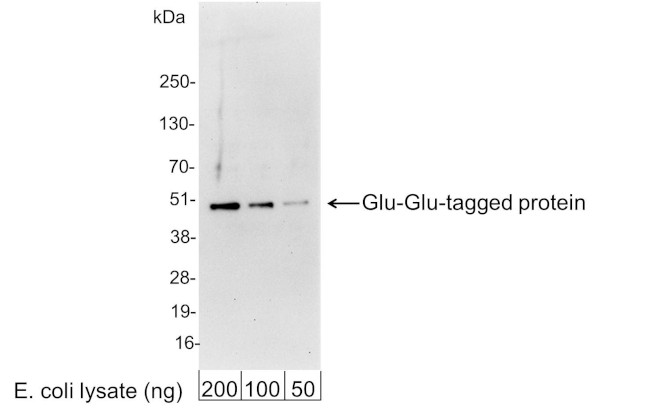
FIGURE: 1 / 1
Glu-Glu Tag Antibody (A190-110A) in WB
Detection of Glu-Glu-tagged protein by western blot. Samples: 200, 100, or 50 ng of E. coli whole cell lysate expressing a multi-tag fusion protein. Antibodies: Affinity purified, goat anti-Glu-Glu antibody (Product # A190-110A) used for WB at 0.2 µg/mL (1:5,000). Detection: Chemiluminescence with an exposure time of 30 seconds.
Please note: We are reviewing Western blot images included in the antibody testing data in our catalog, including those provided by third parties. Unless expressly labeled or annotated as “raw-unedited”, Western blot images included in the antibody testing data in our catalog may have been edited, optimized or otherwise adjusted for presentation.

Product Details
A190-110A
Applications
Tested Dilution
Publications
Product Specifications
Species Reactivity
Tag
Host/Isotype
Goat
/ IgG
Class
Polyclonal
Type
Antibody
Immunogen
Synthetic peptide representing amino acid residues 314 - 319 (EYMPME) of middle T antigen of mouse polyomavirus conjugated to KLH.
Conjugate
Unconjugated
Unconjugated
Unconjugated
Form
Liquid
Concentration
1 mg/mL
Amount
100 µg
Purification
Antigen affinity chromatography
Storage buffer
PBS, pH 6.8 to 7.4
Contains
0.09% sodium azide
Storage conditions
4°C
Shipping conditions
Ambient (domestic); Wet ice (international)
Product Specific Information
Goats were immunized with a synthetic peptide representing amino acid residues 314 - 319 (EYMPME) of middle T antigen of mouse polyomavirus conjugated to KLH. Antibody was isolated by affinity chromatography using the peptide immobilized on solid support.
Target Information
The Glu-Glu tag, also known as the EYMPME sequence, is a short peptide epitope tag consisting of two glutamic acid (Glu) residues interspersed with various amino acids. It is typically incorporated into the N-terminus of proteins through subcloning into vectors such as the pFASTBAC vector. This tag is particularly useful in recombinant protein expression and purification processes. It facilitates the detection and isolation of tagged proteins via specific antibodies that recognize the Glu-Glu sequence. The Glu-Glu tag can be utilized in various systems, including baculovirus expression in insect cells, and provides efficient means for studying protein-protein interactions, localization, and function.
For Research Use Only. Not for use in diagnostic procedures. Not for resale without express authorization.
References (0)
Have you cited this product in a publication?
Let us know so we can reference it here.
Bioinformatics
Protein Aliases: CEEEEYMPME; EYMPME
Disclaimer

Clicking the images or links will redirect you to a website hosted by BenchSci that provides third-party scientific content. Neither the content nor the BenchSci technology and processes for selection have been evaluated by us; we are providing them as-is and without warranty of any kind, including for use or application of the Thermo Fisher Scientific products presented.

Performance Guarantee
If an Invitrogen™ antibody doesn't perform as described on our website or datasheet,we'll replace the product at no cost to you, or provide you with a credit for a future purchase.*
Learn more
We're here to help
Get expert recommendations for common problems or connect directly with an on staff expert for technical assistance related to applications, equipment and general product use.
Contact tech support