Search
Abnova
HCCS Monoclonal Antibody (3C7)
{{$productOrderCtrl.translations['antibody.pdp.commerceCard.promotion.promotions']}}
{{$productOrderCtrl.translations['antibody.pdp.commerceCard.promotion.viewpromo']}}
{{$productOrderCtrl.translations['antibody.pdp.commerceCard.promotion.promocode']}}: {{promo.promoCode}} {{promo.promoTitle}} {{promo.promoDescription}}. {{$productOrderCtrl.translations['antibody.pdp.commerceCard.promotion.learnmore']}}
Additional Information:
{{banner.description}}
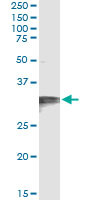
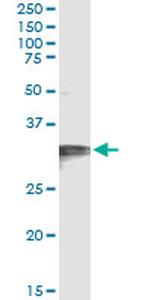
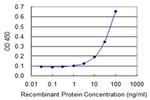


产品信息
H00003052-M01
产品规格
种属反应
Human
宿主/亚型
Mouse
/ IgG2a, kappa
分类
Monoclonal
类型
Antibody
克隆号
3C7
抗原
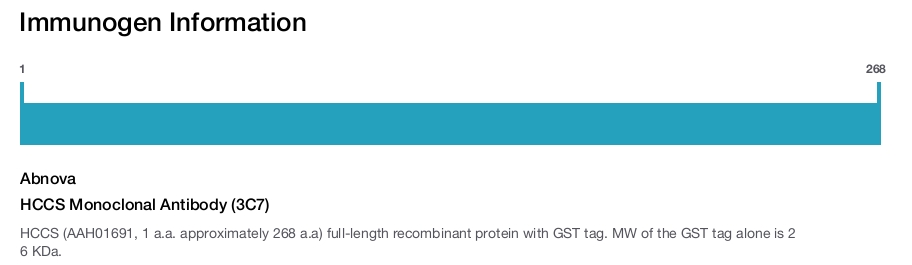
HCCS (AAH01691, 1 a.a. approximately 268 a.a) full-length recombinant protein with GST tag. MW of the GST tag alone is 26 KDa.
偶联物
形式
Liquid
浓度
See Label
规格
100 µg
纯化类型
Affinity chromatography
保存液
PBS, pH 7.4
内含物
no preservative
保存条件
-20°C, Avoid Freeze/Thaw Cycles
运输条件
Ambient (domestic); Wet ice (international)
产品详细信息
Sequence of this protein is as follows: MGLSPSAPAV AVQASNASAS PPSGCPMHEG KMKGCPVNTE PSGPTCEKKT YSVPAHQERA YEYVECPIRG TAAENKENLD PSNLMPPPNQ TPAPDQPFAL STVREESSIP RADSEKKWVY PSEQMFWNAM LKKGWKWKDE DISQKDMYNI IRIHNQNNEQ AWKEILKWEA LHAAECPCGP SLIRFGGKAK EYSPRARIRS WMGYELPFDR HDWIINRCRT EVRYVIDYYD GGEVNKDYQF TILDVRPALD SLSAVWDRMK VAWWRWTS
靶标信息
CCHL (cytochrome c-type heme lyase), also known as HCCS (holocytochrome c-type synthase), is a 268 amino acid mitochondrial inner membrane protein that belongs to the cytochrome c-type heme lyase family. Containing two HRM (heme regulatory motif) repeats, HCCS participates in the covalent linkage of a heme group to an apoprotein of cytochrome c. The gene encoding HCCS maps to the human X chromosome. Defects to this gene cause microphthalmia syndromic type 7 (MCOPS7), also known as MIDAS syndrome or microphthalmia with linear skin defects (MLS). MCOPS7 is an X-linked male-lethal disorder that results in eye deformation, unilateral or bilateral microphthalmia, linear skin defects in affected females, and in utero lethality for males.
仅用于科研。不用于诊断过程。未经明确授权不得转售。
篇参考文献 (0)
您是否在文献中引用过该产品?请点击下方按钮邮件告知我们。
生物信息学
蛋白别名: cytochrome c heme-lyase; Cytochrome c-type heme lyase; Holocytochrome c-type synthase; holocytochrome-c synthetase; microphthalamia with linear skin defects; microphthalmia with linear skin defects; unnamed protein product
基因别名: CCHL; HCCS; LSDMCA1; MCOPS7; MLS
UniProt ID: (Human) P53701
Entrez Gene ID: (Human) 3052
Disclaimer

Clicking the images or links will redirect you to a website hosted by BenchSci that provides third-party scientific content. Neither the content nor the BenchSci technology and processes for selection have been evaluated by us; we are providing them as-is and without warranty of any kind, including for use or application of the Thermo Fisher Scientific products presented.

