Search
Invitrogen
HIN-1 Monoclonal Antibody (3G5)
{{$productOrderCtrl.translations['antibody.pdp.commerceCard.promotion.promotions']}}
{{$productOrderCtrl.translations['antibody.pdp.commerceCard.promotion.promocode']}}: {{promo.promoCode}} {{promo.promoTitle}} {{promo.promoDescription}}. {{$productOrderCtrl.translations['antibody.pdp.commerceCard.promotion.learnmore']}}
{{$ctrl.translations['antibody.pdp.skuNotes.additionalInformation']}}:
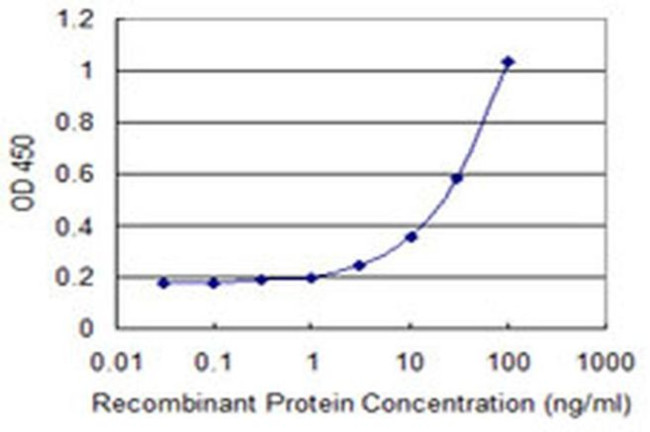
Please note: We are reviewing Western blot images included in the antibody testing data in our catalog, including those provided by third parties. Unless expressly labeled or annotated as “raw-unedited”, Western blot images included in the antibody testing data in our catalog may have been edited, optimized or otherwise adjusted for presentation.

产品信息
MA5-22866
产品规格
种属反应
Human
宿主/亚型
Mouse
/ IgG2a, kappa
分类
Monoclonal
类型
Antibody
克隆号
3G5
抗原
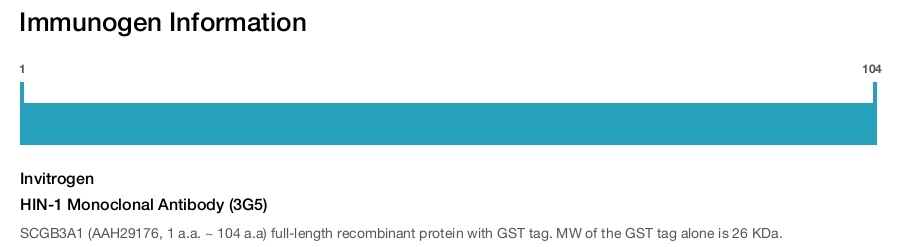
SCGB3A1 (AAH29176, 1 a.a. ~ 104 a.a) full-length recombinant protein with GST tag. MW of the GST tag alone is 26 KDa.
偶联物
Unconjugated
Unconjugated
Unconjugated
形式
Liquid
浓度
1.0 mg/mL
规格
100 µg
纯化类型
Affinity chromatography
保存液
PBS, pH 7.4
内含物
no preservative
保存条件
-20°C, Avoid Freeze/Thaw Cycles
运输条件
Ambient (domestic); Wet ice (international)
RRID
产品详细信息
Peptide Sequence: MKLAALLGLC VALSCSSAAA FLVGSAKPVA QPVAALESAA EAGAGTLANP LGTLNPLKLL LSSLGIPVNH LIEGSQKCVA ELGPQAVGAV KALKALLGAL TVFG
靶标信息
HIN-1, also known as High In Normal-1 or Secretoglobin Family 3A Member 1 (SCGB3A1), is a gene located on chromosome 5q33.3. It encodes a protein that is predominantly expressed in normal mammary epithelial cells and is thought to function in epithelial cell signaling, contributing to cellular differentiation and maintaining normal tissue architecture. The HIN-1 gene is often silenced or downregulated in various cancers, particularly breast cancer, due to hypermethylation of its promoter region, suggesting a potential tumor suppressor role. Loss of HIN-1 expression has been implicated in the progression of malignancies by disrupting normal cell signaling pathways, thereby facilitating oncogenesis. Given its significant downregulation in cancerous tissues, HIN-1 is being explored as a biomarker for early cancer detection and may provide insights into novel therapeutic strategies that aim to restore its expression and normal cellular functions.
仅用于科研。不用于诊断过程。未经明确授权不得转售。
篇参考文献 (0)
您是否在文献中引用过该产品?请点击下方按钮邮件告知我们。
生物信息学
蛋白别名: cytokine high in normal-1; cytokine HIN-1; high in normal 1; high in normal-1 putative cytokine; pneumo secretory protein 2; PnSP-2; UGRP2MGC87867; uteroglobin-related protein 2
基因别名: HIN-1; HIN1; LU105; PnSP-2; UGRP2
UniProt ID: (Human) Q96QR1
Entrez Gene ID: (Human) 92304
Disclaimer

Clicking the images or links will redirect you to a website hosted by BenchSci that provides third-party scientific content. Neither the content nor the BenchSci technology and processes for selection have been evaluated by us; we are providing them as-is and without warranty of any kind, including for use or application of the Thermo Fisher Scientific products presented.

