Search
Abnova
HLA-DOB Polyclonal Antibody, MaxPab™
{{$productOrderCtrl.translations['antibody.pdp.commerceCard.promotion.promotions']}}
{{$productOrderCtrl.translations['antibody.pdp.commerceCard.promotion.viewpromo']}}
{{$productOrderCtrl.translations['antibody.pdp.commerceCard.promotion.promocode']}}: {{promo.promoCode}} {{promo.promoTitle}} {{promo.promoDescription}}. {{$productOrderCtrl.translations['antibody.pdp.commerceCard.promotion.learnmore']}}
Additional Information:
{{banner.description}}
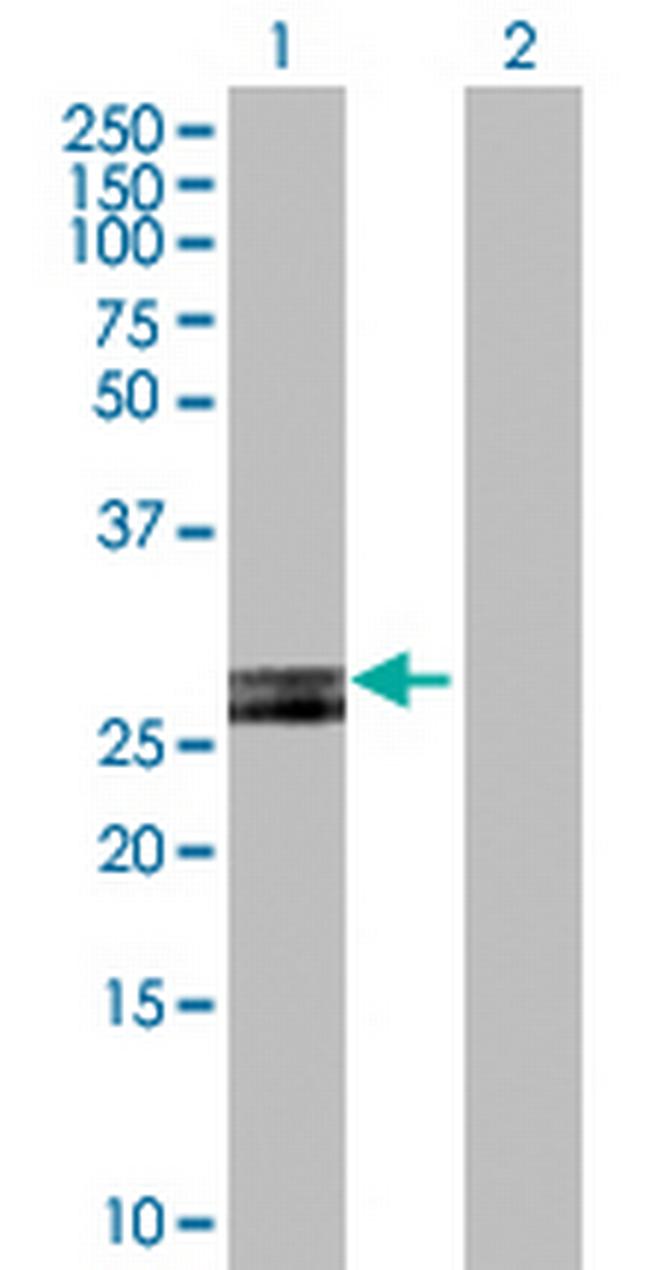
Please note: We are reviewing Western blot images included in the antibody testing data in our catalog, including those provided by third parties. Unless expressly labeled or annotated as “raw-unedited”, Western blot images included in the antibody testing data in our catalog may have been edited, optimized or otherwise adjusted for presentation.

产品信息
H00003112-D01P
产品规格
种属反应
Human
宿主/亚型
Rabbit
/ IgG
分类
Polyclonal
类型
Antibody
抗原
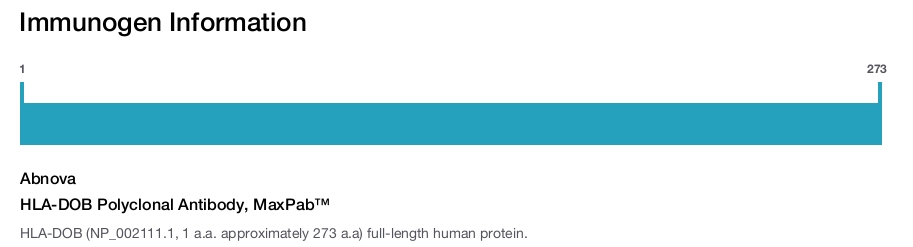
HLA-DOB (NP_002111.1, 1 a.a. approximately 273 a.a) full-length human protein.
偶联物
Unconjugated
Unconjugated
Unconjugated
形式
Liquid
浓度
1 mg/mL
规格
100 µg
纯化类型
Protein A
保存液
PBS, pH 7.4
内含物
no preservative
保存条件
-20°C, Avoid Freeze/Thaw Cycles
运输条件
Ambient (domestic); Wet ice (international)
产品详细信息
Product may be used with Western Blot (Transfected lysate).
The Isotype of this product is composed of an IgG Mixture.
Immunogen sequence: MGSGWVPWVV ALLVNLTRLD SSMTQGTDSP EDFVIQAKAD CYFTNGTEKV QFVVRFIFNL EEYVRFDSDV GMFVALTKLG QPDAEQWNSR LDLLERSRQA VDGVCRHNYR LGAPFTVGRK VQPEVTVYPE RTPLLHQHNL LHCSVTGFYP GDIKIKWFLN GQEERAGVMS TGPIRNGDWT FQTVVMLEMT PELGHVYTCL VDHSSLLSPV SVEWRAQSEY SWRKMLSGIA AFLLGLIFLL VGIVIQLRAQ KGYVRTQMSG NEVSRAVLLP QSC
靶标信息
Peptide (antigen) binding to major histocompatibility complex (MHC) class II molecules destined for presentation to CD4+ helper T cells is determined by two key events. These include the dissociation of class II-associated invariant chain peptides (CLIP) from an antigen binding groove in MHC II-Ig dimers and by the activity of MHC molecules HLA-DM and -DO. Accumulating in endosomal/lysosomal compartments and on the surface of B cells, HLA-DM, -DO molecules regulate the dissociation of CLIP and the subsequent binding of exogenous peptides to HLA class II molecules (HLA-DR) by sustaining a conformation that favors peptide exchange. RFLP analysis of HLA-DM genes from rheumatoid arthritis (RA) patients suggests that certain polymorphisms are genetic factors for RA susceptibility.
HLA and MHC antibodies play a significant role in Immunopeptidomics, facilitating the identification and characterization of neoantigens through high-performance liquid chromatography coupled to tandem Mass Spectrometry.
仅用于科研。不用于诊断过程。未经明确授权不得转售。
篇参考文献 (0)
您是否在文献中引用过该产品?请点击下方按钮邮件告知我们。
生物信息学
蛋白别名: HLA-DO beta; HLA-DOB; MHC class II antigen DOB; MHC DO beta protein precursor; unnamed protein product
基因别名: DOB; HLA_DOB
UniProt ID: (Human) P13765
Entrez Gene ID: (Human) 3112
peptide antigen assembly with MHC class II protein complex
negative regulation of antigen processing and presentation of peptide antigen via MHC class II
immune response
antigen processing and presentation
antigen processing and presentation of exogenous peptide antigen via MHC class II
positive regulation of immune response
positive regulation of T cell activation
Disclaimer

Clicking the images or links will redirect you to a website hosted by BenchSci that provides third-party scientific content. Neither the content nor the BenchSci technology and processes for selection have been evaluated by us; we are providing them as-is and without warranty of any kind, including for use or application of the Thermo Fisher Scientific products presented.

