Search
Abnova
HLA-DPA1 Polyclonal Antibody, MaxPab™
{{$productOrderCtrl.translations['antibody.pdp.commerceCard.promotion.promotions']}}
{{$productOrderCtrl.translations['antibody.pdp.commerceCard.promotion.viewpromo']}}
{{$productOrderCtrl.translations['antibody.pdp.commerceCard.promotion.promocode']}}: {{promo.promoCode}} {{promo.promoTitle}} {{promo.promoDescription}}. {{$productOrderCtrl.translations['antibody.pdp.commerceCard.promotion.learnmore']}}
Additional Information:
{{banner.description}}
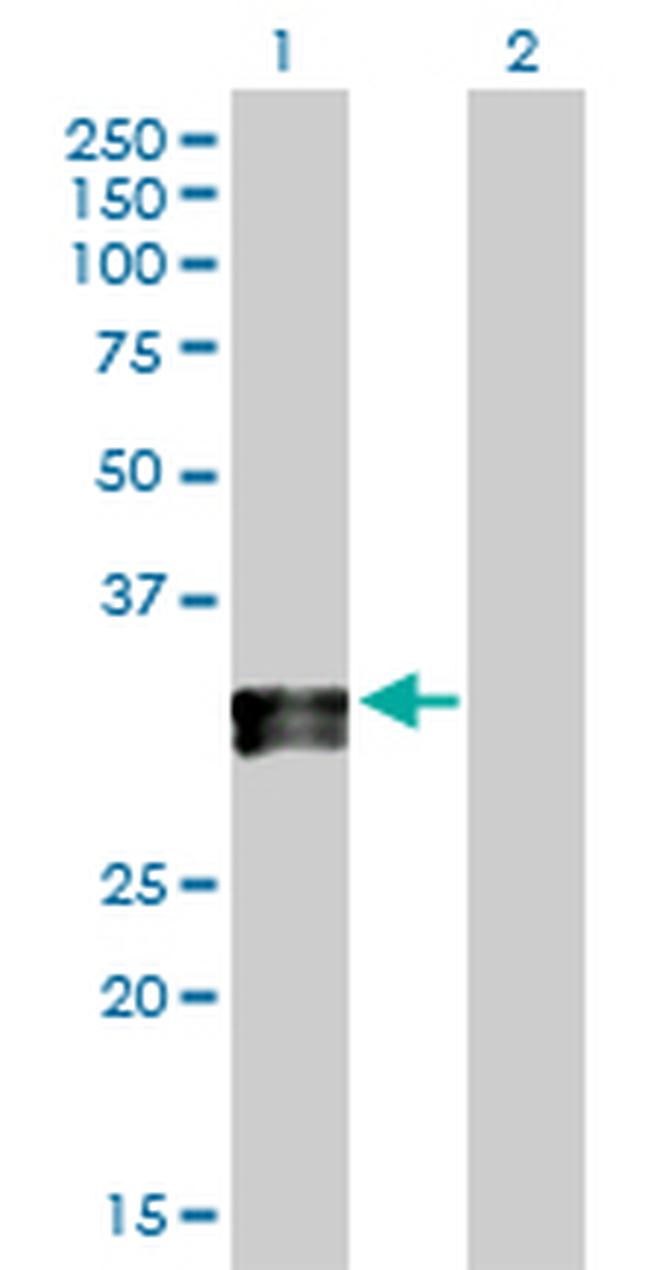
图: 1 / 2
HLA-DPA1 Antibody (H00003113-D01P) in WB
Western Blot analysis of HLA-DPA1 expression in transfected 293T cell line (H00003113-T02) by HLA-DPA1 MaxPab polyclonal antibody.
Lane 1: HLA-DPA1 transfected lysate(29.30 KDa).
Lane 2: Non-transfected lysate.
Lane 1: HLA-DPA1 transfected lysate(29.30 KDa).
Lane 2: Non-transfected lysate.


产品信息
H00003113-D01P
产品规格
宿主/亚型
Rabbit
/ IgG
分类
Polyclonal
类型
Antibody
抗原
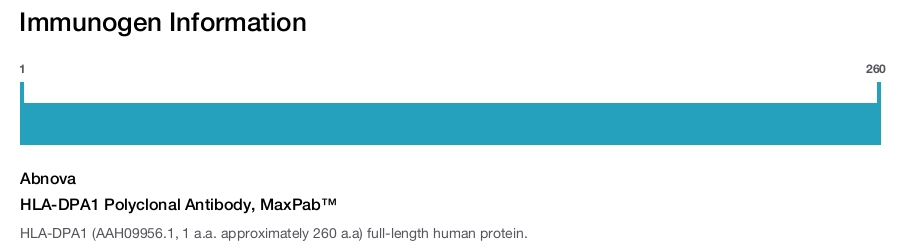
HLA-DPA1 (AAH09956.1, 1 a.a. approximately 260 a.a) full-length human protein.
偶联物
形式
Liquid
浓度
See Label
规格
100 µg
保存条件
-20°C, Avoid Freeze/Thaw Cycles
运输条件
Ambient (domestic); Wet ice (international)
产品详细信息
Sequence of this protein is as follows: MRPEDRMFHI RAVILRALSL AFLLSLRGAG AIKADHVSTY AAFVQTHRPT GEFMFEFDED EQFYVDLDKK ETVWHLEEFG RAFSFEAQGG LANIAILNNN LNTLIQRSNH TQAANDPPEV TVFPKEPVEL GQPNTLICHI DRFFPPVLNV TWLCNGEPVT EGVAESLFLP RTDYSFHKFH YLTFVPSAED VYDCRVEHWG LDQPLLKHWE AQEPIQMPET TETVLCALGL VLGLVGIIVG TVLIIKSLRS GHDPRAQGPL
靶标信息
HLA-DPA1 belongs to the HLA class II alpha chain paralogues. This class II molecule is a heterodimer consisting of an alpha (DPA) and a beta (DPB) chain, both anchored in the membrane. It plays a central role in the immune system by presenting peptides derived from extracellular proteins. Class II molecules are expressed in antigen presenting cells (APC: B lymphocytes, dendritic cells, macrophages). The alpha chain is approximately 33-35 kDa and its gene contains 5 exons. Exon one encodes the leader peptide, exons 2 and 3 encode the two extracellular domains, exon 4 encodes the transmembrane domain and the cytoplasmic tail. Within the DP molecule both the alpha chain and the beta chain contain the polymorphisms specifying the peptide binding specificities, resulting in up to 4 different molecules.
HLA and MHC antibodies play a significant role in Immunopeptidomics, facilitating the identification and characterization of neoantigens through high-performance liquid chromatography coupled to tandem Mass Spectrometry.
仅用于科研。不用于诊断过程。未经明确授权不得转售。
篇参考文献 (0)
您是否在文献中引用过该产品?请点击下方按钮邮件告知我们。
Disclaimer

Clicking the images or links will redirect you to a website hosted by BenchSci that provides third-party scientific content. Neither the content nor the BenchSci technology and processes for selection have been evaluated by us; we are providing them as-is and without warranty of any kind, including for use or application of the Thermo Fisher Scientific products presented.

