Search
Invitrogen
HSP90 beta Polyclonal Antibody
{{$productOrderCtrl.translations['antibody.pdp.commerceCard.promotion.promotions']}}
{{$productOrderCtrl.translations['antibody.pdp.commerceCard.promotion.promocode']}}: {{promo.promoCode}} {{promo.promoTitle}} {{promo.promoDescription}}. {{$productOrderCtrl.translations['antibody.pdp.commerceCard.promotion.learnmore']}}
{{$ctrl.translations['antibody.pdp.skuNotes.additionalInformation']}}:
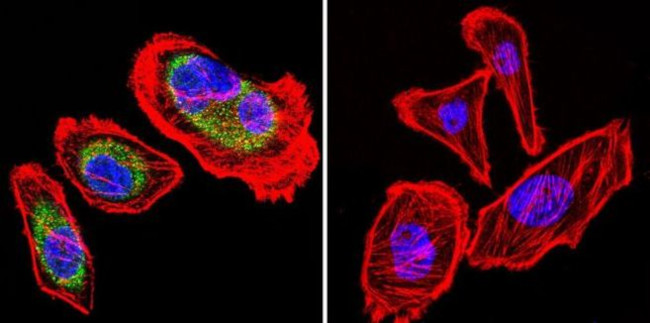
图: 1 / 29
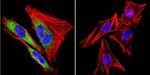
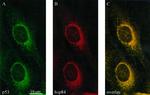
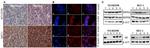
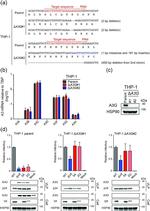
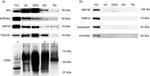
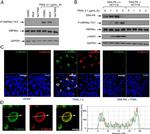
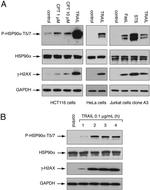
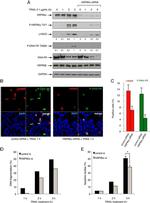
HSP90 beta Antibody (PA3-012) in ICC/IF
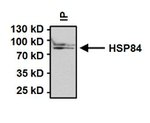
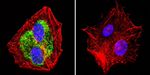
Immunofluorescent analysis of Heat Shock Protein 84 using Anti-Heat Shock Protein 84 Polyclonal Antibody (Product # PA3-012) shows staining in U251 Cells. Heat Shock Protein 84 staining (green), F-Actin staining with Phalloidin (red) and nuclei with DAPI (blue) is shown. Cells were grown on chamber slides and fixed with formaldehyde prior to staining. Cells were probed without (control) or with or an antibo... View More
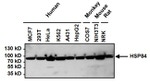
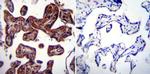

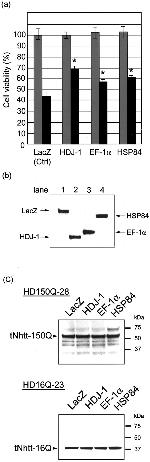
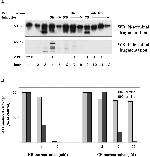
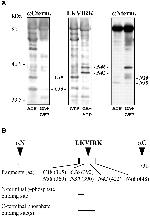
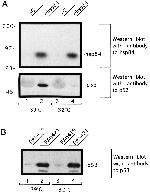
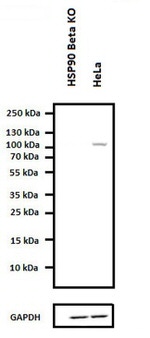
Please note: We are reviewing Western blot images included in the antibody testing data in our catalog, including those provided by third parties. Unless expressly labeled or annotated as “raw-unedited”, Western blot images included in the antibody testing data in our catalog may have been edited, optimized or otherwise adjusted for presentation.


产品信息
PA3-012
应用
建议稀释比
已发表文章
产品规格
种属反应
Human,
Mouse,
Non-human primate,
Rat
已发表种属
Human,
Mouse,
Rat
宿主/亚型
Rabbit
/ IgG
分类
Polyclonal
类型
Antibody
抗原
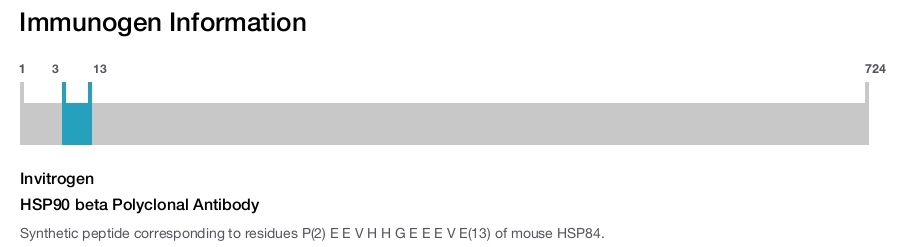
Synthetic peptide corresponding to residues P(2) E E V H H G E E E V E(13) of mouse HSP84.
偶联物
Unconjugated
Unconjugated
Unconjugated
形式
Liquid
浓度
1 mg/mL
规格
100 µg
纯化类型
Antigen affinity chromatography
保存液
PBS with 1mg/mL BSA
内含物
0.05% sodium azide
保存条件
-20°C, Avoid Freeze/Thaw Cycles
运输条件
Ambient (domestic); Wet ice (international)
RRID
产品详细信息
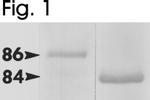
PA3-012 detects heat shock protein 90 beta (HSP90) from human, monkey, mouse, and rat tissues and cells. This antibody does not detect HSP86.
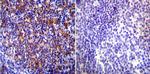
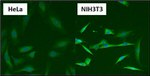
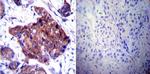
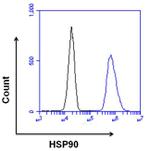
PA3-012 has been successfully used in Western blot, immunohistochemistry, immunofluorescence, flow cytometry, and immunoprecipitation procedures. By Western blot, this antibody detects an ~84 kDa protein representing HSP84 from Hepa1 cell lysate. Immunofluorescence staining of HSP84 in Hepa1 cells with PA3-012 yields a pattern consistent with cytoplasmic staining. Immunoprecipitation experiments with this antibody suggest that HSP84 exists primarily as homodimers in Hepa 1 cells. Furthermore, the antibody is capable of precipitating HSP84 that is complexed with other proteins such as the aryl hydrocarbon (Ah) receptor.
The PA3-012 immunogen is a synthetic peptide corresponding to residues P(2) E E V H H G E E E V E(13) of mouse HSP84. The N-terminal regions of HSP84 and HSP86 show the largest difference in amino acid sequence.
靶标信息
Heat shock proteins (HSP) are expressed in response to various biological stresses, including heat. HSP90 is a 90 kDa protein that is induced under stress conditions, but is also one of the most abundant cellular proteins found under non-stress conditions. HSP90 proteins are highly conserved molecular chaperones that have key roles in signal transduction, protein folding, protein degradation, and morphologic evolution. HSP90 proteins normally associate with other cochaperones and play important roles in folding newly synthesized proteins or stabilizing and refolding denatured proteins after stress. HSP90 has been found to be associated with a number of other intracellular proteins, including steroid receptors, actin, tubulin, aryl hydrocarbon (Ah) receptor, and some kinases.
仅用于科研。不用于诊断过程。未经明确授权不得转售。
生物信息学
蛋白别名: 84 kD heat shock protein; 90kDa heat shock protein; heat shock 84 kDa; heat shock 90kD protein 1, beta; heat shock 90kDa protein 1, beta; Heat shock protein; heat shock protein 1, beta; heat shock protein 90 alpha (cytosolic), class B member 1; heat shock protein 90 kDa; heat shock protein 90kDa alpha (cytosolic), class B member 1; heat shock protein 90kDa alpha family class B member 1; heat shock protein family C member 3; heat shock protein, 84 kDa 1; heat-shock protein hsp84; HSP; HSP 84; HSP84; HSP90-beta; retinal degeneration slow protein; RP1-302G2.1; TSTA; tumor-specific transplantation 84 kDa antigen; unnamed protein product
基因别名: 90kDa; D6S182; HSP84; Hsp84-1; Hsp90; HSP90-BETA; HSP90B; HSPC2; HSPCB
UniProt ID: (Human) P08238, (Mouse) P11499, (Rat) P34058
Entrez Gene ID: (Human) 3326, (Mouse) 15516, (Rat) 301252
RNA binding
double-stranded RNA binding
protein binding
ATP binding
ATPase activity
protein kinase regulator activity
kinase binding
protein kinase binding
MHC class II protein complex binding
nitric-oxide synthase regulator activity
TPR domain binding
heat shock protein binding
ubiquitin protein ligase binding
peptide binding
identical protein binding
protein homodimerization activity
histone deacetylase binding
ATP-dependent protein binding
protein binding involved in protein folding
cadherin binding
protein dimerization activity
tau protein binding
DNA polymerase binding
protein phosphatase activator activity
disordered domain specific binding
ATP-dependent protein folding chaperone
receptor ligand inhibitor activity
histone methyltransferase binding
UTP binding
CTP binding
GTP binding
sulfonylurea receptor binding
dATP binding
ion channel binding
heterocyclic compound binding
protein carrier chaperone
placenta development
protein folding
virion attachment to host cell
positive regulation of transforming growth factor beta receptor signaling pathway
regulation of protein ubiquitination
negative regulation of proteasomal ubiquitin-dependent protein catabolic process
regulation of protein localization
cellular response to heat
positive regulation of protein import into nucleus
negative regulation of apoptotic process
negative regulation of neuron apoptotic process
positive regulation of nitric oxide biosynthetic process
positive regulation of cell differentiation
positive regulation of cell size
protein stabilization
chaperone-mediated protein complex assembly
regulation of cell cycle
cellular response to interleukin-4
positive regulation of protein serine/threonine kinase activity
fibril organization
negative regulation of proteasomal protein catabolic process
negative regulation of complement-dependent cytotoxicity
telomerase holoenzyme complex assembly
positive regulation of protein localization to cell surface
response to unfolded protein
telomere maintenance via telomerase
response to xenobiotic stimulus
response to salt stress
response to cocaine
regulation of protein complex stability
chaperone-mediated autophagy
Disclaimer

Clicking the images or links will redirect you to a website hosted by BenchSci that provides third-party scientific content. Neither the content nor the BenchSci technology and processes for selection have been evaluated by us; we are providing them as-is and without warranty of any kind, including for use or application of the Thermo Fisher Scientific products presented.

