Search
Invitrogen
Hepatitis D virus Polyclonal Antibody
{{$productOrderCtrl.translations['antibody.pdp.commerceCard.promotion.promotions']}}
{{$productOrderCtrl.translations['antibody.pdp.commerceCard.promotion.promocode']}}: {{promo.promoCode}} {{promo.promoTitle}} {{promo.promoDescription}}. {{$productOrderCtrl.translations['antibody.pdp.commerceCard.promotion.learnmore']}}
{{$ctrl.translations['antibody.pdp.skuNotes.additionalInformation']}}:
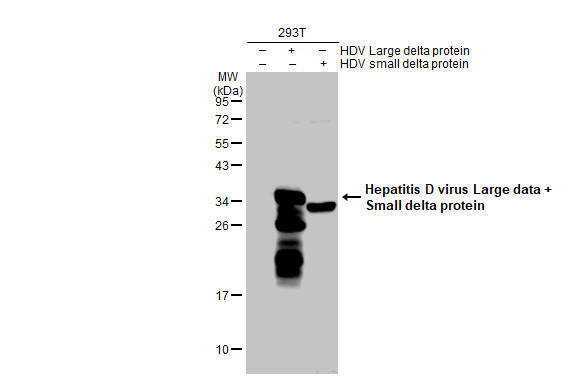
图: 1 / 1
Hepatitis D virus Antibody (PA5-143461) in WB
Western blot analysis of Hepatitis D virus in 293T whole cell extracts (30 µg) separated by 12% SDS-PAGE. Membrane was blotted with Hepatitis D virus Polyclonal antibody (Product # PA5-143461) using a dilution of 1:5,000 followed by HRP-conjugated anti-rabbit IgG secondary antibody.
Please note: We are reviewing Western blot images included in the antibody testing data in our catalog, including those provided by third parties. Unless expressly labeled or annotated as “raw-unedited”, Western blot images included in the antibody testing data in our catalog may have been edited, optimized or otherwise adjusted for presentation.

产品信息
PA5-143461
产品规格
种属反应
Virus
宿主/亚型
Rabbit
/ IgG
分类
Polyclonal
类型
Antibody
抗原
Full length HepatitisHepatitis D virus Small delta recombinant protein.
偶联物
Unconjugated
Unconjugated
Unconjugated
形式
Liquid
浓度
1.9 mg/mL
规格
190 µg
纯化类型
Antigen affinity chromatography
保存液
PBS, pH 7, with 20% glycerol
内含物
0.025% Proclin 300
保存条件
Store at 4°C short term. For long term storage, store at -20°C, avoiding freeze/thaw cycles.
运输条件
Ambient (domestic); Wet ice (international)
RRID
产品详细信息
Store as concentrated solution.
Centrifuge briefly prior to opening vial.
靶标信息
Hepatitis D virus (HDV), also known as hepatitis delta virus, is a defective RNA virus that requires the hepatitis B virus (HBV) for its replication and assembly. Discovered in 1977, HDV is dependent on the HBV surface antigen (HBsAg) for completing its life cycle, as it does not encode its own envelope proteins. HDV infection leads to a severe form of viral hepatitis, often resulting in more rapid progression to liver cirrhosis, liver failure, and hepatocellular carcinoma compared to HBV infection alone. HDV primarily co-infects or super-infects individuals with HBV, impacting approximately 12-72 million people worldwide. New therapeutic approaches are being explored to manage this difficult-to-treat disease, given its association with adverse liver outcomes. Chronic HDV/HBV co-infection has a higher incidence of severe liver disease within a short period, typically within 5-10 years.
仅用于科研。不用于诊断过程。未经明确授权不得转售。
篇参考文献 (0)
您是否在文献中引用过该产品?请点击下方按钮邮件告知我们。
生物信息学
蛋白别名: HDV; Hepatitis Delta Virus
Disclaimer

Clicking the images or links will redirect you to a website hosted by BenchSci that provides third-party scientific content. Neither the content nor the BenchSci technology and processes for selection have been evaluated by us; we are providing them as-is and without warranty of any kind, including for use or application of the Thermo Fisher Scientific products presented.

