Search
Invitrogen
Her-2/Her-3 (Zenocutuzumab Biosimilar) Recombinant Human Monoclonal Antibody
{{$productOrderCtrl.translations['antibody.pdp.commerceCard.promotion.promotions']}}
{{$productOrderCtrl.translations['antibody.pdp.commerceCard.promotion.promocode']}}: {{promo.promoCode}} {{promo.promoTitle}} {{promo.promoDescription}}. {{$productOrderCtrl.translations['antibody.pdp.commerceCard.promotion.learnmore']}}
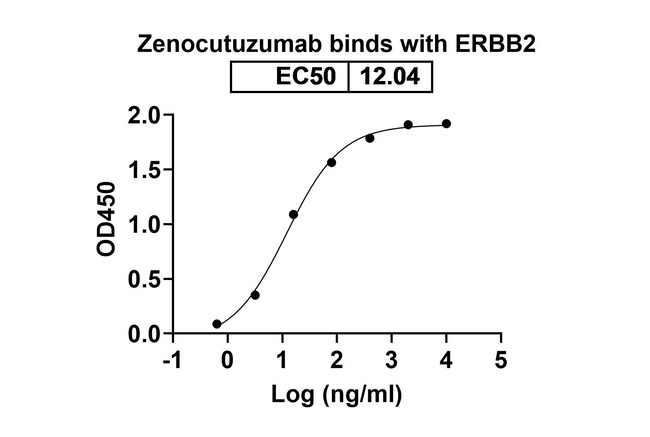
图: 1 / 2
Her-2/Her-3 (Zenocutuzumab Biosimilar) Antibody (MA5-42176) in ELISA
ELISA binding of Her-2/Her-3 (Zenocutuzumab Biosimilar) to immobilized recombinant antigen (coated at 5 µg/mL). Her-2/Her-3 (Zenocutuzumab Biosimilar) monoclonal (Product # MA5-42176) antibody was serially diluted from 10,000 ng/mL to 0.64 ng/mL.
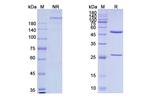
Please note: We are reviewing Western blot images included in the antibody testing data in our catalog, including those provided by third parties. Unless expressly labeled or annotated as “raw-unedited”, Western blot images included in the antibody testing data in our catalog may have been edited, optimized or otherwise adjusted for presentation.


产品信息
MA5-42176
产品规格
种属反应
Human
宿主/亚型
Human
/ IgG1, kappa
Expression System
CHO cells
分类
Recombinant Monoclonal
类型
Antibody
抗原
Human ERBB2/ERBB3
偶联物
Unconjugated
Unconjugated
Unconjugated
形式
Liquid
浓度
1.75 mg/mL
规格
100 µg
纯化类型
Protein A/G
保存液
PBS, pH 7.4
内含物
no preservative
保存条件
-20°C, Avoid Freeze/Thaw Cycles
运输条件
Ambient (domestic); Wet ice (international)
RRID
产品详细信息
Endotoxin level < 0.01EU/µg by LAL method
Use a manual defrost freezer and avoid repeated freeze thaw cycles. Store at 2 to 8 °C for one week. Store at -20 to -80 °C for twelve months from the date of receipt.
This product is a Humanized mouse antibody.
靶标信息
HER2, also known as ErbB2, is a member of the epidermal growth factor receptor (EGFR/ErbB) family of receptor tyrosine kinases. Unlike other family members, HER2 has no known direct ligand and functions primarily through heterodimerization with other ErbB receptors, leading to activation of downstream signaling pathways such as PI3K/AKT and MAPK that regulate cell proliferation, survival, and differentiation. HER2 is overexpressed or amplified in several cancers, most notably breast and gastric cancers, where it is associated with aggressive disease and poor prognosis. Due to its role in tumor growth and its cell surface accessibility, HER2 is an important target for monoclonal antibodies, antibody-drug conjugates, and other targeted therapies.
ErbB3 (c-erbB-3/HER-3) is a member of the type I family of growth factor receptors and binds to ligands in the heregulin family. ErbB3 is over-expressed in a variety of tumors in the prostate, bladder, breast, stomach, pancreas, and colon. Heregulin and EGF stimulate tyrosine phosphorylation of c-erbB-3 to different extents. The ErbB3 gene is located on the long arm of human chromosome 12 (12q13) and is transcribed into a 6. 2kb mRNA which is translated into a 160/180 kDa glycoprotein. The ErbB3 gene encodes a transmembrane receptor tyrosine kinase due to alternative splicing and forms heterodimers with other EGF receptor family members that have kinase activity. Heterodimerization leads to the activation of pathways that lead to cell proliferation or differentiation. Alternate transcriptional splice variants encoding different isoforms of ErbB3 have been characterized. One ErbB3 isoform lacks the intermembrane region, is secreted outside the cell, and acts to modulate the activity of the membrane-bound form. Additional splice variants have also been reported, but they have not been thoroughly characterized.
仅用于科研。不用于诊断过程。未经明确授权不得转售。
篇参考文献 (0)
您是否在文献中引用过该产品?请点击下方按钮邮件告知我们。
Disclaimer

Clicking the images or links will redirect you to a website hosted by BenchSci that provides third-party scientific content. Neither the content nor the BenchSci technology and processes for selection have been evaluated by us; we are providing them as-is and without warranty of any kind, including for use or application of the Thermo Fisher Scientific products presented.

