Search
Abnova
ISL1 Polyclonal Antibody, MaxPab™
{{$productOrderCtrl.translations['antibody.pdp.commerceCard.promotion.promotions']}}
{{$productOrderCtrl.translations['antibody.pdp.commerceCard.promotion.viewpromo']}}
{{$productOrderCtrl.translations['antibody.pdp.commerceCard.promotion.promocode']}}: {{promo.promoCode}} {{promo.promoTitle}} {{promo.promoDescription}}. {{$productOrderCtrl.translations['antibody.pdp.commerceCard.promotion.learnmore']}}
Additional Information:
{{banner.description}}
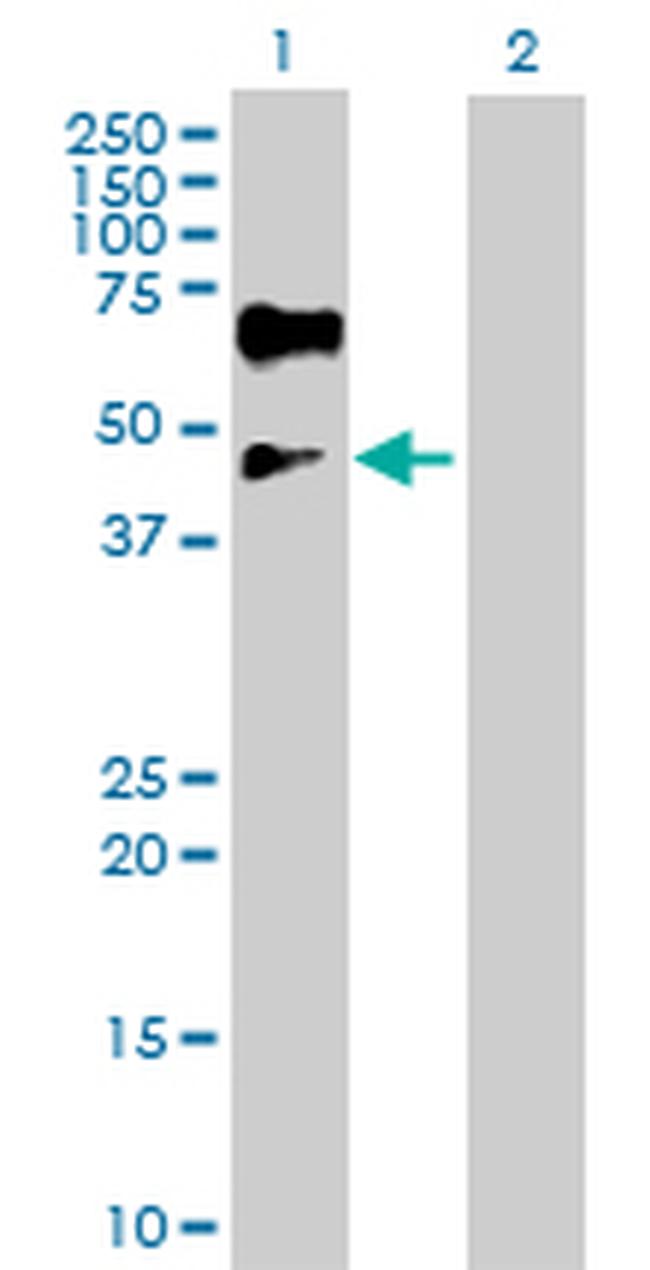
图: 1 / 3
ISL1 Antibody (H00003670-D01P) in WB
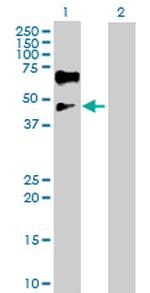
Western Blot analysis of ISL1 expression in transfected 293T cell line (H00003670-T01) by ISL1 MaxPab polyclonal antibody.
Lane 1: ISL1 transfected lysate(38.70 KDa).
Lane 2: Non-transfected lysate.
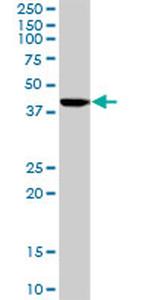
Lane 1: ISL1 transfected lysate(38.70 KDa).
Lane 2: Non-transfected lysate.


产品信息
H00003670-D01P
产品规格
宿主/亚型
Rabbit
/ IgG
分类
Polyclonal
类型
Antibody
抗原
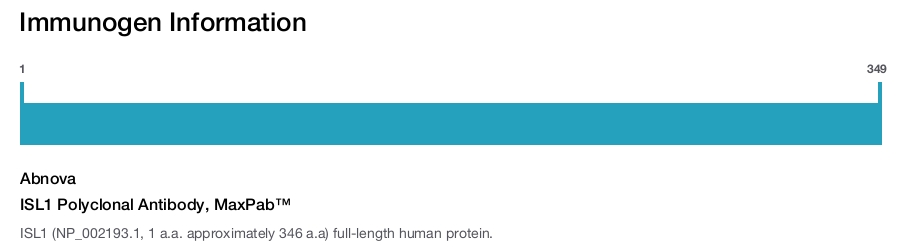
ISL1 (NP_002193.1, 1 a.a. approximately 346 a.a) full-length human protein.
偶联物
形式
Liquid
浓度
See Label
规格
100 µg
保存条件
-20°C, Avoid Freeze/Thaw Cycles
运输条件
Ambient (domestic); Wet ice (international)
产品详细信息
Sequence of this protein is as follows: MGDPPKKKRL ISLCVGCGNQ IHDQYILRVS PDLEWHAACL KCAECNQYLD ESCTCFVRDG KTYCKRDYIR LYGIKCAKCS IGFSKNDFVM RARSKVYHIE CFRCVACSRQ LIPGDEFALR EDGLFCRADH DVVERASLGA GDPLSPLHPA RPLQMAAEPI SARQPALRPH VHKQPEKTTR VRTVLNEKQL HTLRTCYAAN PRPDALMKEQ LVEMTGLSPR VIRVWFQNKR CKDKKRSIMM KQLQQQQPND KTNIQGMTGT PMVAASPERH DGGLQANPVE VQSYQPPWKV LSDFALQSDI DQPAFQQLVN FSEGGPGSNS TGSEVASMSS QLPDTPNSMV ASPIEA
靶标信息
This gene encodes a member of the LIM/homeodomain family of transcription factors. The encoded protein binds to the enhancer region of the insulin gene, among others, and may play an important role in regulating insulin gene expression. The encoded protein is central to the development of pancreatic cell lineages and may also be required for motor neuron generation. Mutations in this gene have been associated with maturity-onset diabetes of the young.
仅用于科研。不用于诊断过程。未经明确授权不得转售。
篇参考文献 (0)
您是否在文献中引用过该产品?请点击下方按钮邮件告知我们。
Disclaimer

Clicking the images or links will redirect you to a website hosted by BenchSci that provides third-party scientific content. Neither the content nor the BenchSci technology and processes for selection have been evaluated by us; we are providing them as-is and without warranty of any kind, including for use or application of the Thermo Fisher Scientific products presented.

