Search
Invitrogen
ITGB5 Polyclonal Antibody
{{$productOrderCtrl.translations['antibody.pdp.commerceCard.promotion.promotions']}}
{{$productOrderCtrl.translations['antibody.pdp.commerceCard.promotion.promocode']}}: {{promo.promoCode}} {{promo.promoTitle}} {{promo.promoDescription}}. {{$productOrderCtrl.translations['antibody.pdp.commerceCard.promotion.learnmore']}}
{{$ctrl.translations['antibody.pdp.skuNotes.additionalInformation']}}:
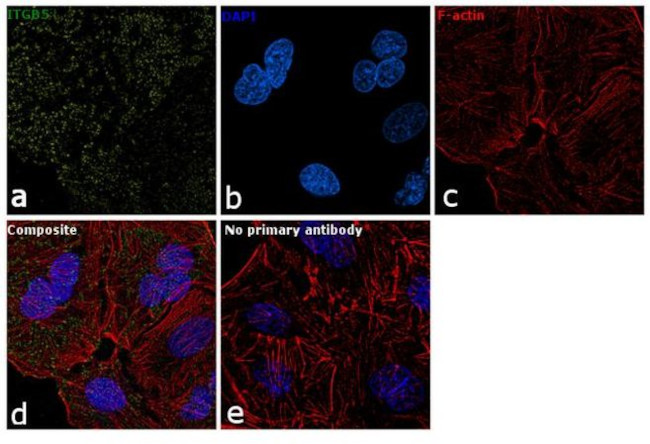
图: 1 / 6
ITGB5 Antibody (PA5-17260) in ICC/IF
Immunofluorescence analysis of ITGB5 was performed using 70% confluent log phase A549 cells. The cells were fixed with 4% paraformaldehyde for 10 minutes, permeabilized with 0.1% Triton™ X-100 for 15 minutes, and blocked with 1% BSA for 1 hour at room temperature. The cells were labeled with ITGB5 Polyclonal Antibody (Product # PA5-17260) at 1:25 dilution in 0.1% BSA, incubated at 4 degree Celsius overnight and then labeled with Goat anti-Rabbit IgG (Heavy Chain) Superclonal™ Secondary Antibody, Alexa Fluor® 488 conjugate (Product # A27034... View More
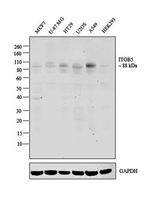
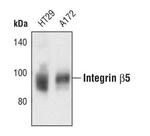
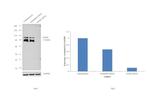
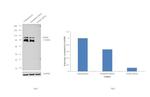
Please note: We are reviewing Western blot images included in the antibody testing data in our catalog, including those provided by third parties. Unless expressly labeled or annotated as “raw-unedited”, Western blot images included in the antibody testing data in our catalog may have been edited, optimized or otherwise adjusted for presentation.


产品信息
PA5-17260
产品规格
种属反应
Human
宿主/亚型
Rabbit
/ IgG
分类
Polyclonal
类型
Antibody
抗原
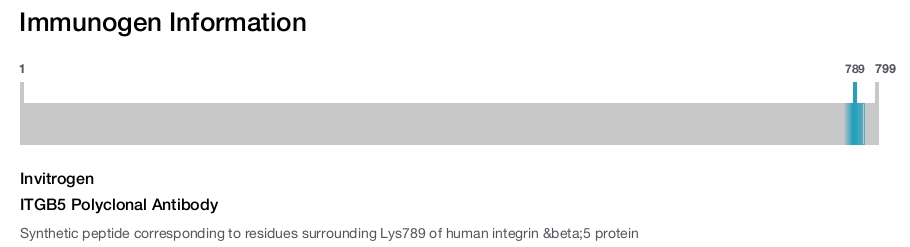
Synthetic peptide corresponding to residues surrounding Lys789 of human integrin β5 protein
偶联物
Unconjugated
Unconjugated
Unconjugated
形式
Liquid
浓度
60 µg/mL
规格
6 µg
纯化类型
Antigen affinity chromatography, Protein A
保存液
0.01M HEPES, pH 7.5, with 0.15M NaCl, 100µg/mL BSA, 50% glycerol
内含物
no preservative
保存条件
-20°C
运输条件
Ambient (domestic); Wet ice (international)
RRID
产品详细信息
It is not recommended to aliquot this antibody.
靶标信息
Integrins are important extracellular matrix (ECM) receptor proteins located on cell surfaces. They are hetrodimers composed of an alpha and a beta transmembrane glycoprotein subunit. Around 22 different integrins (different alpha/ beta subunit combinations) are found in nature. Integrins are generally present in high concentrations at the cell surface, but, unlike most other cell-surface receptors, they bind ligands with very low affinity. Due to their weak individual binding, integrins need to cluster and bind in-groups in order to effectively bind the ECM. Integrins bind many different ligands including laminin. Each integrin is made up of a large N-terminal extracellular domain that binds the ECM ligand and a small C-terminal cytoplasmic domain that mediates interaction with the actin cytoskeleton and signaling function.
仅用于科研。不用于诊断过程。未经明确授权不得转售。
篇参考文献 (0)
您是否在文献中引用过该产品?请点击下方按钮邮件告知我们。
生物信息学
蛋白别名: CD61; FLJ26658; GP3A; GPIIIa; integrin beta-5 subunit; integrin beta-5 subunit precursor; testis secretory sperm-binding protein Li 217p; unnamed protein product
UniProt ID: (Human) P18084
Entrez Gene ID: (Human) 3693
formation of primary germ layer
cell-matrix adhesion
transforming growth factor beta receptor signaling pathway
integrin-mediated signaling pathway
cell migration
cell adhesion mediated by integrin
wound healing, spreading of epidermal cells
endodermal cell differentiation
stress fiber assembly
epithelial cell-cell adhesion
cell-cell adhesion
Disclaimer

Clicking the images or links will redirect you to a website hosted by BenchSci that provides third-party scientific content. Neither the content nor the BenchSci technology and processes for selection have been evaluated by us; we are providing them as-is and without warranty of any kind, including for use or application of the Thermo Fisher Scientific products presented.

