Search
Invitrogen
Insulin Recombinant Rabbit Monoclonal Antibody (HL4457)
{{$productOrderCtrl.translations['antibody.pdp.commerceCard.promotion.promotions']}}
{{$productOrderCtrl.translations['antibody.pdp.commerceCard.promotion.promocode']}}: {{promo.promoCode}} {{promo.promoTitle}} {{promo.promoDescription}}. {{$productOrderCtrl.translations['antibody.pdp.commerceCard.promotion.learnmore']}}
{{$ctrl.translations['antibody.pdp.skuNotes.additionalInformation']}}:
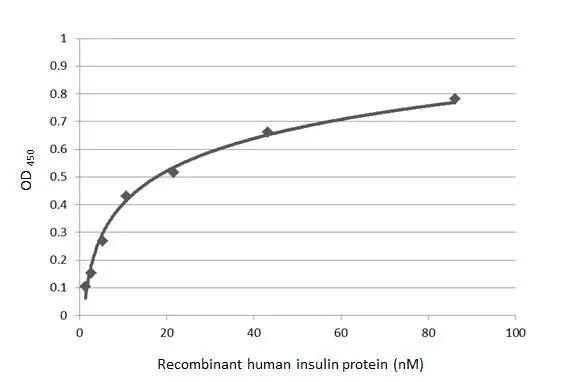
图: 1 / 1
Insulin Antibody (MA574112) in ELISA
ELISA analysis of Insulin was performed by coating the plate with recombinant E. coli expressed, human insulin protein (86.21-1.35 nM). Samples were incubated with Insulin Recombinant Monoclonal (Product # MA574112) at a concentration of 1 µg/mL and detected with Goat anti-rabbit IgG antibody (HRP).
Please note: We are reviewing Western blot images included in the antibody testing data in our catalog, including those provided by third parties. Unless expressly labeled or annotated as “raw-unedited”, Western blot images included in the antibody testing data in our catalog may have been edited, optimized or otherwise adjusted for presentation.

产品信息
MA574112
产品规格
种属反应
Human
宿主/亚型
Rabbit
/ IgG
Expression System
HEK293 cells
分类
Recombinant Monoclonal
类型
Antibody
克隆号
HL4457
抗原
Recombinant protein encompassing a sequence within the B chain region of human Insulin. The exact sequence is proprietary.
偶联物
Unconjugated
Unconjugated
Unconjugated
形式
Liquid
浓度
1 mg/mL
规格
100 µg
纯化类型
Protein A
保存液
PBS
内含物
no preservative
保存条件
Store at 4°C short term. For long term storage, store at -20°C, avoiding freeze/thaw cycles.
运输条件
Ambient (domestic); Wet ice (international)
靶标信息
Insulin is a peptide hormone secreted by beta cells of the pancreatic islets. It regulates carbohydrate, protein and lipid metabolism by enhancing membrane transport of glucose, amino acids, and certain ions. It also promotes glycogen storage, formation of triglycerides and synthesis of proteins and nucleic acids. Insulin is 51-amino acid polypeptide product produced from a precursor peptide, proinsulin. Proinsulin is post-translationally cleaved into two chains (peptide A and peptide B) that are covalently linked via two disulfide bonds and one molecule of C-peptide. Insulin deficiency results in diabetes mellitus, one of the leading causes of morbidity and mortality in the general population. Insulin is also present in tumors of b-cell origin such as insulinoma.
仅用于科研。不用于诊断过程。未经明确授权不得转售。
篇参考文献 (0)
您是否在文献中引用过该产品?请点击下方按钮邮件告知我们。
生物信息学
蛋白别名: Ins; INSU1; INSU2; INSU3B; INSUA; INSUB; INSUC; insulin splice variant; insulin variant; INS-splice; Insulin-1; preproinsulin; proinsulin
基因别名: IDDM; IDDM1; IDDM2; ILPR; IRDN; MODY10; PNDM4
UniProt ID: (Human) P01308
Entrez Gene ID: (Human) 3630
positive regulation of cytokine production
negative regulation of acute inflammatory response
regulation of transcription, DNA-templated
acute-phase response
G-protein coupled receptor signaling pathway
cell-cell signaling
positive regulation of cell proliferation
insulin receptor signaling pathway
positive regulation of gene expression
negative regulation of gene expression
positive regulation of neuron projection development
positive regulation of cell growth
positive regulation of cell migration
regulation of protein localization
nitric oxide-cGMP-mediated signaling pathway
wound healing
negative regulation of protein catabolic process
vasodilation
glucose homeostasis
positive regulation of I-kappaB kinase/NF-kappaB signaling
positive regulation of MAPK cascade
positive regulation of cell differentiation
negative regulation of gluconeogenesis
positive regulation of glycogen biosynthetic process
negative regulation of glycogen catabolic process
positive regulation of glycolytic process
positive regulation of mitotic nuclear division
negative regulation of fatty acid metabolic process
positive regulation of glucose import
positive regulation of insulin receptor signaling pathway
alpha-beta T cell activation
positive regulation of lipid biosynthetic process
regulation of synaptic plasticity
regulation of protein secretion
negative regulation of protein secretion
positive regulation of protein secretion
cognition
negative regulation of lipid catabolic process
positive regulation of nitric-oxide synthase activity
positive regulation of protein kinase B signaling
fatty acid homeostasis
relaxation of vascular smooth muscle
negative regulation of respiratory burst involved in inflammatory response
positive regulation of respiratory burst
positive regulation of peptide hormone secretion
positive regulation of brown fat cell differentiation
positive regulation of protein localization to nucleus
positive regulation of long-term synaptic potentiation
cellular response to oxygen-containing compound
negative regulation of oxidative stress-induced intrinsic apoptotic signaling pathway
positive regulation of dendritic spine maintenance
regulation of protein localization to plasma membrane
negative regulation of reactive oxygen species biosynthetic process
neuron projection maintenance
negative regulation of feeding behavior
Disclaimer

Clicking the images or links will redirect you to a website hosted by BenchSci that provides third-party scientific content. Neither the content nor the BenchSci technology and processes for selection have been evaluated by us; we are providing them as-is and without warranty of any kind, including for use or application of the Thermo Fisher Scientific products presented.

