Search
Alomone Labs, LTD
KCNK3 (TASK-1) Polyclonal Antibody
{{$productOrderCtrl.translations['antibody.pdp.commerceCard.promotion.promotions']}}
{{$productOrderCtrl.translations['antibody.pdp.commerceCard.promotion.promocode']}}: {{promo.promoCode}} {{promo.promoTitle}} {{promo.promoDescription}}. {{$productOrderCtrl.translations['antibody.pdp.commerceCard.promotion.learnmore']}}
{{$ctrl.translations['antibody.pdp.skuNotes.additionalInformation']}}:
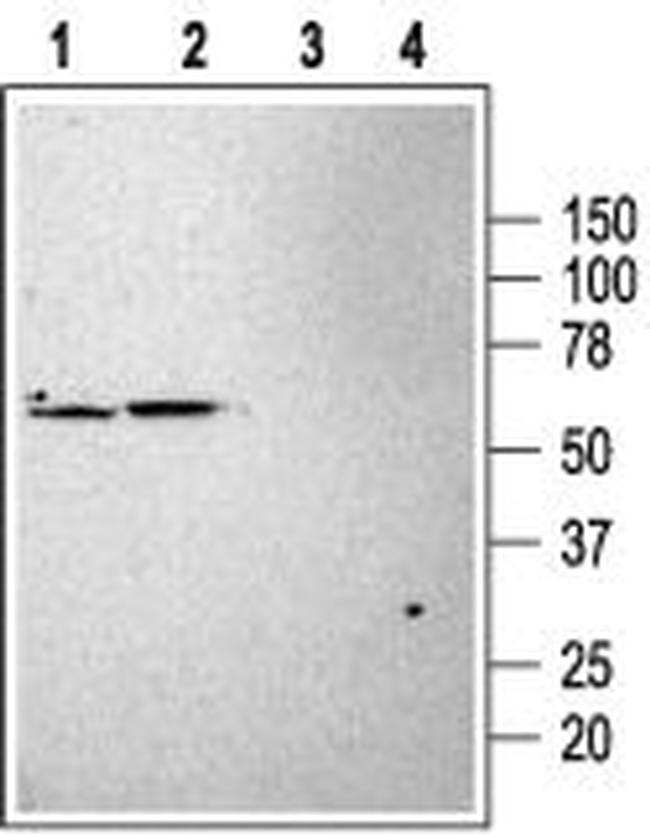
Please note: We are reviewing Western blot images included in the antibody testing data in our catalog, including those provided by third parties. Unless expressly labeled or annotated as “raw-unedited”, Western blot images included in the antibody testing data in our catalog may have been edited, optimized or otherwise adjusted for presentation.

产品信息
APC-024-200UL
产品规格
种属反应
Human,
Rat
宿主/亚型
Rabbit
/ IgG
分类
Polyclonal
类型
Antibody
抗原
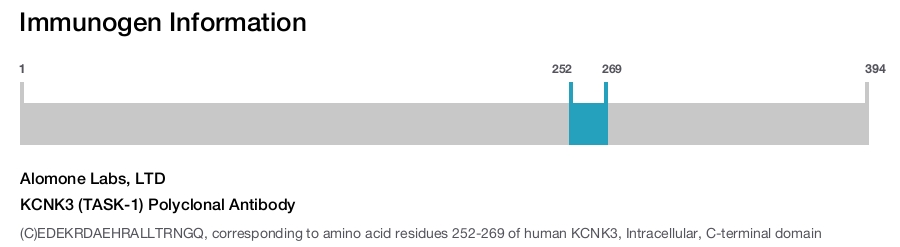
(C)EDEKRDAEHRALLTRNGQ, corresponding to amino acid residues 252-269 of human KCNK3, Intracellular, C-terminal domain
偶联物
Unconjugated
Unconjugated
Unconjugated
形式
Lyophilized
浓度
0.8 mg/mL once reconstituted
规格
160 µg
纯化类型
Antigen affinity chromatography
保存液
PBS, pH 7.4, with 1% BSA, 5% sucrose
内含物
0.025% sodium azide
保存条件
-20°C, Avoid Freeze/Thaw Cycles
运输条件
Ambient (domestic); Wet ice (international)
产品详细信息
Reconstitution: 25 µL, 50 µL or 0.2 mL double distilled water (DDW), depending on the sample size. The antibody ships as a lyophilized powder at room temperature. Upon arrival, it should be stored at -20C. The reconstituted solution can be stored at 4C for up to 1 week. For longer periods, small aliquots should be stored at -20C. Avoid multiple freezing and thawing. Centrifuge all antibody preparations before use (10000 x g 5 min).
靶标信息
KCNK3 encodes one of the members of the superfamily of potassium channel proteins containing two pore-forming P domains. The gene product is an outwardly rectifying channel that is sensitive to changes in extracellular pH and is inhibited by extracellular acidification. Also referred to as an acid-sensitive potassium channel, it is activated by the anesthetics halothane and isoflurane. Although three transcripts are detected in northern blots, there is currently no sequence available to confirm transcript variants for this gene.
仅用于科研。不用于诊断过程。未经明确授权不得转售。
篇参考文献 (0)
您是否在文献中引用过该产品?请点击下方按钮邮件告知我们。
生物信息学
蛋白别名: acid-sensitive potassium channel protein TASK; acid-sensitive potassium channel protein TASK-1; cardiac potassium channel; cTBAK 1; potassium channel, subfamily K, member 3; potassium channel, two pore domain subfamily K, member 3; potassium inwardly-rectifying channel, subfamily K, member 3; TASK 1; TWIK-related acid-sensitive K(+) channel 1; TWIK-related acid-sensitive K+ 1; TWIK-related acid-sensitive K+ channel; two P domain potassium channel; two P domain potassium channel; cardiac potassium channel; KCNK3; two pore K(+) channel KT3.1; two pore potassium channel KT3.1
基因别名: DDSA; K2p3.1; OAT1; PPH4; rTASK; TASK; TASK-1; TASK1; TBAK1
UniProt ID: (Human) O14649, (Rat) O54912
Entrez Gene ID: (Human) 3777, (Rat) 29553
detection of hypoxic conditions in blood by carotid body chemoreceptor signaling
potassium ion transport
response to xenobiotic stimulus
ion transmembrane transport
sodium ion transmembrane transport
negative regulation of cytosolic calcium ion concentration
regulation of resting membrane potential
cellular response to zinc ion
cellular response to hypoxia
cellular response to acidic pH
potassium ion transmembrane transport
cochlea development
regulation of action potential firing rate
positive regulation of voltage-gated potassium channel activity
chemical synaptic transmission
Disclaimer

Clicking the images or links will redirect you to a website hosted by BenchSci that provides third-party scientific content. Neither the content nor the BenchSci technology and processes for selection have been evaluated by us; we are providing them as-is and without warranty of any kind, including for use or application of the Thermo Fisher Scientific products presented.

