Search
Invitrogen
KCNT1 Polyclonal Antibody
{{$productOrderCtrl.translations['antibody.pdp.commerceCard.promotion.promotions']}}
{{$productOrderCtrl.translations['antibody.pdp.commerceCard.promotion.promocode']}}: {{promo.promoCode}} {{promo.promoTitle}} {{promo.promoDescription}}. {{$productOrderCtrl.translations['antibody.pdp.commerceCard.promotion.learnmore']}}
{{$ctrl.translations['antibody.pdp.skuNotes.additionalInformation']}}:
产品信息
PA5-69615
产品规格
种属反应
Mouse
宿主/亚型
Rabbit
/ IgG
分类
Polyclonal
类型
Antibody
抗原
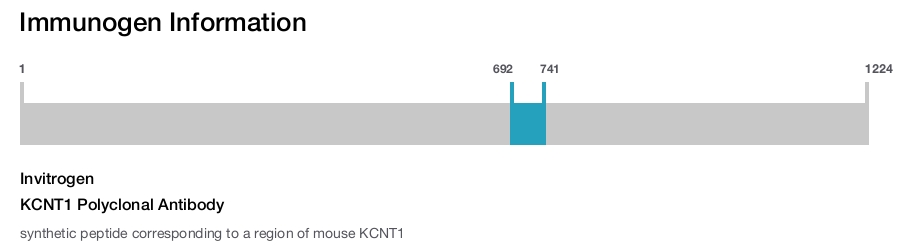
synthetic peptide corresponding to a region of mouse KCNT1
偶联物
Unconjugated
Unconjugated
Unconjugated
形式
Liquid
浓度
0.5 mg/mL
规格
50 µg
纯化类型
Affinity chromatography
保存液
PBS with 2% sucrose
内含物
0.09% sodium azide
保存条件
-20°C, Avoid Freeze/Thaw Cycles
运输条件
Ambient (domestic); Wet ice (international)
RRID
产品详细信息
This target displays homology in the following species: Cow: 86%; Dog: 93%; Guinea Pig: 79%; Horse: 93%; Human: 100%; Mouse: 100%; Rabbit: 79%; Rat: 100%
靶标信息
Potassium channels represent the most complex class of voltage-gated ion channels from both functional and structural standpoints. Their diverse functions include regulating neurotransmitter release, heart rate, insulin secretion, neuronal excitability, epithelial electrolyte transport, smooth muscle contraction, and cell volume. This gene encodes a sodium-activated potassium channel subunit which is thought to function in ion conductance and developmental signaling pathways. Mutations in this gene cause the early-onset epileptic disorders, malignant migrating partial seizures of infancy and autosomal dominant nocturnal frontal lobe epilepsy. Alternative splicing results in multiple transcript variants.
仅用于科研。不用于诊断过程。未经明确授权不得转售。
篇参考文献 (0)
您是否在文献中引用过该产品?请点击下方按钮邮件告知我们。
生物信息学
蛋白别名: KCa4.1KIAA1422FLJ41282; potassium channel subunit homolog; Slo2.2; sodium-activated potassium channel; unnamed protein product
基因别名: C030030G16Rik; Slack; slo2; Slo2.2
UniProt ID: (Mouse) Q6ZPR4
Entrez Gene ID: (Mouse) 227632
Disclaimer

Clicking the images or links will redirect you to a website hosted by BenchSci that provides third-party scientific content. Neither the content nor the BenchSci technology and processes for selection have been evaluated by us; we are providing them as-is and without warranty of any kind, including for use or application of the Thermo Fisher Scientific products presented.

