Search
Invitrogen
KIF2A Polyclonal Antibody
{{$productOrderCtrl.translations['antibody.pdp.commerceCard.promotion.promotions']}}
{{$productOrderCtrl.translations['antibody.pdp.commerceCard.promotion.promocode']}}: {{promo.promoCode}} {{promo.promoTitle}} {{promo.promoDescription}}. {{$productOrderCtrl.translations['antibody.pdp.commerceCard.promotion.learnmore']}}
{{$ctrl.translations['antibody.pdp.skuNotes.additionalInformation']}}:
Please note: We are reviewing Western blot images included in the antibody testing data in our catalog, including those provided by third parties. Unless expressly labeled or annotated as “raw-unedited”, Western blot images included in the antibody testing data in our catalog may have been edited, optimized or otherwise adjusted for presentation.

产品信息
PA1-640
应用
建议稀释比
已发表文章
产品规格
种属反应
Mouse
宿主/亚型
Rabbit
/ IgG
分类
Polyclonal
类型
Antibody
抗原
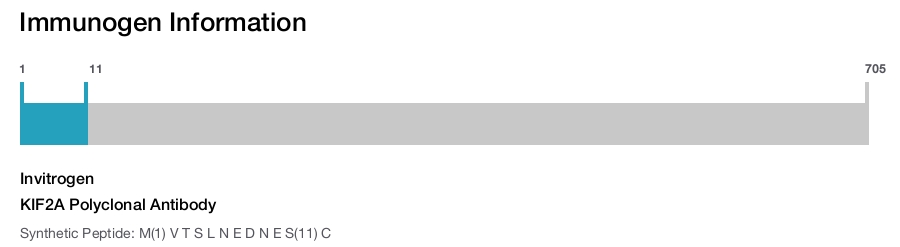
Synthetic Peptide: M(1) V T S L N E D N E S(11) C
偶联物
Unconjugated
Unconjugated
Unconjugated
形式
Liquid
浓度
1 mg/mL
规格
200 µg
纯化类型
Antigen affinity chromatography
保存液
PBS with 1mg/mL BSA
内含物
0.05% sodium azide
保存条件
-20°C, Avoid Freeze/Thaw Cycles
运输条件
Ambient (domestic); Wet ice (international)
RRID
产品详细信息
PA1-640 detects kinesin 2 (KIF2) from mouse tissues.
PA1-640 has been successfully used in Western blot procedures. By Western blot, this antibody detects an ~95 kDa protein representing KIF2 from mouse brain homogenate.
PA1-640 immunizing peptide corresonds to amino acid residues 1-11 from mouse KIF2. This sequence is completely conserved in human KIF2. PA1-640 immunizing peptide (Cat. # PEP-040) is available for use in neutralization and control experiments.
靶标信息
KIF2A, a gene encoding the kinesin family member 2A protein, plays a pivotal role in neuronal development and function. This gene is part of the kinesin-13 subfamily, characterized by its unique ability to depolymerize microtubules, which are essential components of the cytoskeleton responsible for maintaining cell shape, enabling motility, and facilitating intracellular transport. KIF2A is particularly significant in neural settings, where it regulates microtubule dynamics crucial for neuronal migration and dendritic development. Dysfunctional KIF2A, due to mutations, has been linked to early-onset neurodegenerative diseases such as progressive microcephaly and mental disabilities due to impaired microtubule regulation, reflecting its foundational role in correct brain development and architecture. Additionally, KIF2A is involved in spindle assembly and chromosome segregation during cell division, further cementing its importance in both neurodevelopment and general cellular functions.
仅用于科研。不用于诊断过程。未经明确授权不得转售。
生物信息学
蛋白别名: kinesin heavy chain member 2; kinesin-2; unnamed protein product
基因别名: C530030B14Rik; Kif2; Kns2; M-kinesin
UniProt ID: (Mouse) P28740
Entrez Gene ID: (Mouse) 16563
Disclaimer

Clicking the images or links will redirect you to a website hosted by BenchSci that provides third-party scientific content. Neither the content nor the BenchSci technology and processes for selection have been evaluated by us; we are providing them as-is and without warranty of any kind, including for use or application of the Thermo Fisher Scientific products presented.

