Search
Abnova
KRT16 Polyclonal Antibody, MaxPab™
{{$productOrderCtrl.translations['antibody.pdp.commerceCard.promotion.promotions']}}
{{$productOrderCtrl.translations['antibody.pdp.commerceCard.promotion.promocode']}}: {{promo.promoCode}} {{promo.promoTitle}} {{promo.promoDescription}}. {{$productOrderCtrl.translations['antibody.pdp.commerceCard.promotion.learnmore']}}
{{$ctrl.translations['antibody.pdp.skuNotes.additionalInformation']}}:
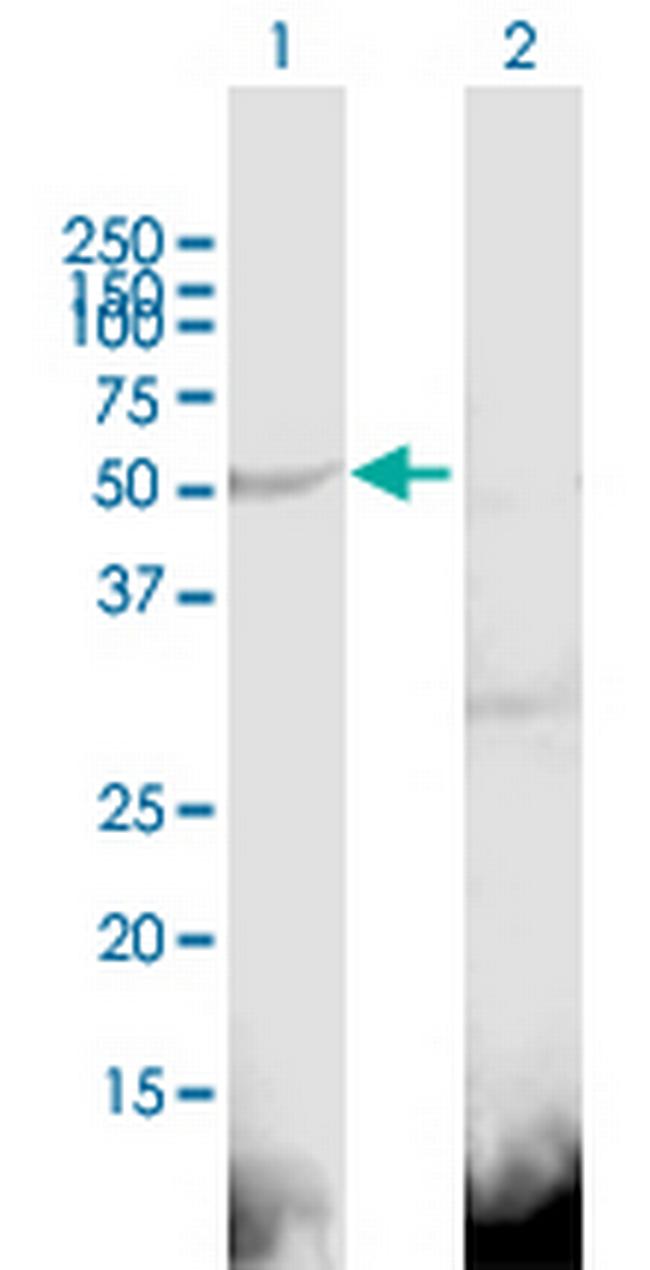
Please note: We are reviewing Western blot images included in the antibody testing data in our catalog, including those provided by third parties. Unless expressly labeled or annotated as “raw-unedited”, Western blot images included in the antibody testing data in our catalog may have been edited, optimized or otherwise adjusted for presentation.

产品信息
H00003868-B01P
产品规格
种属反应
Human
宿主/亚型
Mouse
/ IgG
分类
Polyclonal
类型
Antibody
抗原
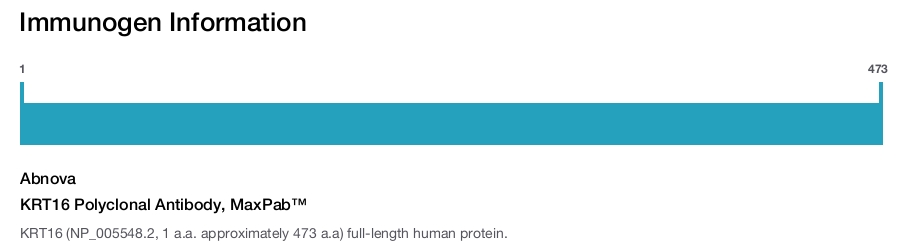
KRT16 (NP_005548.2, 1 a.a. approximately 473 a.a) full-length human protein.
偶联物
Unconjugated
Unconjugated
Unconjugated
形式
Liquid
浓度
0.5-1 mg/mL
规格
50 µg
纯化类型
Protein A
保存液
PBS, pH 7.4
内含物
no preservative
保存条件
-20°C, Avoid Freeze/Thaw Cycles
运输条件
Ambient (domestic); Wet ice (international)
产品详细信息
Product may be used with Western Blot (Transfected lysate).
The Isotype of this product is composed of an IgG Mixture.
Immunogen sequence: MTTCSRQFTS SSSMKGSCGI GGGIGGGSSR ISSVLAGGSC RAPSTYGGGL SVSSRFSSGG ACGLGGGYGG GFSSSSSFGS GFGGGYGGGL GAGFGGGLGA GFGGGFAGGD GLLVGSEKVT MQNLNDRLAS YLDKVRALEE ANADLEVKIR DWYQRQRPSE IKDYSPYFKT IEDLRNKIIA ATIENAQPIL QIDNARLAAD DFRTKYEHEL ALRQTVEADV NGLRRVLDEL TLARTDLEMQ IEGLKEELAY LRKNHEEEML ALRGQTGGDV NVEMDAAPGV DLSRILNEMR DQYEQMAEKN RRDAETWFLS KTEELNKEVA SNSELVQSSR SEVTELRRVL QGLEIELQSQ LSMKASLENS LEETKGRYCM QLSQIQGLIG SVEEQLAQLR CEMEQQSQEY QILLDVKTRL EQEIATYRRL LEGEDAHLSS QQASGQSYSS REVFTSSSSS SSRQTRPILK EQSSSSFSQG QSS
靶标信息
KRT16 is a member of the keratin gene family. The keratins are intermediate filament proteins responsible for the structural integrity of epithelial cells and are subdivided into cytokeratins and hair keratins. Most of the type I cytokeratins consist of acidic proteins which are arranged in pairs of heterotypic keratin chains and are clustered in a region of chromosome 17q12-q21. This keratin has been coexpressed with keratin 14 in a number of epithelial tissues, including esophagus, tongue, and hair follicles. Mutations in this gene are associated with type 1 pachyonychia congenita, non-epidermolytic palmoplantar keratoderma and unilateral palmoplantar verrucous nevus.
仅用于科研。不用于诊断过程。未经明确授权不得转售。
篇参考文献 (0)
您是否在文献中引用过该产品?请点击下方按钮邮件告知我们。
生物信息学
蛋白别名: cytokeratin 16; focal non-epidermolytic palmoplantar keratoderma; intermediate filament protein K16; keratin 16 homolog; keratin 16, type I; unnamed protein product
基因别名: CK16; FNEPPK; K16; K1CP; KRT16A; NEPPK; PC1
UniProt ID: (Human) P08779
Entrez Gene ID: (Human) 3868
Disclaimer

Clicking the images or links will redirect you to a website hosted by BenchSci that provides third-party scientific content. Neither the content nor the BenchSci technology and processes for selection have been evaluated by us; we are providing them as-is and without warranty of any kind, including for use or application of the Thermo Fisher Scientific products presented.

