Search
Invitrogen
Kallikrein 11 (Cleaved Ile54) Polyclonal Antibody
{{$productOrderCtrl.translations['antibody.pdp.commerceCard.promotion.promotions']}}
{{$productOrderCtrl.translations['antibody.pdp.commerceCard.promotion.promocode']}}: {{promo.promoCode}} {{promo.promoTitle}} {{promo.promoDescription}}. {{$productOrderCtrl.translations['antibody.pdp.commerceCard.promotion.learnmore']}}
{{$ctrl.translations['antibody.pdp.skuNotes.additionalInformation']}}:
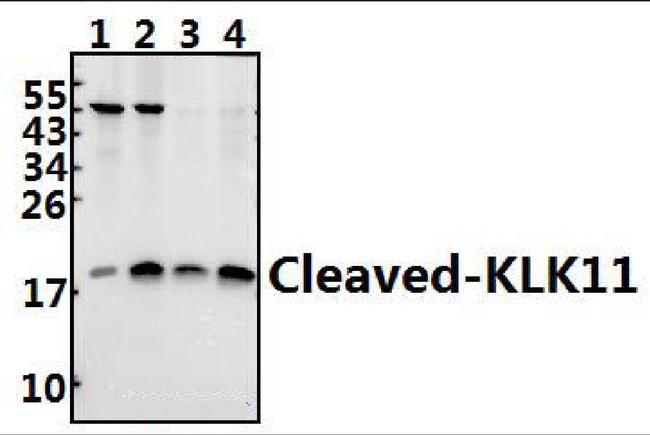
图: 1 / 1
Kallikrein 11 (Cleaved Ile54) Antibody (PA5-37436) in WB
Western blot analysis of Kallikrein 11 (Cleaved Ile54) in Lane 1: C6 whole cell lysate (40 µg), Lane 2: BV2 whole cell lysate (40 µg), Lane 3: U-87MG whole cell lysate (40 µg), Lane 4: A2780 whole cell lysate (40 µg). Samples were incubated with Kallikrein 11 (Cleaved Ile54) polyclonal antibody (Product # PA5-37436) at a dilution of 1:500.
Please note: We are reviewing Western blot images included in the antibody testing data in our catalog, including those provided by third parties. Unless expressly labeled or annotated as “raw-unedited”, Western blot images included in the antibody testing data in our catalog may have been edited, optimized or otherwise adjusted for presentation.

产品信息
PA5-37436
产品规格
种属反应
Human,
Mouse,
Rat
宿主/亚型
Rabbit
/ IgG
分类
Polyclonal
类型
Antibody
抗原
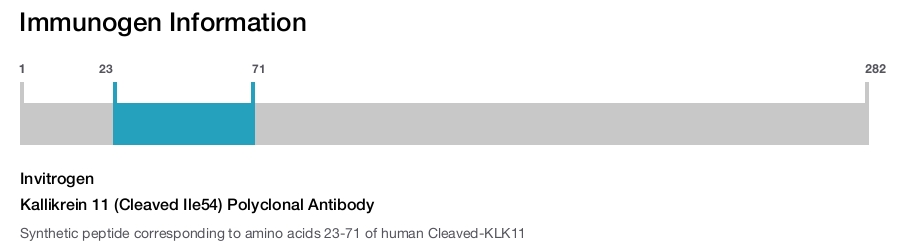
Synthetic peptide corresponding to amino acids 23-71 of human Cleaved-KLK11
偶联物
Unconjugated
Unconjugated
Unconjugated
形式
Liquid
浓度
1 mg/mL
规格
100 µg
纯化类型
Antigen affinity chromatography
保存液
PBS, pH 7.2, with 50% glycerol
内含物
0.02% sodium azide
保存条件
Store at 4°C short term. For long term storage, store at -20°C, avoiding freeze/thaw cycles.
运输条件
Ambient (domestic); Wet ice (international)
RRID
产品详细信息
This antibody detects endogenous protein at a molecular weight of 25 and 31 kDa.
Purity is >95% by SDS-PAGE.
靶标信息
Kallikreins (KLKs) belong to the serine protease family of proteolytic enzymes. Human pancreatic/renal KLK encodes for the KLK1 enzyme, which is involved in post-translational processing of polypeptide precursors. The function of the other members of KLK gene family is currently unknown, but evidence suggests that many KLKs are implicated in carcinogenesis. The human KLK gene family consists of 15 serine proteases. The human KLK genes are clustered on chromosome 19q13. Unlike other kalllikreins, the KLK4-15 encoded proteases are less related and do not contain a conventional KLK loop. Clusters of genes exhibit high prostatic (KLK2-4, KLK15) or pancreatic (KLK6-13) expression . KLK2 is also known as glandular kallikrein 2, tissue kallikrein or HGK-1, and KLK3 is known as prostate-specific antigen (PSA). Both KLK2 and KLK3 have important applications in prostate cancer and breast cancer diagnostics. KLK4, KLK5, KLK9, KLK13, KLK12 and KLK14 have been previously known as KLK-L1, KLK-L2, KLK-L3, KLK-L4, KLK-L5 and KLK-L6, respectively.
仅用于科研。不用于诊断过程。未经明确授权不得转售。
篇参考文献 (0)
您是否在文献中引用过该产品?请点击下方按钮邮件告知我们。
生物信息学
蛋白别名: hippostasin; hK11; kallikrein 11; kallikrein g; kallikrein-11 isoform 4; Kallikrein11; serine protease 20; trypsin-like protease; unnamed protein product
基因别名: 2310015I08Rik; IEKD; Klng; PRSS20; TLSP
UniProt ID: (Human) Q9UBX7, (Mouse) Q9QYN3
Entrez Gene ID: (Human) 11012, (Mouse) 56538, (Rat) 292849
Disclaimer

Clicking the images or links will redirect you to a website hosted by BenchSci that provides third-party scientific content. Neither the content nor the BenchSci technology and processes for selection have been evaluated by us; we are providing them as-is and without warranty of any kind, including for use or application of the Thermo Fisher Scientific products presented.

