Search
Agrisera
Kelch repeat protein Polyclonal Antibody
{{$productOrderCtrl.translations['antibody.pdp.commerceCard.promotion.promotions']}}
{{$productOrderCtrl.translations['antibody.pdp.commerceCard.promotion.viewpromo']}}
{{$productOrderCtrl.translations['antibody.pdp.commerceCard.promotion.promocode']}}: {{promo.promoCode}} {{promo.promoTitle}} {{promo.promoDescription}}. {{$productOrderCtrl.translations['antibody.pdp.commerceCard.promotion.learnmore']}}
Additional Information:
{{banner.description}}
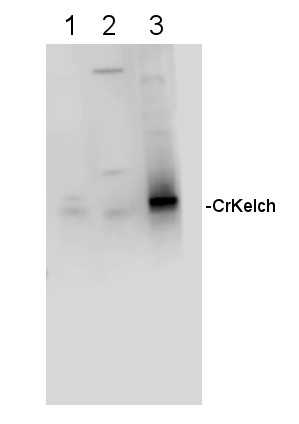
图: 1 / 1
Kelch repeat protein Antibody (AS14-2761) in WB
Total protein from Chlamydomonas reinhardtii (1), Gonium Pectorale (2), Eudorina elegans (3) was extracted using 1 x LaemmLi buffer + DTT + protease and phosphatase inhibitors without bromophenol blue heated at 95 ° C for ten minutes then vortexed with zirconia beads at max speed for ten minutes. Lysate was spun at 4 ° C for ten minutes at max speed in a tabletop centrifuge. Proteins were precipitated out o... View More

产品信息
AS14-2761
产品规格
种属反应
Algae
宿主/亚型
Rabbit
分类
Polyclonal
类型
Antibody
抗原
Recombinant Cr-Klech.
偶联物
形式
Lyophilized
保存液
whole serum
内含物
no preservative
保存条件
-20°C, Avoid Freeze/Thaw Cycles
运输条件
Ambient (domestic); Wet ice (international)
产品详细信息
Store lyophilized/reconstituted at -20°C; once reconstituted make aliquots to avoid repeated freeze-thaw cycles. Please remember to spin the tubes briefly prior to opening them to avoid any losses that might occur from material adhering to the cap or sides of the tube.
For reconstitution add 50 µL of sterile water.
Specific Species Reactivity: Chlamydomonas reinhardtii (strain 21grm cw15, M10), Gonium pectorale, Eudorina elegans
靶标信息
Kelch repeat proteins of the KLHL family are intracellular, predominantly cytoplasmic adaptors that concentrate on specific subcellular structures such as the actin cytoskeleton and, for some members, early secretory pathway membranes (endoplasmic reticulum exit sites/COPII assemblies). Structurally, they are modular proteins built around an N-terminal BTB/POZ domain (supporting homodimerization and Cullin 3 engagement), a central BACK domain that contributes to Cullin 3 complex assembly, and a C-terminal Kelch-repeat beta-propeller that provides the principal substrate-recognition interface. Functionally, KLHL proteins act as substrate receptors for Cullin 3-RING E3 ubiquitin ligases (CRL3), thereby specifying ubiquitination (often degradative, but also regulatory mono-ubiquitination) of selected client proteins to control protein turnover and pathway output; for example, KLHL12 recruits SEC31 for mono-ubiquitination to promote formation of enlarged COPII coats required for efficient export of bulky procollagen and collagen secretion, linking kelch-repeat adaptors to extracellular matrix biogenesis and secretory capacity, while other kelch-repeat adaptors couple cytoskeletal organization to ubiquitin-dependent remodeling programs.
仅用于科研。不用于诊断过程。未经明确授权不得转售。
篇参考文献 (0)
您是否在文献中引用过该产品?请点击下方按钮邮件告知我们。
生物信息学
蛋白别名: F6E13.26; KISS ME DEADLY 3; KMD3
Disclaimer

Clicking the images or links will redirect you to a website hosted by BenchSci that provides third-party scientific content. Neither the content nor the BenchSci technology and processes for selection have been evaluated by us; we are providing them as-is and without warranty of any kind, including for use or application of the Thermo Fisher Scientific products presented.

