Search
Invitrogen
Ketoprofen Recombinant Mouse Monoclonal Antibody (3C6)
{{$productOrderCtrl.translations['antibody.pdp.commerceCard.promotion.promotions']}}
{{$productOrderCtrl.translations['antibody.pdp.commerceCard.promotion.promocode']}}: {{promo.promoCode}} {{promo.promoTitle}} {{promo.promoDescription}}. {{$productOrderCtrl.translations['antibody.pdp.commerceCard.promotion.learnmore']}}
{{$ctrl.translations['antibody.pdp.skuNotes.additionalInformation']}}:
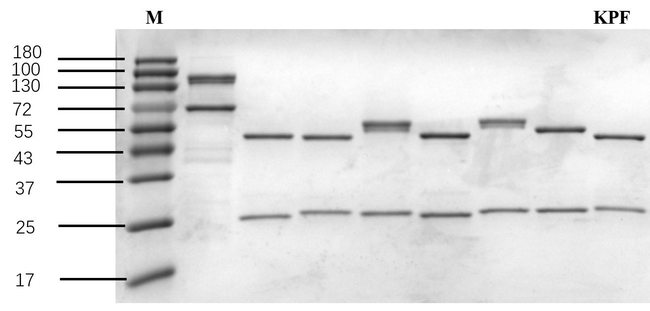
图: 1 / 1
Ketoprofen Antibody (MA566441) in SDS-PAGE
SDS-PAGE characterization of Ketoprofen under reducing conditions. Lane M: Protein marker (kDa); Lane KPF: Purified Ketoprofen Recombinant Monoclonal (Product # MA566441). Ketoprofen showing heavy chain (~50 kDa) and light chain (~25 kDa). Gels were stained with Coomassie Brilliant Blue R-679.
Please note: We are reviewing Western blot images included in the antibody testing data in our catalog, including those provided by third parties. Unless expressly labeled or annotated as “raw-unedited”, Western blot images included in the antibody testing data in our catalog may have been edited, optimized or otherwise adjusted for presentation.

产品信息
MA566441
产品规格
种属反应
Chemical
宿主/亚型
Mouse
/ IgG
Expression System
CHO cells
分类
Recombinant Monoclonal
类型
Antibody
克隆号
3C6
抗原
Conjugate of KPF hapten and KLH.
偶联物
Unconjugated
Unconjugated
Unconjugated
形式
Liquid
浓度
9.3 mg/mL
规格
200 µg
纯化类型
Protein G
保存液
PBS
内含物
0.09% sodium azide
保存条件
-20°C
运输条件
Ambient (domestic); Wet ice (international)
RRID
靶标信息
Ketoprofen is only found in individuals that have used or taken this drug. It is a propionic acid derivative and is a nonsteroidal anti-inflammatory agent (NSAIA) with analgesic and antipyretic properties. The anti-inflammatory effects of ketoprofen are believed to be due to inhibition cylooxygenase-2 (COX-2), an enzyme involved in prostaglandin synthesis via the arachidonic acid pathway. This results in decreased levels of prostaglandins that mediate pain, fever and inflammation. Ketoprofen is a non-specific cyclooxygenase inhibitor and inhibition of COX-1 is thought to confer some of its side effects, such as GI upset and ulceration. Ketoprofen is thought to have anti-bradykinin activity, as well as lysosomal membrane-stabilizing action. Antipyretic effects may be due to action on the hypothalamus, resulting in an increased peripheral blood flow, vasodilation, and subsequent heat dissipation. [National Center for Biotechnology Information. PubChem Compound Database; CID=3825].
仅用于科研。不用于诊断过程。未经明确授权不得转售。
篇参考文献 (0)
您是否在文献中引用过该产品?请点击下方按钮邮件告知我们。
生物信息学
蛋白别名: C16H14O3
Disclaimer

Clicking the images or links will redirect you to a website hosted by BenchSci that provides third-party scientific content. Neither the content nor the BenchSci technology and processes for selection have been evaluated by us; we are providing them as-is and without warranty of any kind, including for use or application of the Thermo Fisher Scientific products presented.

