Search
Antibodies Inc
Kir6.1 Potassium Channel Monoclonal Antibody (N366/60)
{{$productOrderCtrl.translations['antibody.pdp.commerceCard.promotion.promotions']}}
{{$productOrderCtrl.translations['antibody.pdp.commerceCard.promotion.promocode']}}: {{promo.promoCode}} {{promo.promoTitle}} {{promo.promoDescription}}. {{$productOrderCtrl.translations['antibody.pdp.commerceCard.promotion.learnmore']}}
{{$ctrl.translations['antibody.pdp.skuNotes.additionalInformation']}}:
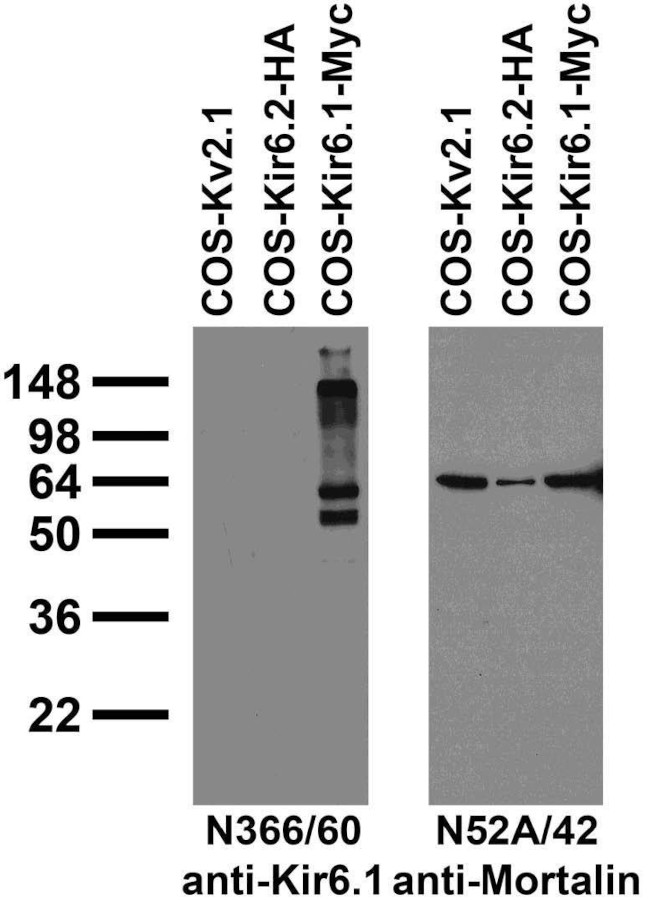

Please note: We are reviewing Western blot images included in the antibody testing data in our catalog, including those provided by third parties. Unless expressly labeled or annotated as “raw-unedited”, Western blot images included in the antibody testing data in our catalog may have been edited, optimized or otherwise adjusted for presentation.


产品信息
75-394
应用
建议稀释比
已发表文章
产品规格
种属反应
Mouse,
Rat
宿主/亚型
Mouse
/ IgG2a
分类
Monoclonal
类型
Antibody
克隆号
N366/60
抗原
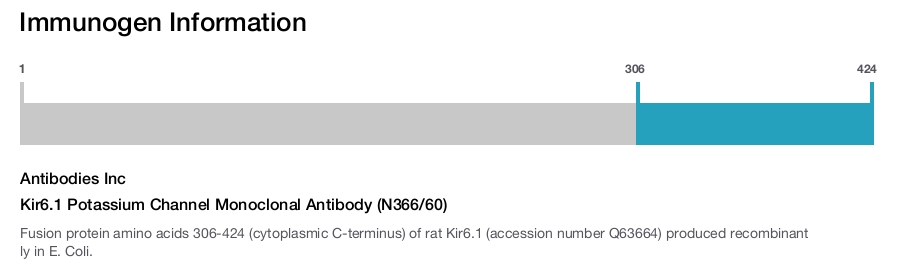
Fusion protein amino acids 306-424 (cytoplasmic C-terminus) of rat Kir6.1 (accession number Q63664) produced recombinantly in E. Coli.
偶联物
Unconjugated
Unconjugated
Unconjugated
形式
Liquid
浓度
1 mg/mL
规格
100 µg
纯化类型
Protein A
保存液
TBS, pH 7.4
内含物
0.065% sodium azide
保存条件
Store at 4°C short term. For long term storage, store at -20°C, avoiding freeze/thaw cycles.
运输条件
Ambient (domestic); Dry ice (international)
产品详细信息
For maximum recovery of product, centrifuge the vial prior to removing the cap.
靶标信息
Potassium channels are present in most mammalian cells, where they participate in a wide range of physiologic responses. KCNJ8 is an integral membrane protein and inward-rectifier type potassium channel. KCNJ8, which has a greater tendency to allow potassium to flow into a cell rather than out of a cell, is controlled by G-proteins.Potassium channels are present in most mammalian cells, where they participate in a wide range of physiologic responses. The protein encoded by this gene is an integral membrane protein and inward-rectifier type potassium channel. The encoded protein, which has a greater tendency to allow potassium to flow into a cell rather than out of a cell, is controlled by G-proteins.
仅用于科研。不用于诊断过程。未经明确授权不得转售。
篇参考文献 (0)
您是否在文献中引用过该产品?请点击下方按钮邮件告知我们。
生物信息学
蛋白别名: inward rectifier K(+) channel Kir6.1; inwardly rectifier K(+) channel Kir6.1; Inwardly rectifying potassium channel gene, subfamily J-8 (ATP sensitive); Kir6; potassium channel, inwardly rectifying subfamily J member 8; potassium voltage-gated channel subfamily J member 8; unnamed protein product
基因别名: gnite; Kir6.1; slmbr; sltr; uKATP-1; UKATP1
UniProt ID: (Mouse) P97794, (Rat) Q63664
Entrez Gene ID: (Mouse) 16523, (Rat) 25472
inward rectifier potassium channel activity
protein binding
ATP binding
ATP-activated inward rectifier potassium channel activity
sulfonylurea receptor binding
cation-transporting ATPase activity
voltage-gated monoatomic ion channel activity involved in regulation of presynaptic membrane potential
voltage-gated potassium channel activity involved in ventricular cardiac muscle cell action potential repolarization
action potential
blood vessel development
response to hypoxia
microglial cell activation
kidney development
vasculature development
regulation of heart rate
adaptive immune response
response to ischemia
heart morphogenesis
ventricular cardiac muscle tissue development
potassium ion transport
apoptotic process
response to stress
inflammatory response
heart development
regulation of blood pressure
cell proliferation
determination of adult lifespan
protein secretion
response to xenobiotic stimulus
phloem or xylem histogenesis
gene expression
fatty acid transport
transmission of nerve impulse
establishment of cell polarity
response to lipopolysaccharide
response to insulin
response to ATP
response to cytokine
response to endoplasmic reticulum stress
p38MAPK cascade
vasodilation
response to exogenous dsRNA
NLRP3 inflammasome complex assembly
fat cell differentiation
fibroblast proliferation
neurological system process
neuromuscular process
synaptic growth at neuromuscular junction
neuron apoptotic process
defense response to virus
transmembrane transport
cardiac pacemaker cell differentiation
atrioventricular node cell differentiation
coronary vasculature development
glutamate secretion, neurotransmission
CAMKK-AMPK signaling cascade
calcium ion transmembrane transport
potassium ion transmembrane transport
circulatory system development
membrane repolarization during ventricular cardiac muscle cell action potential
regulation of presynaptic membrane potential
reactive gliosis
response to resveratrol
potassium ion import across plasma membrane
Disclaimer

Clicking the images or links will redirect you to a website hosted by BenchSci that provides third-party scientific content. Neither the content nor the BenchSci technology and processes for selection have been evaluated by us; we are providing them as-is and without warranty of any kind, including for use or application of the Thermo Fisher Scientific products presented.

