Search
Invitrogen
LDL receptor Polyclonal Antibody
{{$productOrderCtrl.translations['antibody.pdp.commerceCard.promotion.promotions']}}
{{$productOrderCtrl.translations['antibody.pdp.commerceCard.promotion.promocode']}}: {{promo.promoCode}} {{promo.promoTitle}} {{promo.promoDescription}}. {{$productOrderCtrl.translations['antibody.pdp.commerceCard.promotion.learnmore']}}
{{$ctrl.translations['antibody.pdp.skuNotes.additionalInformation']}}:
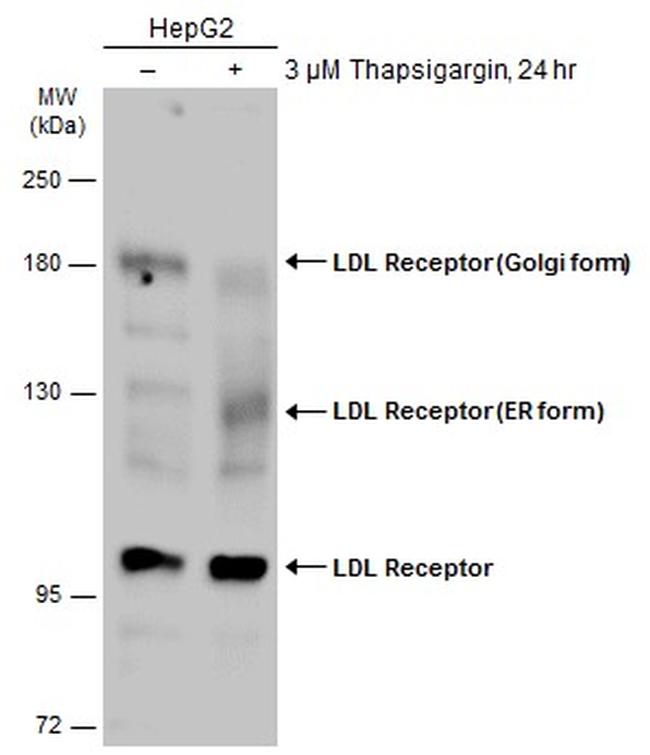
图: 1 / 1
LDL receptor Antibody (PA5-117365) in WB
Western blot analysis of LDL receptor in Untreated (–) and treated (+) HepG2 whole cell extracts (60 µg). Samples were separated with 7.5% SDS-PAGE and incubated in LDL receptor polyclonal antibody (Product # PA5-117365) using a dilution of 1:1,000, followed by HRP-conjugated anti-rabbit IgG.
Please note: We are reviewing Western blot images included in the antibody testing data in our catalog, including those provided by third parties. Unless expressly labeled or annotated as “raw-unedited”, Western blot images included in the antibody testing data in our catalog may have been edited, optimized or otherwise adjusted for presentation.

产品信息
PA5-117365
产品规格
种属反应
Human
宿主/亚型
Rabbit
/ IgG
分类
Polyclonal
类型
Antibody
抗原
Synthetic peptide encompassing a sequence within the Extracellular domain of human LDL Receptor. The exact sequence is proprietary.
偶联物
Unconjugated
Unconjugated
Unconjugated
形式
Liquid
浓度
2.03 mg/mL
规格
203 µg
纯化类型
Antigen affinity chromatography
保存液
PBS, pH 7, with 20% glycerol
内含物
0.025% ProClin 300
保存条件
Store at 4°C short term. For long term storage, store at -20°C, avoiding freeze/thaw cycles.
运输条件
Ambient (domestic); Wet ice (international)
RRID
产品详细信息
Centrifuge briefly prior to opening.
靶标信息
The low density lipoprotein receptor (LDL-R) gene family consists of cell surface proteins involved in receptor-mediated endocytosis of specific ligands. Low density lipoprotein (LDL) is normally bound at the cell membrane and taken into the cell ending up in lysosomes where the protein is degraded and the cholesterol is made available for repression of microsomal enzyme 3-hydroxy-3-methylglutaryl coenzyme A (HMG CoA) reductase, the rate-limiting step in cholesterol synthesis. At the same time, a reciprocal stimulation of cholesterol ester synthesis takes place. Mutations in the LDL-R gene cause the autosomal dominant disorder, familial hypercholesterolemia. Along with SCARB1, CLDN1, and the tetraspanin superfamily member CD81, LDL-R has been reported to be an entry factor for the Hepatitis C virus. At least three isoforms of LDL-R are known to exist.
仅用于科研。不用于诊断过程。未经明确授权不得转售。
篇参考文献 (0)
您是否在文献中引用过该产品?请点击下方按钮邮件告知我们。
生物信息学
蛋白别名: LDL receptor; ldl-r; low-density lipoprotein receptor class A domain-containing protein 3; unnamed protein product
基因别名: LDLCQ2
UniProt ID: (Human) P01130
Entrez Gene ID: (Human) 3949
beta-amyloid binding
protease binding
low-density lipoprotein receptor activity
calcium ion binding
protein binding
low-density lipoprotein particle binding
very-low-density lipoprotein particle receptor activity
clathrin heavy chain binding
identical protein binding
binding, bridging
lipoprotein particle binding
retinoid metabolic process
negative regulation of receptor recycling
lipid metabolic process
endocytosis
receptor-mediated endocytosis
phagocytosis
long-term memory
positive regulation of gene expression
negative regulation of gene expression
positive regulation of triglyceride biosynthetic process
regulation of phosphatidylcholine catabolic process
negative regulation of low-density lipoprotein particle clearance
phospholipid transport
intestinal cholesterol absorption
cholesterol transport
plasma lipoprotein particle clearance
low-density lipoprotein particle clearance
high-density lipoprotein particle clearance
cholesterol homeostasis
artery morphogenesis
positive regulation of inflammatory response
negative regulation of multicellular organismal process
regulation of protein metabolic process
negative regulation of protein metabolic process
response to caloric restriction
negative regulation of astrocyte activation
cholesterol import
cellular response to fatty acid
cellular response to low-density lipoprotein particle stimulus
receptor-mediated endocytosis of low-density lipoprotein particle involved in cholesterol transport
regulation of cholesterol metabolic process
beta-amyloid clearance
amyloid-beta clearance by cellular catabolic process
negative regulation of microglial cell activation
positive regulation of lysosomal protein catabolic process
negative regulation of amyloid fibril formation
Disclaimer

Clicking the images or links will redirect you to a website hosted by BenchSci that provides third-party scientific content. Neither the content nor the BenchSci technology and processes for selection have been evaluated by us; we are providing them as-is and without warranty of any kind, including for use or application of the Thermo Fisher Scientific products presented.

