Search
Agrisera
LEA4-25/Group 4-late embryogenesis abundant protein Polyclonal Antibody
{{$productOrderCtrl.translations['antibody.pdp.commerceCard.promotion.promotions']}}
{{$productOrderCtrl.translations['antibody.pdp.commerceCard.promotion.viewpromo']}}
{{$productOrderCtrl.translations['antibody.pdp.commerceCard.promotion.promocode']}}: {{promo.promoCode}} {{promo.promoTitle}} {{promo.promoDescription}}. {{$productOrderCtrl.translations['antibody.pdp.commerceCard.promotion.learnmore']}}
Additional Information:
{{banner.description}}
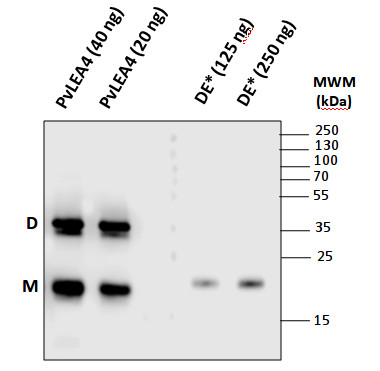
图: 1 / 1
LEA4-25/Group 4-late embryogenesis abundant protein Antibody (AS13-2757) in WB
Phaseolus vulgaris seed protein extracts which is an extract enriched in hydrophilic proteins, obtained in a following way: Dry seeds were used to separate embryos from cotyledons. Approximately 500 mg of embryos were ground in a mortar in the presence of liquid nitrogen or dry ice. The powder was resuspended and homogenized in 1 m L of 20 m M TES p H 8.0,0.5 M Na Cl, 10 m M Na 2 VO 3,10 m M Na F, 1 m M PMS... View More

产品信息
AS13-2757
产品规格
种属反应
Plant
宿主/亚型
Rabbit
分类
Polyclonal
类型
Antibody
抗原
Recombinant Phaseolus vulgaris PvLEA 4-1 sequence.
偶联物
Unconjugated
Unconjugated
Unconjugated
形式
Lyophilized
保存液
whole serum
内含物
no preservative
保存条件
-20°C, Avoid Freeze/Thaw Cycles
运输条件
Ambient (domestic); Wet ice (international)
产品详细信息
Store lyophilized/reconstituted at -20°C; once reconstituted make aliquots to avoid repeated freeze-thaw cycles. Please remember to spin the tubes briefly prior to opening them to avoid any losses that might occur from material adhering to the cap or sides of the tube.
For reconstitution add 50 µL of sterile water.
Specific Species Reactivity: Phaseolus vulgaris
靶标信息
LEA4-25 encodes a plant group 4 late-embryogenesis abundant (LEA4) protein that accumulates in desiccation-tolerant tissues (notably maturing seeds) and is also induced in vegetative organs during abiotic stress, consistent with a role in dehydration-associated protection. In common bean (Phaseolus vulgaris), the corresponding LEA4 protein is a small, highly hydrophilic polypeptide of ~16 kDa that can display an apparent higher mass on SDS-PAGE, a behavior typical of intrinsically disordered proteins, and is expected to be rich in disorder-promoting residues with stress-dependent conformational plasticity (acquiring more alpha-helix under water-limiting or crowding conditions). Functionally, LEA4 proteins act as molecular shields with chaperone-like activity that helps preserve enzyme activity and limits protein aggregation during partial dehydration and freeze-thaw stress, thereby supporting drought/low-water adaptation and recovery; additional evidence across LEA4 proteins supports potential metal-ion binding/sequestration capacity (notably via histidine-enriched regions) that could further mitigate stress-associated damage. Subcellularly, LEA4 proteins have been observed in the nucleus for at least one characterized plant LEA4 member and, more broadly, can show whole-cell distribution without strong compartment restriction, consistent with a generalized protective role across cellular compartments during stress.
仅用于科研。不用于诊断过程。未经明确授权不得转售。
篇参考文献 (0)
您是否在文献中引用过该产品?请点击下方按钮邮件告知我们。
生物信息学
蛋白别名: Putative late embryogenesis abundant protein LEA; PvLEA4-25
Disclaimer

Clicking the images or links will redirect you to a website hosted by BenchSci that provides third-party scientific content. Neither the content nor the BenchSci technology and processes for selection have been evaluated by us; we are providing them as-is and without warranty of any kind, including for use or application of the Thermo Fisher Scientific products presented.

