Search
Agrisera
LEA6/Late embryogenesis abundant protein 6 Polyclonal Antibody
{{$productOrderCtrl.translations['antibody.pdp.commerceCard.promotion.promotions']}}
{{$productOrderCtrl.translations['antibody.pdp.commerceCard.promotion.viewpromo']}}
{{$productOrderCtrl.translations['antibody.pdp.commerceCard.promotion.promocode']}}: {{promo.promoCode}} {{promo.promoTitle}} {{promo.promoDescription}}. {{$productOrderCtrl.translations['antibody.pdp.commerceCard.promotion.learnmore']}}
Additional Information:
{{banner.description}}
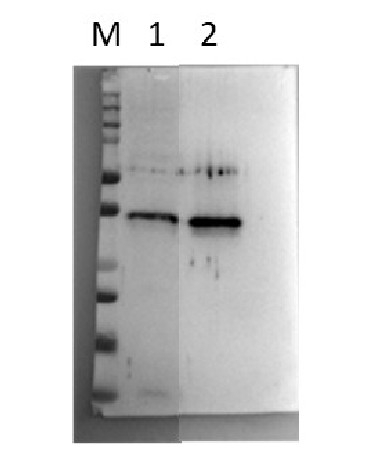
图: 1 / 1
LEA6/Late embryogenesis abundant protein 6 Antibody (AS21-4596) in WB
Samples: M - Precision plus protein dual color standard Bio-Rad 1 - Bacterial extract, 4 µL 2 - Purified, His-tagged Arabidopsis thaliana LEA 16 protein, 8 µL Samples were denatured with SDS DTT sample buffer (12 m M Tris p H 6.8,10% glycerol, 0.4% SDS, 80 m M DTT, 0.02% bromophenol blue) for 30 min at room temperature, then were separated on 12% SDS-PAGE and blotted 1 h at 100 V to PVDF membrane (pore size... View More
Please note: We are reviewing Western blot images included in the antibody testing data in our catalog, including those provided by third parties. Unless expressly labeled or annotated as “raw-unedited”, Western blot images included in the antibody testing data in our catalog may have been edited, optimized or otherwise adjusted for presentation.

产品信息
AS21-4596
产品规格
种属反应
Plant
宿主/亚型
Rabbit
分类
Polyclonal
类型
Antibody
抗原
KLH-conjugated peptide derived from Arabidopsis thaliana LEA6 protein sequences.
偶联物
Unconjugated
Unconjugated
Unconjugated
形式
Lyophilized
规格
50 µg
纯化类型
Affinity chromatography
保存液
PBS, pH 7.4
内含物
no preservative
保存条件
-20°C, Avoid Freeze/Thaw Cycles
运输条件
Ambient (domestic); Wet ice (international)
产品详细信息
Store lyophilized/reconstituted at -20°C; once reconstituted make aliquots to avoid repeated freeze-thaw cycles. Please, remember to spin tubes briefly prior to opening them to avoid any losses that might occur from lyophilized material adhering to the cap or sides of the tubes.
For reconstitution add 50 µL of sterile water.
Specific Species Reactivity: Arabidopsis thaliana (recombinant LEA6)
靶标信息
LEA6 encodes a small, highly hydrophilic late embryogenesis abundant (LEA) family 6 protein that accumulates predominantly in seeds during late embryogenesis and shortly after imbibition, and is also induced by water-deficit-related signals. In Arabidopsis, LEA6 family members are encoded by compact, nuclear-genome loci and produce proteins in the low-molecular-mass range typical of LEA6 (about 7-14 kDa) that are enriched in disorder-promoting residues and can behave as intrinsically disordered proteins in aqueous conditions, with stress-mimicking environments promoting partial structuring and protective activity. Functional genetic analyses indicate that at least one Arabidopsis LEA6 member is required for robust tolerance to osmotic and salinity stress during germination and early seedling establishment, and is critical for maintaining seed longevity by supporting formation/maintenance of the low-mobility "glassy" cytoplasmic state associated with desiccation tolerance; loss of LEA6 compromises glass stability and accelerates viability decline during aging. Collectively, LEA6 proteins act as dehydration-associated protectants that help preserve cellular integrity under low-water availability, particularly in the seed context, likely by stabilizing macromolecules and biophysical properties of the intracellular milieu during drying and subsequent rehydration.
仅用于科研。不用于诊断过程。未经明确授权不得转售。
篇参考文献 (0)
您是否在文献中引用过该产品?请点击下方按钮邮件告知我们。
生物信息学
蛋白别名: AtLEA6-2.1; AtLEA6-2.2; AtLEA6-2.3; PvLEA18
Disclaimer

Clicking the images or links will redirect you to a website hosted by BenchSci that provides third-party scientific content. Neither the content nor the BenchSci technology and processes for selection have been evaluated by us; we are providing them as-is and without warranty of any kind, including for use or application of the Thermo Fisher Scientific products presented.

