Search
Abnova
LRRK1 Polyclonal Antibody, MaxPab™
{{$productOrderCtrl.translations['antibody.pdp.commerceCard.promotion.promotions']}}
{{$productOrderCtrl.translations['antibody.pdp.commerceCard.promotion.viewpromo']}}
{{$productOrderCtrl.translations['antibody.pdp.commerceCard.promotion.promocode']}}: {{promo.promoCode}} {{promo.promoTitle}} {{promo.promoDescription}}. {{$productOrderCtrl.translations['antibody.pdp.commerceCard.promotion.learnmore']}}
Additional Information:
{{banner.description}}
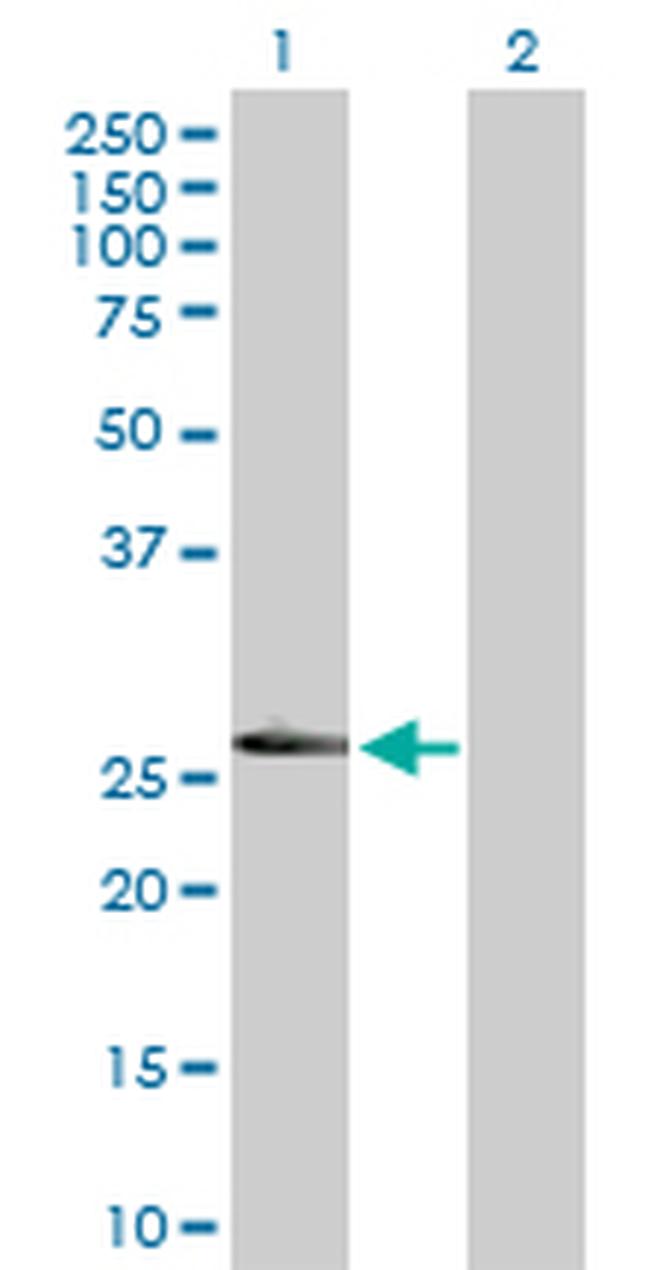
图: 1 / 2
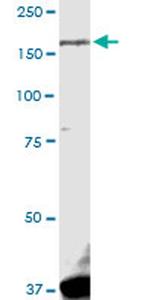
LRRK1 Antibody (H00079705-D01P) in WB
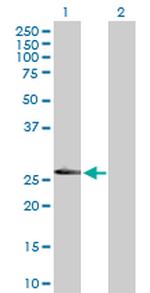
Western Blot analysis of LRRK1 expression in transfected 293T cell line (H00079705-T02) by LRRK1 MaxPab polyclonal antibody.
Lane 1: LRRK1 transfected lysate(28.60 KDa).
Lane 2: Non-transfected lysate.
Lane 1: LRRK1 transfected lysate(28.60 KDa).
Lane 2: Non-transfected lysate.


产品信息
H00079705-D01P
产品规格
种属反应
Human,
Rat
宿主/亚型
Rabbit
/ IgG
分类
Polyclonal
类型
Antibody
抗原
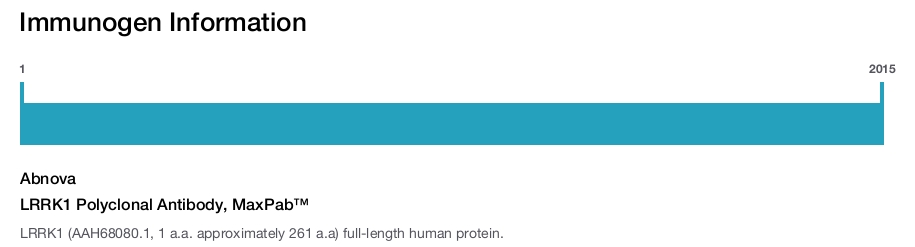
LRRK1 (AAH68080.1, 1 a.a. approximately 261 a.a) full-length human protein.
偶联物
形式
Liquid
浓度
See Label
规格
100 µg
纯化类型
Affinity chromatography
保存液
PBS, pH 7.4
内含物
no preservative
保存条件
-20°C, Avoid Freeze/Thaw Cycles
运输条件
Ambient (domestic); Wet ice (international)
产品详细信息
Sequence of this protein is as follows: MSQRPPSMYW CVGPEESAVC PERAMETLNG AGDTGGKPST RGGDPAARSR RTEGIRAAYR RGDRGGARDL LEEACDQCAS QLEKGQLLSI PAAYGDLEMV RYLLSKRLVE LPTEPTDDNP AVVAAYFGHT AVVQELLESL PGPCSPQRLL NWMLALACQR GHLGVVKLLV LTHGADPESY AVRKNEFPVI VRLPLYAAIK SGNEDIAIFL LRHGAYFCSY ILLDSPDPSK HLLRKYFIEA SPLPSSYPGK TVSSHCLWSV F
靶标信息
Protein kinases are enzymes that transfer a phosphate group from a phosphate donor, generally the g phosphate of ATP, onto an acceptor amino acid in a substrate protein. By this basic mechanism, protein kinases mediate most of the signal transduction in eukaryotic cells, regulating cellular metabolism, transcription, cell cycle progression, cytoskeletal rearrangement and cell movement, apoptosis, and differentiation. With more than 500 gene products, the protein kinase family is one of the largest families of proteins in eukaryotes. The family has been classified in 8 major groups based on sequence comparison of their tyrosine (PTK) or serine/threonine (STK) kinase catalytic domains.
仅用于科研。不用于诊断过程。未经明确授权不得转售。
篇参考文献 (0)
您是否在文献中引用过该产品?请点击下方按钮邮件告知我们。
生物信息学
蛋白别名: Leucine-rich repeat serine/threonine-protein kinase 1; ROCO protein; protein kinase; unnamed protein product
基因别名: KIAA1790; LRRK1; OSMD; RIPK6; Roco1
UniProt ID: (Human) Q38SD2
Entrez Gene ID: (Human) 79705, (Rat) 308703
positive regulation of signal transduction
intracellular signal transduction
osteoclast development
bone resorption
positive regulation of canonical Wnt signaling pathway
positive regulation of intracellular signal transduction
protein phosphorylation
small GTPase mediated signal transduction
positive regulation of peptidyl-tyrosine phosphorylation
negative regulation of peptidyl-tyrosine phosphorylation
Disclaimer

Clicking the images or links will redirect you to a website hosted by BenchSci that provides third-party scientific content. Neither the content nor the BenchSci technology and processes for selection have been evaluated by us; we are providing them as-is and without warranty of any kind, including for use or application of the Thermo Fisher Scientific products presented.

