Search
Invitrogen
LST1 Monoclonal Antibody (LST1/02)
{{$productOrderCtrl.translations['antibody.pdp.commerceCard.promotion.promotions']}}
{{$productOrderCtrl.translations['antibody.pdp.commerceCard.promotion.promocode']}}: {{promo.promoCode}} {{promo.promoTitle}} {{promo.promoDescription}}. {{$productOrderCtrl.translations['antibody.pdp.commerceCard.promotion.learnmore']}}
{{$ctrl.translations['antibody.pdp.skuNotes.additionalInformation']}}:
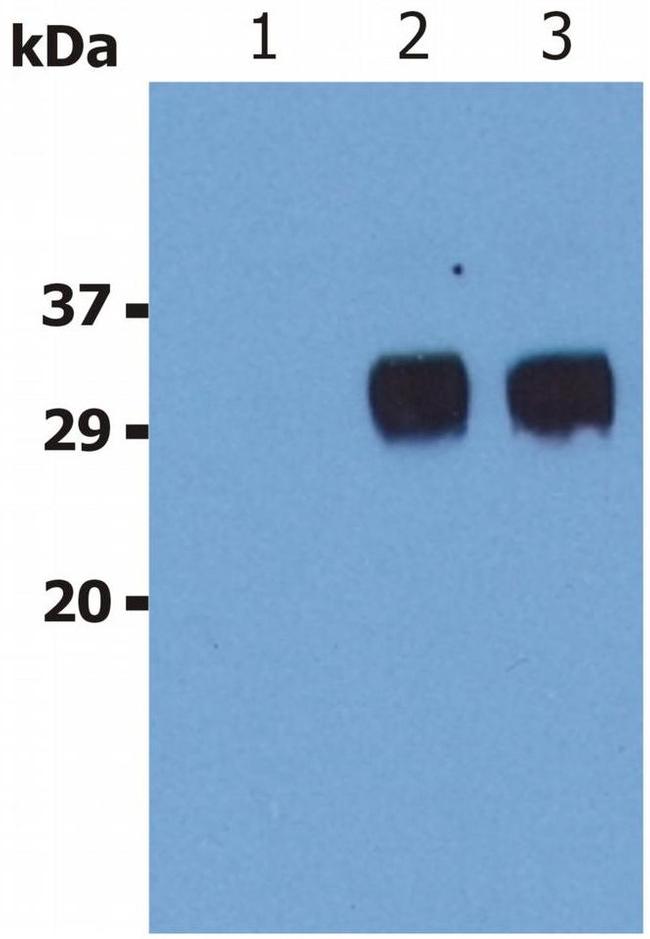
图: 1 / 1
LST1 Antibody (MA1-10400) in WB
Western blotting analysis (non-reducing conditions) of LST1 in whole cell lysate of U937 human Caucasian histiocytic lymphoma cell line. Lane 1: immunostaining with Isotype mouse IgG1 control (PPV-06; cat. no. 11-457-C100). Lane 2-3: immunostaining with anti-human LST1 (LST1/02)Monoclonal antibodies (Product # MA1-10400), two independent batches. Note: It migrates on SDS PAGE gels as approximately 25-28 kDa molecule.
Please note: We are reviewing Western blot images included in the antibody testing data in our catalog, including those provided by third parties. Unless expressly labeled or annotated as “raw-unedited”, Western blot images included in the antibody testing data in our catalog may have been edited, optimized or otherwise adjusted for presentation.

产品信息
MA1-10400
应用
建议稀释比
已发表文章
产品规格
种属反应
Human
宿主/亚型
Mouse
/ IgG1
分类
Monoclonal
类型
Antibody
克隆号
LST1/02
抗原
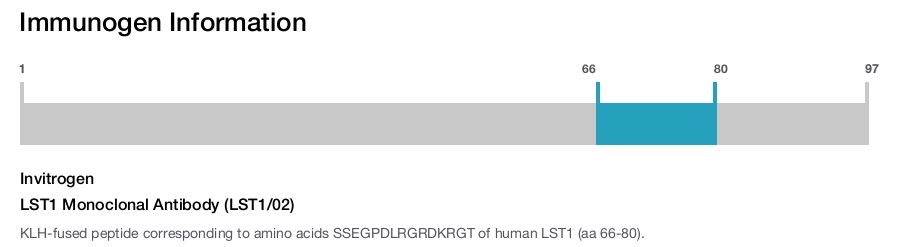
KLH-fused peptide corresponding to amino acids SSEGPDLRGRDKRGT of human LST1 (aa 66-80).
偶联物
Unconjugated
Unconjugated
Unconjugated
形式
Liquid
浓度
1 mg/mL
规格
100 µg
纯化类型
Protein A
保存液
PBS, pH 7.4
内含物
15mM sodium azide
保存条件
4°C, do not freeze
运输条件
Ambient (domestic); Wet ice (international)
RRID
产品详细信息
This antibody reacts with an extracellular epitope of LST1, an approximately 6-11 kDa protein expressed as various transmembrane or soluble forms. LST1 is found predominantly on monocytes and dendritic cells. It migrates on SDS PAGE gels as approximately 25-28 kDa molecule.
靶标信息
LST1 (leukocyte-specific transcript, also known as B144) is expressed in cells of myeloid/erythroid lineage (monocytes, granulocytes, dendritic cells, platelets, erythrocytes). At least 14 alternatively spliced variants (LST1/A - LST1/N) can be detected; some of them (LST1/A, B, C, G, I, K) are transmembrane cell surface-exposed forms, the other are soluble. LST1 induces production of long, thin filopodia in dendritic cells, has an inhibitory effect on lymphocyte proliferation and may have an immunomodulatory role. LST1/A is an 11 kDa transmembrane adaptor present in membrane rafts and forms spontaneously covalent homodimers. Its intracellular domain contains two tyrosine motifs, one of them being an ITIM very similar to such motifs in Siglec.
仅用于科研。不用于诊断过程。未经明确授权不得转售。
篇参考文献 (0)
您是否在文献中引用过该产品?请点击下方按钮邮件告知我们。
生物信息学
蛋白别名: cL232ST1/A splice variant; cLST1/C splice variant; cLST1/E splice variant; DAAP-90L16.2; LST1; lymphocyte antigen 117; MGC119006; MGC119007
基因别名: B144; D6S49E; LST-1
UniProt ID: (Human) O00453
Entrez Gene ID: (Human) 7940
Disclaimer

Clicking the images or links will redirect you to a website hosted by BenchSci that provides third-party scientific content. Neither the content nor the BenchSci technology and processes for selection have been evaluated by us; we are providing them as-is and without warranty of any kind, including for use or application of the Thermo Fisher Scientific products presented.

