Search
Invitrogen
M-cadherin Monoclonal Antibody (K92056_12G8)
{{$productOrderCtrl.translations['antibody.pdp.commerceCard.promotion.promotions']}}
{{$productOrderCtrl.translations['antibody.pdp.commerceCard.promotion.promocode']}}: {{promo.promoCode}} {{promo.promoTitle}} {{promo.promoDescription}}. {{$productOrderCtrl.translations['antibody.pdp.commerceCard.promotion.learnmore']}}
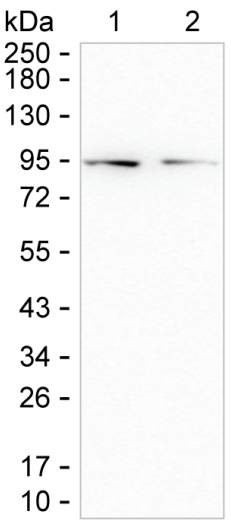
图: 1 / 1
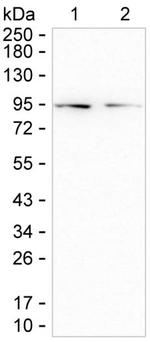
M-cadherin Antibody (MA5-55670) in WB
Western blot analysis of M-cadherin in 15 µg of mouse brain tissue lysate. Sample was run on 6-18% SDS-PAGE under reducing conditions, blotted onto nitrocellulose membrane, and peroxidase conjugated goat anti-mouse IgG was used as the secondary antibody. M-cadherin band was visualized using ECL Western Blotting Substrate. Incubation with primary M-cadherin monoclonal antibody (Product # MA5-55670) at a dilution of 1 µg/mL was used.
Please note: We are reviewing Western blot images included in the antibody testing data in our catalog, including those provided by third parties. Unless expressly labeled or annotated as “raw-unedited”, Western blot images included in the antibody testing data in our catalog may have been edited, optimized or otherwise adjusted for presentation.

产品信息
MA5-55670
产品规格
种属反应
Human,
Mouse
宿主/亚型
Mouse
/ IgG2b
分类
Monoclonal
类型
Antibody
克隆号
K92056_12G8
抗原
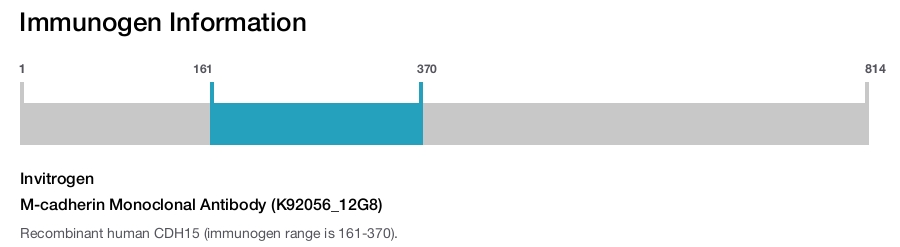
Recombinant human CDH15 (immunogen range is 161-370).
偶联物
Unconjugated
Unconjugated
Unconjugated
形式
Liquid
浓度
0.45 mg/mL
规格
22.5 µg
纯化类型
Protein A
保存液
PBS with 50% glycerol, 0.5% BSA
内含物
0.09% sodium azide
保存条件
Store at 4°C short term. For long term storage, store at -20°C, avoiding freeze/thaw cycles.
RRID
产品详细信息
Sequence of this protein is as follows: VLEGAVPGTY VTRAEATDAD DPETDNAALR FSILQQGSPE LFSIDELTGE IRTVQVGLDR EVVAVYNLTL QVADMSGDGL TATASAIITL DDINDNAPEF TRDEFFMEAI EAVSGVDVGR LEVEDRDLPG SPNWVARFTI LEGDPDGQFT IRTDPKTNEG VLSIVKALDY ESCEHYELKV SVQNEAPLQA AALRAERGQA KVRVHVQDTN
靶标信息
Cadherins are a multigene family of Ca++-dependent cell adhesion molecules. They are transmembrane glycoproteins consisting of an extracellular domain, which mediates Ca++-dependent intercellular adhesion by homophilic interactions, a transmembrane region and a cytoplasmic domain. The extracellular domain is divided into a series of subdomains designated EC1-EC5. Homolgies between different members of the cadherin family are most prominent in the cytoplasmic domain and in EC1 and EC2 and much less so in EC5 of the extracellular domain and in the transmembrane region. The binding properties and specificities of the adhesive function are located in the N-terminal part of the molecules. Four members of the cadherin family have been identified and molecularly cloned from mammalian cells. These include the neuronal (N), epithelial (E), placental (P) and muscle (M) cadherins. M-cadherin is not found in fibroblasts but is expressed at low level in myoblasts and is upregulated following induction of myotube formation, suggesting a specific function in skeletal muscle cell differentiation.
仅用于科研。不用于诊断过程。未经明确授权不得转售。
篇参考文献 (0)
您是否在文献中引用过该产品?请点击下方按钮邮件告知我们。
生物信息学
蛋白别名: cadherin 15, type 1, M-cadherin (myotubule); cadherin-14; cadherin-3; CRSBP-1; HAR; LYVE-1; M-cadherin; muscle cadherin; muscle-cadherin; XLKD1
基因别名: CDH14; CDH3; CDHM; MCAD; MRD3
UniProt ID: (Human) P55291, (Mouse) P33146
Entrez Gene ID: (Human) 1013, (Mouse) 12555
cell morphogenesis
cell-cell junction assembly
cell adhesion
homophilic cell adhesion via plasma membrane adhesion molecules
calcium-dependent cell-cell adhesion via plasma membrane cell adhesion molecules
cell migration
adherens junction organization
cell-cell adhesion mediated by cadherin
cell-cell adhesion
Disclaimer

Clicking the images or links will redirect you to a website hosted by BenchSci that provides third-party scientific content. Neither the content nor the BenchSci technology and processes for selection have been evaluated by us; we are providing them as-is and without warranty of any kind, including for use or application of the Thermo Fisher Scientific products presented.

