Search
Invitrogen
Phospho-Btk (Tyr551) Recombinant Rabbit Monoclonal Antibody (BtkY551-G12), FITC
{{$productOrderCtrl.translations['antibody.pdp.commerceCard.promotion.promotions']}}
{{$productOrderCtrl.translations['antibody.pdp.commerceCard.promotion.promocode']}}: {{promo.promoCode}} {{promo.promoTitle}} {{promo.promoDescription}}. {{$productOrderCtrl.translations['antibody.pdp.commerceCard.promotion.learnmore']}}
{{$ctrl.translations['antibody.pdp.skuNotes.additionalInformation']}}:
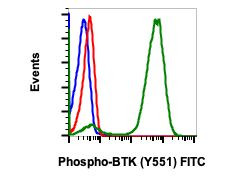
图: 1 / 1
Phospho-Btk (Tyr551) Antibody (MA5-37122) in Flow
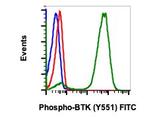
Flow cytometry of Phospho-Btk (Tyr551) using Ramos cells. Samples were incubated in monoclonal Phospho-Btk (Tyr551) antibody (Product # MA5-37122). Images correspond with the following conditions: unstained, untreated as negative control (blue), untreated (red), treated with pervanadate (green).
Please note: We are reviewing Western blot images included in the antibody testing data in our catalog, including those provided by third parties. Unless expressly labeled or annotated as “raw-unedited”, Western blot images included in the antibody testing data in our catalog may have been edited, optimized or otherwise adjusted for presentation.

产品信息
MA5-37122
产品规格
种属反应
Human
宿主/亚型
Rabbit
/ IgG, kappa
Expression System
HEK293 cells
分类
Recombinant Monoclonal
类型
Antibody
克隆号
BtkY551-G12
抗原
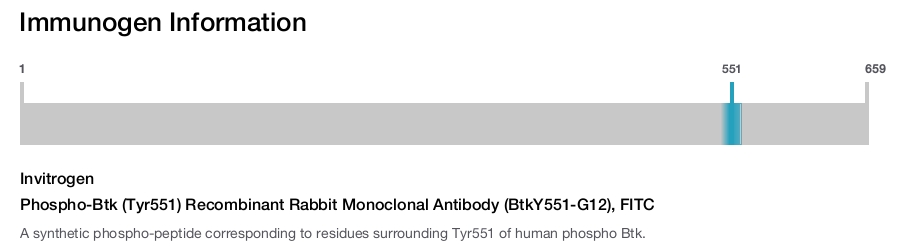
A synthetic phospho-peptide corresponding to residues surrounding Tyr551 of human phospho Btk.
偶联物
FITC
FITC
FITC
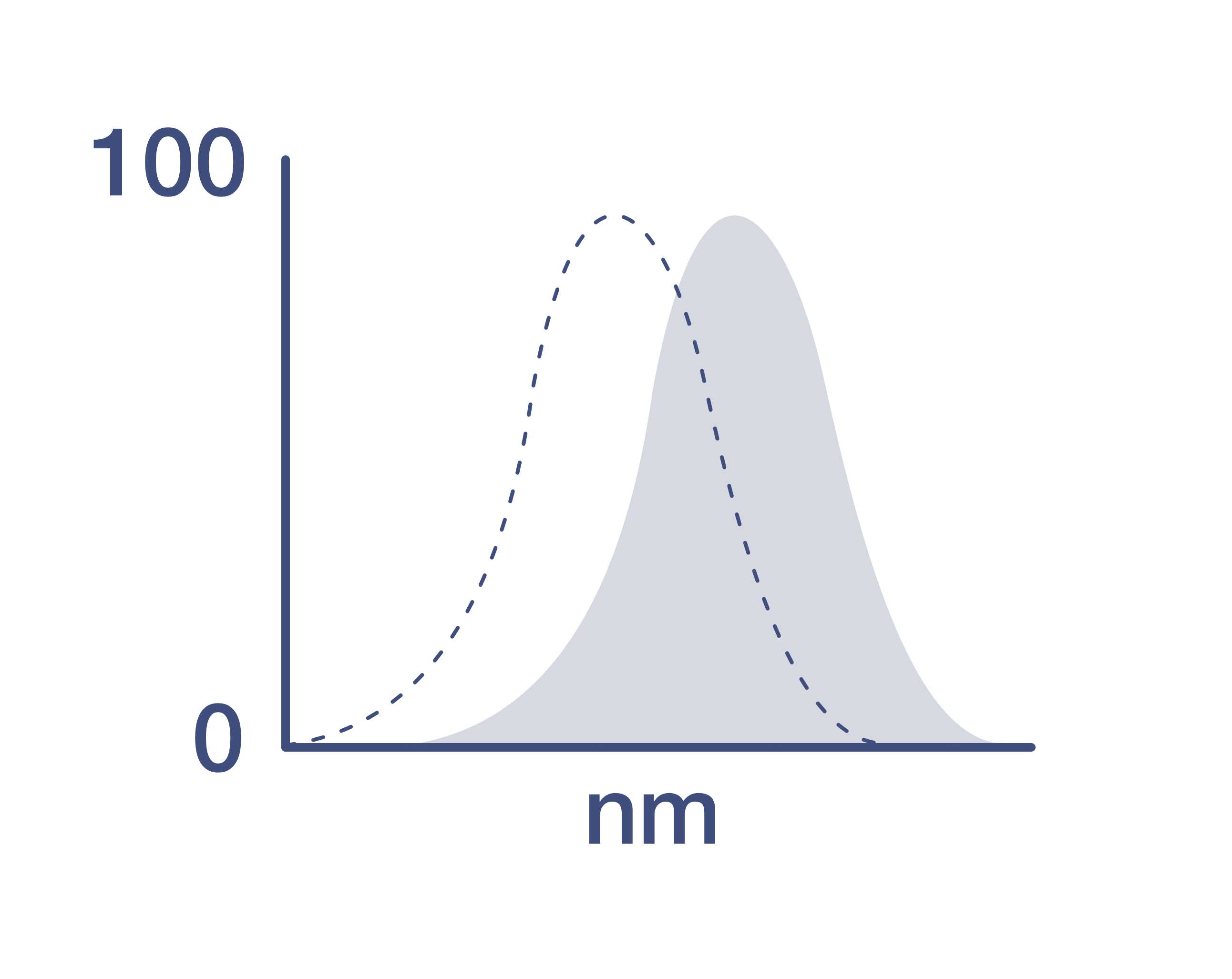
激发/发射光谱
498/517 nm
查看光谱
形式
Liquid
纯化类型
Protein A/G
保存液
PBS with 0.20% BSA
内含物
0.09% sodium azide
保存条件
4°C, store in dark
运输条件
Ambient (domestic); Wet ice (international)
RRID
靶标信息
Bruton tyrosine kinase (BTK) is a cytoplasmic tyrosine kinase belonging to the SRC-related TEC subfamily of tyrosine kinases. Mutations in the BTK gene have been linked to severe developmental blocks in human B-cell ontogeny and immunodeficiency disorders. It has recently been shown to interact with members of the toll-like receptor (TLR) family such as TLR4, 6, 8, and 9. The TLRs are critical molecules in both the innate and adaptive immunity and can recognize diverse microbial pathogens. BTK has also been shown to interact with key proteins involved in TLR4 signal transduction such as MyD88, TIRAP, and IRAK, but not TRAF-6, suggesting that BTK is involved in lipopolysaccharide signal transduction.
仅用于科研。不用于诊断过程。未经明确授权不得转售。
How to use the Panel Builder
Watch the video to learn how to use the Invitrogen Flow Cytometry Panel Builder to build your next flow cytometry panel in 5 easy steps.
篇参考文献 (0)
您是否在文献中引用过该产品?请点击下方按钮邮件告知我们。
生物信息学
蛋白别名: agammaglobulinaemia tyrosine kinase; B-cell progenitor kinase; Bruton agammaglobulinemia tyrosine kinase; Bruton's tyrosine kinase; dominant-negative kinase-deficient Brutons tyrosine kinase; frameshift mutation results in truncated protein; MGC126261; MGC126262; OTTHUMP00000023677; RP1-164F3.2; unnamed protein product
基因别名: AGMX1; AT; ATK; BPK; IGHD3; IMD1; PSCTK1; XLA
UniProt ID: (Human) Q06187
Entrez Gene ID: (Human) 695
neutrophil homeostasis
positive regulation of type III hypersensitivity
positive regulation of type I hypersensitivity
negative regulation of cytokine production
adaptive immune response
histamine secretion by mast cell
positive regulation of immunoglobulin production
regulation of B cell cytokine production
MyD88-dependent toll-like receptor signaling pathway
regulation of B cell apoptotic process
mesoderm development
peptidyl-tyrosine phosphorylation
calcium-mediated signaling
proteoglycan catabolic process
positive regulation of B cell proliferation
response to lipopolysaccharide
negative regulation of interleukin-10 production
positive regulation of interleukin-6 production
positive regulation of tumor necrosis factor production
cellular response to reactive oxygen species
intracellular signal transduction
Fc-epsilon receptor signaling pathway
B cell activation
positive regulation of I-kappaB kinase/NF-kappaB signaling
innate immune response
positive regulation of B cell differentiation
positive regulation of phagocytosis
T cell receptor signaling pathway
B cell receptor signaling pathway
regulation of B cell activation
negative regulation of B cell activation
monocyte proliferation
negative regulation of leukocyte proliferation
cellular response to molecule of fungal origin
apoptotic signaling pathway
positive regulation of cGAS/STING signaling pathway
positive regulation of interleukin-17A production
positive regulation of NLRP3 inflammasome complex assembly
positive regulation of synoviocyte proliferation
eosinophil homeostasis
Disclaimer

Clicking the images or links will redirect you to a website hosted by BenchSci that provides third-party scientific content. Neither the content nor the BenchSci technology and processes for selection have been evaluated by us; we are providing them as-is and without warranty of any kind, including for use or application of the Thermo Fisher Scientific products presented.

