Search
Invitrogen
METTL15P1 Recombinant Mouse Monoclonal Antibody (K1H006_6E6)
{{$productOrderCtrl.translations['antibody.pdp.commerceCard.promotion.promotions']}}
{{$productOrderCtrl.translations['antibody.pdp.commerceCard.promotion.viewpromo']}}
{{$productOrderCtrl.translations['antibody.pdp.commerceCard.promotion.promocode']}}: {{promo.promoCode}} {{promo.promoTitle}} {{promo.promoDescription}}. {{$productOrderCtrl.translations['antibody.pdp.commerceCard.promotion.learnmore']}}
Additional Information:
{{banner.description}}
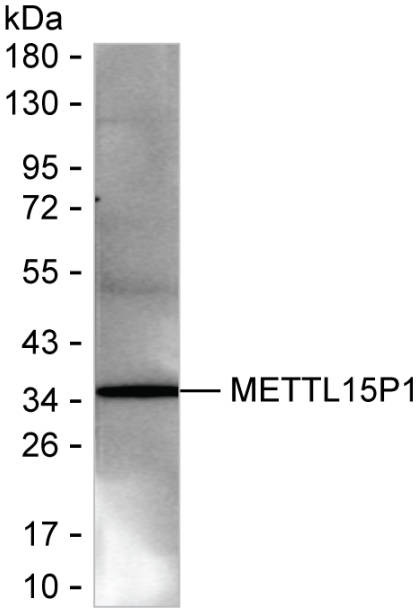
图: 1 / 1
METTL15P1 Antibody (MA564504) in WB
Western blot analysis of METTL15P1 in mouse testis tissue lysate (15 µg). Samples were incubated with METTL15P1 recombinant monoclonal (Product # MA564504) using a dilution of 1 µg/mL followed by peroxidase conjugated goat anti-mouse IgG. Sample was run on 6-18% SDS-PAGE under reducing conditions and blotted onto nitrocellulose membrane. METTL15P1 band was visualized using ECL Western Blotting Substrate.

产品信息
MA564504
产品规格
种属反应
Human,
Mouse
宿主/亚型
Mouse
/ IgG2a
Expression System
CHO cells
分类
Recombinant Monoclonal
类型
Antibody
克隆号
K1H006_6E6
抗原
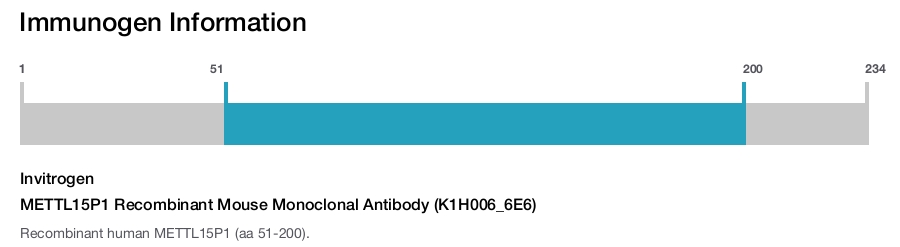
Recombinant human METTL15P1 (aa 51-200).
偶联物
Unconjugated
Unconjugated
Unconjugated
形式
Liquid
浓度
1 mg/mL
规格
100 µg
纯化类型
Protein A
保存液
PBS with 50% glycerol, 0.5% BSA
内含物
0.09% sodium azide
保存条件
Maintain refrigerated at 2-8°C for up to 1 month. For long term storage store at -20°C
运输条件
Ambient (domestic); Wet ice (international)
RRID
产品详细信息
Immunogen sequence: QTQVQELHRS QDRDFETMAK LHIPVMVDEV VHCLSPQKGQ IFLDMTFGSG GHTKAILQKE SDIVLYALDR DPTAYALAEH LSELYPKQIR AMLGQFSQAE ALLMKAGVQP GTFDGVLMDL GCSSMQLDTP ERGSSLRKDG PLDIRMDGGR
Highest antigen sequence identity to the following orthologs: Mouse - 79%, Pig - 87%, Cynomolgus monkey - 96%.
靶标信息
METTL15P1 is a pseudogene related to the METTL15 gene, which encodes a methyltransferase responsible for methylation of mitochondrial 12S rRNA at m4C839 both in vivo and in vitro. The METTL15 protein is involved in fine-tuning gene expression, particularly during differentiation processes in cells, as part of the METTL3-METTL14-DNMT1 axis, which is crucial for regulating expression of key differentiation genes in embryonic stem cells. Additionally, METTL15 is linked to the regulation of the mitochondrial genome, influencing stress-specific responses and contributing to an information-rich genotype-phenotype map that elucidates gene function and cellular dynamics. While pseudogenes like METTL15P1 do not encode functional proteins, they may still play roles in gene regulation and the broader genomic context. The study of METTL15P1 could potentially reveal insights into the evolutionary history of RNA methylation and its impact on cellular processes.
仅用于科研。不用于诊断过程。未经明确授权不得转售。
篇参考文献 (0)
您是否在文献中引用过该产品?请点击下方按钮邮件告知我们。
Disclaimer

Clicking the images or links will redirect you to a website hosted by BenchSci that provides third-party scientific content. Neither the content nor the BenchSci technology and processes for selection have been evaluated by us; we are providing them as-is and without warranty of any kind, including for use or application of the Thermo Fisher Scientific products presented.

