Search
Agrisera
MKK2/Mitogen-activated protein kinase kinase 2 Polyclonal Antibody
{{$productOrderCtrl.translations['antibody.pdp.commerceCard.promotion.promotions']}}
{{$productOrderCtrl.translations['antibody.pdp.commerceCard.promotion.viewpromo']}}
{{$productOrderCtrl.translations['antibody.pdp.commerceCard.promotion.promocode']}}: {{promo.promoCode}} {{promo.promoTitle}} {{promo.promoDescription}}. {{$productOrderCtrl.translations['antibody.pdp.commerceCard.promotion.learnmore']}}
Additional Information:
{{banner.description}}
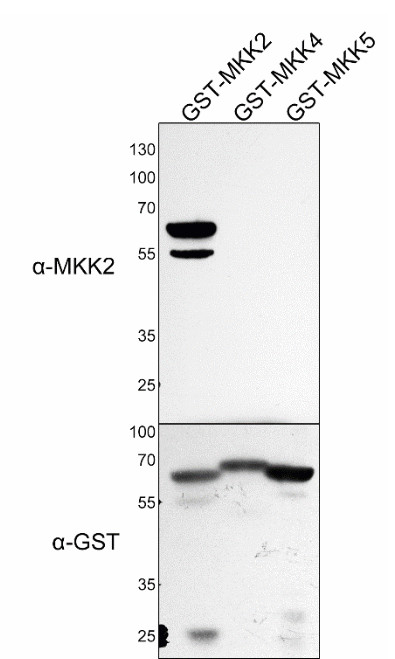
图: 1 / 2
MKK2/Mitogen-activated protein kinase kinase 2 Antibody (AS15-2905) in WB
Optical densities (OD 600) of IPTG-induced E. coli expressing GST-MKK 2/MKK 4/MKK 5 were determined and sample volumes based on the equation 1/OD 600 were centrifuged to pellet bacteria. The resulting pellets were resuspended in 7 M urea, mixed with standard LaemmLi sample buffer and then the samples were denatured at 95°C for 5 min. Samples were separated on 10% SDS-PAGE and blotted 1 h onto NCL membrane u... View More
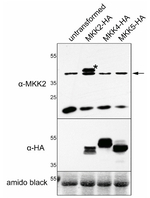
Please note: We are reviewing Western blot images included in the antibody testing data in our catalog, including those provided by third parties. Unless expressly labeled or annotated as “raw-unedited”, Western blot images included in the antibody testing data in our catalog may have been edited, optimized or otherwise adjusted for presentation.


产品信息
AS15-2905
产品规格
种属反应
Plant
宿主/亚型
Rabbit
分类
Polyclonal
类型
Antibody
抗原
KLH-conjugated synthetic peptide derived from Arabidopsis thaliana sequence of MKK2.
偶联物
Unconjugated
Unconjugated
Unconjugated
形式
Lyophilized
规格
50 µg
纯化类型
Antigen affinity chromatography
保存液
PBS, pH 7.4
内含物
no preservative
保存条件
-20°C, Avoid Freeze/Thaw Cycles
运输条件
Ambient (domestic); Wet ice (international)
产品详细信息
Store lyophilized/reconstituted at -20°C; once reconstituted make aliquots to avoid repeated freeze-thaw cycles. Please remember to spin the tubes briefly prior to opening them to avoid any losses that might occur from material adhering to the cap or sides of the tube.
For reconstitution add 50 µL of sterile water.
Specific Species Reactivity: Arabidopsis thaliana (protoplasts)
靶标信息
MKK2 encodes a dual-specificity protein kinase that functions in the canonical RAS-RAF-MAP2K-ERK signaling module; the protein is predominantly cytoplasmic at steady state and acts as an upstream activator of ERK family MAP kinases. Structurally, MKK2 is a MAP kinase kinase with an N-terminal regulatory region mediating pathway-specific interactions and control, and a C-terminal conserved catalytic kinase domain that binds ATP and catalyzes phosphorylation on both threonine and tyrosine within the Thr-Glu-Tyr activation motif of downstream ERK MAP kinases. Biologically, MKK2 is activated by phosphorylation by MAP kinase kinase kinases in response to mitogens and growth factors, and in turn phosphorylates and activates ERK signaling to regulate core cellular programs including proliferation, differentiation, and survival; consistent with pathway relevance in development, pathogenic variants in MKK2 are implicated in cardiofaciocutaneous syndrome.
仅用于科研。不用于诊断过程。未经明确授权不得转售。
篇参考文献 (0)
您是否在文献中引用过该产品?请点击下方按钮邮件告知我们。
生物信息学
蛋白别名: ATMKK2; F27B13.50; F27B13_50; MAP KINASE KINASE 1; MAP2K; MAP2K2; MEK2; MK1
Disclaimer

Clicking the images or links will redirect you to a website hosted by BenchSci that provides third-party scientific content. Neither the content nor the BenchSci technology and processes for selection have been evaluated by us; we are providing them as-is and without warranty of any kind, including for use or application of the Thermo Fisher Scientific products presented.

