Search
Invitrogen
MSP Polyclonal Antibody
{{$productOrderCtrl.translations['antibody.pdp.commerceCard.promotion.promotions']}}
{{$productOrderCtrl.translations['antibody.pdp.commerceCard.promotion.promocode']}}: {{promo.promoCode}} {{promo.promoTitle}} {{promo.promoDescription}}. {{$productOrderCtrl.translations['antibody.pdp.commerceCard.promotion.learnmore']}}
{{$ctrl.translations['antibody.pdp.skuNotes.additionalInformation']}}:
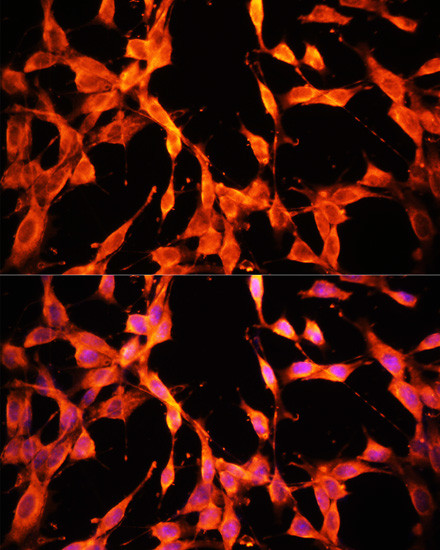
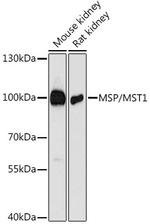
Please note: We are reviewing Western blot images included in the antibody testing data in our catalog, including those provided by third parties. Unless expressly labeled or annotated as “raw-unedited”, Western blot images included in the antibody testing data in our catalog may have been edited, optimized or otherwise adjusted for presentation.


产品信息
PA5-88894
应用
建议稀释比
已发表文章
产品规格
种属反应
Human,
Mouse,
Rat
宿主/亚型
Rabbit
/ IgG
分类
Polyclonal
类型
Antibody
抗原
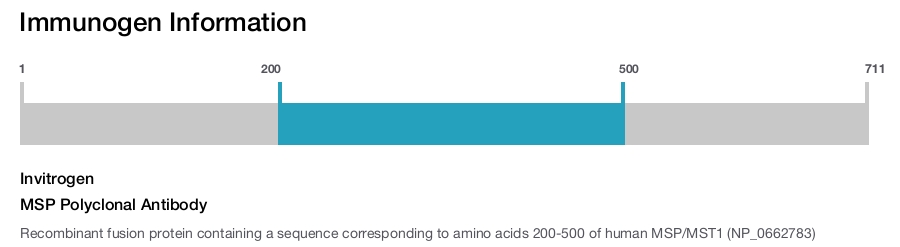
Recombinant fusion protein containing a sequence corresponding to amino acids 200-500 of human MSP/MST1 (NP_0662783)
偶联物
Unconjugated
Unconjugated
Unconjugated
形式
Liquid
浓度
2.46 mg/mL
规格
246 µg
纯化类型
Affinity Chromatography
保存液
PBS, pH 7.3, with 50% glycerol
内含物
0.01% thimerosal
保存条件
-20°C, Avoid Freeze/Thaw Cycles
运输条件
Ambient (domestic); Wet ice (international)
RRID
产品详细信息
Immunogen sequence: CREAACVWCN GEEYRGAVDR TESGRECQRW DLQHPHQHPF EPGKFLDQGL DDNYCRNPDG SERPWCYTTD PQIEREFCDL PRCGSEAQPR QEATTVSCFR GKGEGYRGTA NTTTAGVPCQ RWDAQIPHQH RFTPEKYACK DLRENFCRNP DGSEAPWCFT LRPGMRAAFC YQIRRCTDDV RPQDCYHGAG EQYRGTVSKT RKGVQCQRWS AETPHKPQFT FTSEPHAQLE ENFCRNPDGD SHGPWCYTMD PRTPFDYCAL RRCADDQPPS ILDPPDQVQF EKCGKRVDRL DQRRSKLRVV G; Positive Samples: Mouse kidney, Rat kidney
靶标信息
MSP (or MST1) contains four kringle domains and a serine protease domain, similar to that found in hepatic growth factor. Despite the presence of the serine protease domain, the encoded protein may not have any proteolytic activity. The receptor for this protein is RON tyrosine kinase, which upon activation stimulates ciliary motility of ciliated epithelial lung cells. This protein is secreted and cleaved to form an alpha chain and a beta chain bridged by disulfide bonds.
⚠WARNING: This product can expose you to chemicals including mercury, which is known to the State of California to cause birth defects or other reproductive harm. For more information go to www.P65Warnings.ca.gov.
仅用于科研。不用于诊断过程。未经明确授权不得转售。
篇参考文献 (0)
您是否在文献中引用过该产品?请点击下方按钮邮件告知我们。
生物信息学
蛋白别名: D8h3f15s2; E2F transcription factor 2; hepatocyte growth factor-like protein homolog; Macrophage stimulating 1 (hepatocyte growth factor-like); macrophage stimulatory protein; macrophage-stimulating protein; MSP; unnamed protein product
基因别名: D3F15S2; D3F15S2h; D9H3F15S2; DNF15S2; DNF15S2h; E2F2; HGFL; MSP; NF15S2
UniProt ID: (Human) P26927, (Mouse) P26928
Entrez Gene ID: (Human) 4485, (Rat) 24566, (Mouse) 15235
chromatin remodeling
proteolysis
spermatogenesis
embryo implantation
positive regulation of gene expression
regulation of macrophage chemotaxis
sperm motility
mammary gland development
positive regulation of mammary gland epithelial cell proliferation
positive regulation of apoptotic process
negative regulation of gluconeogenesis
regulation of JAK-STAT cascade
mammary duct terminal end bud growth
cellular response to interferon-gamma
cellular response to hypoxia
negative regulation of epithelial cell apoptotic process
regulation of cAMP-dependent protein kinase activity
Disclaimer

Clicking the images or links will redirect you to a website hosted by BenchSci that provides third-party scientific content. Neither the content nor the BenchSci technology and processes for selection have been evaluated by us; we are providing them as-is and without warranty of any kind, including for use or application of the Thermo Fisher Scientific products presented.

