Search
Invitrogen
MUSK Recombinant Rabbit Monoclonal Antibody (PSH05-68)
{{$productOrderCtrl.translations['antibody.pdp.commerceCard.promotion.promotions']}}
{{$productOrderCtrl.translations['antibody.pdp.commerceCard.promotion.promocode']}}: {{promo.promoCode}} {{promo.promoTitle}} {{promo.promoDescription}}. {{$productOrderCtrl.translations['antibody.pdp.commerceCard.promotion.learnmore']}}
{{$ctrl.translations['antibody.pdp.skuNotes.additionalInformation']}}:
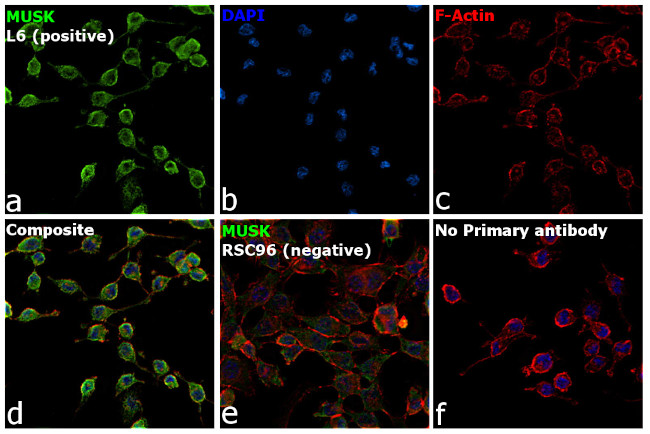
图: 1 / 20
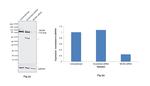
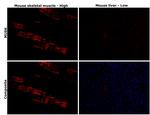
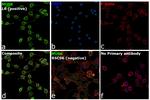
MUSK Antibody (MA5-52463) in ICC/IF
Immunofluorescence analysis of MUSK was performed using 70% confluent log phase L6 and RSC96 cells. The cells were fixed with 4% paraformaldehyde for 10 minutes, permeabilized with 0.1% Triton™ X-100 for 15 minutes, and blocked with 2% BSA for 1 hour at room temperature. The cells were labeled with MUSK Recombinant Rabbit Monoclonal Antibody (PSH05-68) (Product # MA5-52463) at 1:100 dilution in 0.1% BSA, incubated at 4 degree celsius overnight and then labeled with Donkey anti-Rabbit IgG (H+L) Highly Cross-Adsorbed Secondary Antibody, Alex... View More
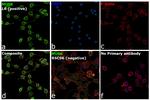
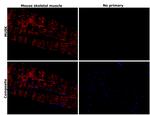
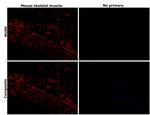
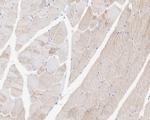
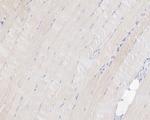
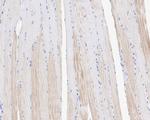
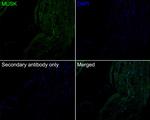
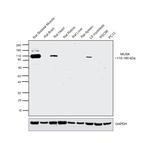
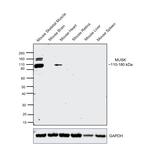
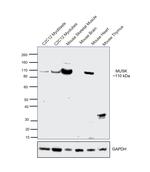
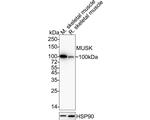
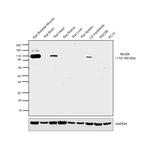
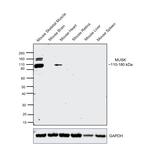
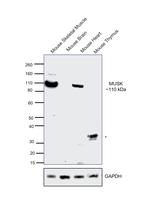

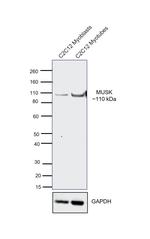
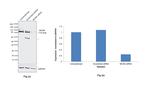
Please note: We are reviewing Western blot images included in the antibody testing data in our catalog, including those provided by third parties. Unless expressly labeled or annotated as “raw-unedited”, Western blot images included in the antibody testing data in our catalog may have been edited, optimized or otherwise adjusted for presentation.


产品信息
MA5-52463
产品规格
种属反应
Human,
Mouse,
Rat
宿主/亚型
Rabbit
/ IgG
Expression System
HEK293 cells
分类
Recombinant Monoclonal
类型
Antibody
克隆号
PSH05-68
抗原
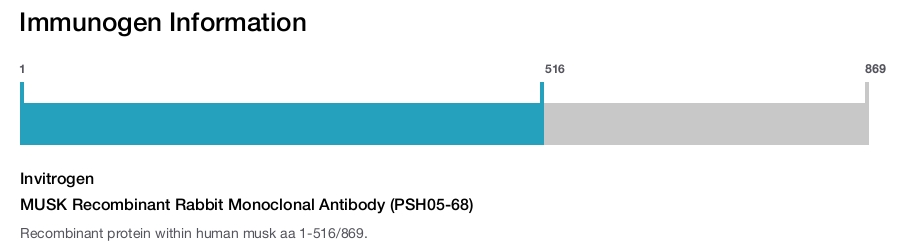
Recombinant protein within human musk aa 1-516/869.
偶联物
Unconjugated
Unconjugated
Unconjugated
形式
Liquid
浓度
1.06 mg/mL
规格
106 µg
纯化类型
Protein A
保存液
PBS, pH 7.4, with 40% glycerol, 0.1% BSA
内含物
0.05% sodium azide
保存条件
Store at 4°C short term. For long term storage, store at -20°C, avoiding freeze/thaw cycles.
运输条件
Ambient (domestic); Wet ice (international)
RRID
产品详细信息
Positive Control: Mouse skeletal muscle tissue lysate, rat skeletal muscle tissue lysate, human skeletal muscle tissue, mouse skeletal muscle tissue, rat skeletal muscle tissue.
Sequence Similarities: 100% Mouse/Rat.
Subcellular Location: Postsynaptic cell membrane.
Predicted band size: 97 kDa.
靶标信息
MUSK plays an important and selective role in many aspects of skeletal muscle development and function through the initial step of postsynaptic differentiation and formation of end-plate bands in cooperation with Rapsyn. Communication between cells is often mediated by receptors on the surface of the target cell that are triggered by specific ligands released by other cells. Receptor tyrosine kinase activity is strictly regulated by the binding of the appropriate ligand to the extracellular active site of the receptor. MuSK has been shown to be part of the agrin signaling complex and plays an important role in the development and architectural maintenance of the neuromuscular junction.
仅用于科研。不用于诊断过程。未经明确授权不得转售。
篇参考文献 (0)
您是否在文献中引用过该产品?请点击下方按钮邮件告知我们。
生物信息学
蛋白别名: MGC126323; MGC126324; muscle localized kinase 2; muscle specific kinase (neural fold/somite kinase 1); muscle, skeletal, receptor tyrosine kinase; muscle-specific kinase receptor; muscle-specific tyrosine kinase receptor MuSK; muscle-specific tyrosine protein kinase receptor; muscle-specific tyrosine-protein kinase receptor; MuSK; Nsk2; RP23-170A3.1
基因别名: CMS9; FADS; Mdk4; Mlk; Nsk1; Nsk2; Nsk3
UniProt ID: (Human) O15146, (Rat) Q62838, (Mouse) Q61006
Entrez Gene ID: (Human) 4593, (Rat) 81725, (Mouse) 18198
positive regulation of protein phosphorylation
enzyme linked receptor protein signaling pathway
transmembrane receptor protein tyrosine kinase signaling pathway
neuromuscular junction development
memory
regulation of synaptic growth at neuromuscular junction
positive regulation of gene expression
positive regulation of Rac protein signal transduction
skeletal muscle acetylcholine-gated channel clustering
positive regulation of skeletal muscle acetylcholine-gated channel clustering
positive regulation of protein geranylgeranylation
regulation of transcription, DNA-templated
negative regulation of gene expression
response to muscle activity
positive regulation of synaptic transmission, cholinergic
receptor clustering
positive regulation of neuron apoptotic process
positive regulation of synaptic growth at neuromuscular junction
protein autophosphorylation
response to axon injury
positive regulation of peptidyl-tyrosine phosphorylation
response to electrical stimulus
retina development in camera-type eye
long-term synaptic potentiation
cochlea development
signal transduction
Disclaimer

Clicking the images or links will redirect you to a website hosted by BenchSci that provides third-party scientific content. Neither the content nor the BenchSci technology and processes for selection have been evaluated by us; we are providing them as-is and without warranty of any kind, including for use or application of the Thermo Fisher Scientific products presented.

