Search
Invitrogen
Menin Recombinant Rabbit Monoclonal Antibody (K01_1K75)
{{$productOrderCtrl.translations['antibody.pdp.commerceCard.promotion.promotions']}}
{{$productOrderCtrl.translations['antibody.pdp.commerceCard.promotion.viewpromo']}}
{{$productOrderCtrl.translations['antibody.pdp.commerceCard.promotion.promocode']}}: {{promo.promoCode}} {{promo.promoTitle}} {{promo.promoDescription}}. {{$productOrderCtrl.translations['antibody.pdp.commerceCard.promotion.learnmore']}}
Additional Information:
{{banner.description}}
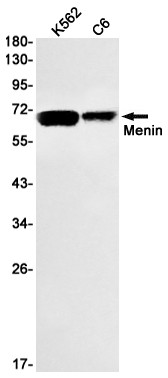
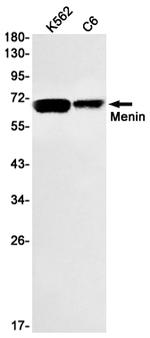
Please note: We are reviewing Western blot images included in the antibody testing data in our catalog, including those provided by third parties. Unless expressly labeled or annotated as “raw-unedited”, Western blot images included in the antibody testing data in our catalog may have been edited, optimized or otherwise adjusted for presentation.

产品信息
MA563150
产品规格
种属反应
Human,
Rat
宿主/亚型
Rabbit
/ IgG
Expression System
HEK293F
分类
Recombinant Monoclonal
类型
Antibody
克隆号
K01_1K75
抗原
A synthetic peptide of human Menin.
偶联物
Unconjugated
Unconjugated
Unconjugated
形式
Liquid
浓度
1 mg/mL
规格
100 µg
纯化类型
Protein A/G
保存液
50mM tris glycine, pH 7.4, with 40% glycerol, 150mM NaCl, 0.05% BSA
内含物
0.01% sodium azide
保存条件
Maintain refrigerated at 2-8°C for up to 1 month. For long term storage store at -20°C
运输条件
Ambient (domestic); Wet ice (international)
RRID
靶标信息
Potassium channels are a group of ubiquitously expressed proteins that serve numerous functions in excitable and non-excitable cells. One class of integral membrane potassium channels is the large conductance, calcium-activated potassium channel (Maxi K+). Maxi K+ differs from most other potassium channels in that its activation is controlled by both increases in intracellular calcium and by membrane depolarization. Maxi K+ dual activation is possible because of its structure. The core of the channel, which is similar to other potassium channels, is a Maxi K+ alpha homotetramer that contains both a voltage sensor and an intracellular calcium binding domain. In vascular smooth muscle, an auxiliary beta-subunit is found in a 1:1 stoichiometry. The beta-subunit exhibits its effect on the Maxi K+ channel by effectively decreasing by 5- to 10- fold the concentration of calcium required to keep the pore open.
仅用于科研。不用于诊断过程。未经明确授权不得转售。
篇参考文献 (0)
您是否在文献中引用过该产品?请点击下方按钮邮件告知我们。
生物信息学
蛋白别名: MEN1; multiple endocrine neoplasia 1; multiple endocrine neoplasia I; multiple endocrine neoplasia type I; unnamed protein product
基因别名: MEAI; menin; SCG2
UniProt ID: (Human) O00255, (Rat) Q9WVR8
Entrez Gene ID: (Human) 4221, (Rat) 29417
four-way junction DNA binding
Y-form DNA binding
transcription regulatory region sequence-specific DNA binding
bacterial-type RNA polymerase transcriptional activator activity, sequence-specific DNA binding
DNA binding
chromatin binding
double-stranded DNA binding
protein binding
protein binding, bridging
sequence-specific DNA binding
phosphoprotein binding
R-SMAD binding
negative regulation of transcription from RNA polymerase II promoter
osteoblast development
DNA repair
regulation of transcription from RNA polymerase II promoter
cellular response to DNA damage stimulus
negative regulation of cell proliferation
response to UV
response to gamma radiation
positive regulation of transforming growth factor beta receptor signaling pathway
T-helper 2 cell differentiation
negative regulation of osteoblast differentiation
negative regulation of cell cycle
positive regulation of gene expression, epigenetic
negative regulation of transcription, DNA-templated
positive regulation of transcription from RNA polymerase II promoter
negative regulation of JNK cascade
ossification
leukocyte homeostasis
osteoblast fate commitment
type B pancreatic cell differentiation
chromatin remodeling
regulation of gene expression
positive regulation of gene expression
negative regulation of cell-substrate adhesion
hemopoiesis
regulation of activin receptor signaling pathway
positive regulation of apoptotic process
positive regulation of cell differentiation
positive regulation of osteoblast differentiation
positive regulation of transcription, DNA-templated
negative regulation of organ growth
decidualization
embryonic skeletal system morphogenesis
negative regulation of epithelial cell proliferation
positive regulation of cell division
palate development
maternal process involved in female pregnancy
regulation of type B pancreatic cell proliferation
cellular response to glucose stimulus
cellular response to peptide hormone stimulus
response to transforming growth factor beta
negative regulation of cell cycle G1/S phase transition
regulation of G1/S transition of mitotic cell cycle
Disclaimer

Clicking the images or links will redirect you to a website hosted by BenchSci that provides third-party scientific content. Neither the content nor the BenchSci technology and processes for selection have been evaluated by us; we are providing them as-is and without warranty of any kind, including for use or application of the Thermo Fisher Scientific products presented.

