Search
Disclaimer

Clicking the images or links will redirect you to a website hosted by BenchSci that provides third-party scientific content. Neither the content nor the BenchSci technology and processes for selection have been evaluated by us; we are providing them as-is and without warranty of any kind, including for use or application of the Thermo Fisher Scientific products presented.
Invitrogen
Mepolizumab Humanized Recombinant Human Monoclonal Antibody
{{$productOrderCtrl.translations['antibody.pdp.commerceCard.promotion.promotions']}}
{{$productOrderCtrl.translations['antibody.pdp.commerceCard.promotion.viewpromo']}}
{{$productOrderCtrl.translations['antibody.pdp.commerceCard.promotion.promocode']}}: {{promo.promoCode}} {{promo.promoTitle}} {{promo.promoDescription}}. {{$productOrderCtrl.translations['antibody.pdp.commerceCard.promotion.learnmore']}}
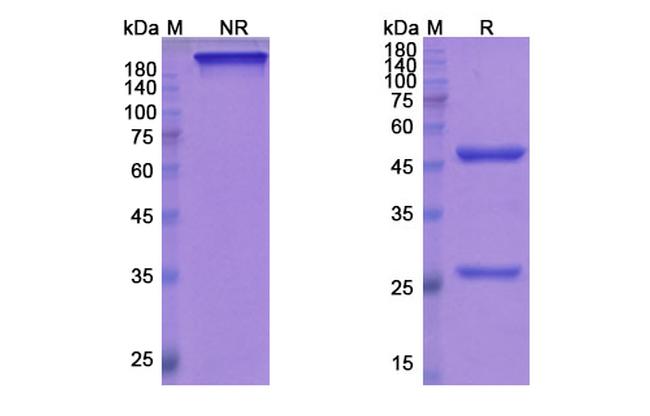
图: 1 / 1
Mepolizumab Humanized Antibody (MA5-41724) in SDS-PAGE
SDS-PAGE analysis of the recombinant Human IL5 protein expressed in CHO cells using a Mepolizumab biosimilar monoclonal antibody (Product # MA5-41724). R denotes the lane was run under reducing conditions. NR denotes the lane was run under non-reducing conditions.

产品信息
MA5-41724
产品规格
种属反应
Human
宿主/亚型
Human
/ IgG1, kappa
Expression System
CHO cells
分类
Recombinant Monoclonal
类型
Antibody
抗原
Human IL5
偶联物
形式
Liquid
浓度
4.52 mg/mL
纯化类型
Protein A/G
保存液
PBS, pH 7.4
内含物
no preservative
保存条件
-20°C, Avoid Freeze/Thaw Cycles
运输条件
Ambient (domestic); Wet ice (international)
RRID
产品详细信息
Endotoxin level < 0.01EU/µg by LAL method
Use a manual defrost freezer and avoid repeated freeze thaw cycles. Store at 2 to 8 °C for one week. Store at -20 to -80 °C for twelve months from the date of receipt.
靶标信息
Mepolizumab is a humanized IL-5 antagonist monoclonal antibody produced by recombinant DNA technology in Chinese hamster ovary cells. It has a molecular weight of approximately 149 kDa. It was approved by the FDA in November, 2015 for the treatment of asthma under the brand name Nucala (marketed by GlaxoSmithKline). Mepolizumab has been investigated in the treatment of severe nasal polyposis, among numerous other conditions. Mepolizumab is an interleukin-5 antagonist (IgG1 kappa). IL-5 is the major cytokine responsible for the growth and differentiation, recruitment, activation, and survival of eosinophils. Mepolizumab binds to IL-5 with a dissociation constant of 100 pM, inhibiting the bioactivity of IL-5 by blocking its binding to the alpha chain of the IL-5 receptor complex expressed on the eosinophil cell surface. Inflammation is an important component in the pathogenesis of asthma. Multiple cell types (e.g., mast cells, eosinophils, neutrophils, macrophages, lymphocytes) and mediators (e.g., histamine, eicosanoids, leukotrienes, cytokines) are involved in inflammation. Mepolizumab, by inhibiting IL-5 signaling, reduces the production and survival of eosinophils; however, the mechanism of mepolizumab action in asthma has not been definitively established.
仅用于科研。不用于诊断过程。未经明确授权不得转售。
篇参考文献 (0)
您是否在文献中引用过该产品?请点击下方按钮邮件告知我们。

