Search
Invitrogen
Mouse anti-Bovine Ig (Light chain) Secondary Antibody
{{$productOrderCtrl.translations['antibody.pdp.commerceCard.promotion.promotions']}}
{{$productOrderCtrl.translations['antibody.pdp.commerceCard.promotion.promocode']}}: {{promo.promoCode}} {{promo.promoTitle}} {{promo.promoDescription}}. {{$productOrderCtrl.translations['antibody.pdp.commerceCard.promotion.learnmore']}}
{{$ctrl.translations['antibody.pdp.skuNotes.additionalInformation']}}:
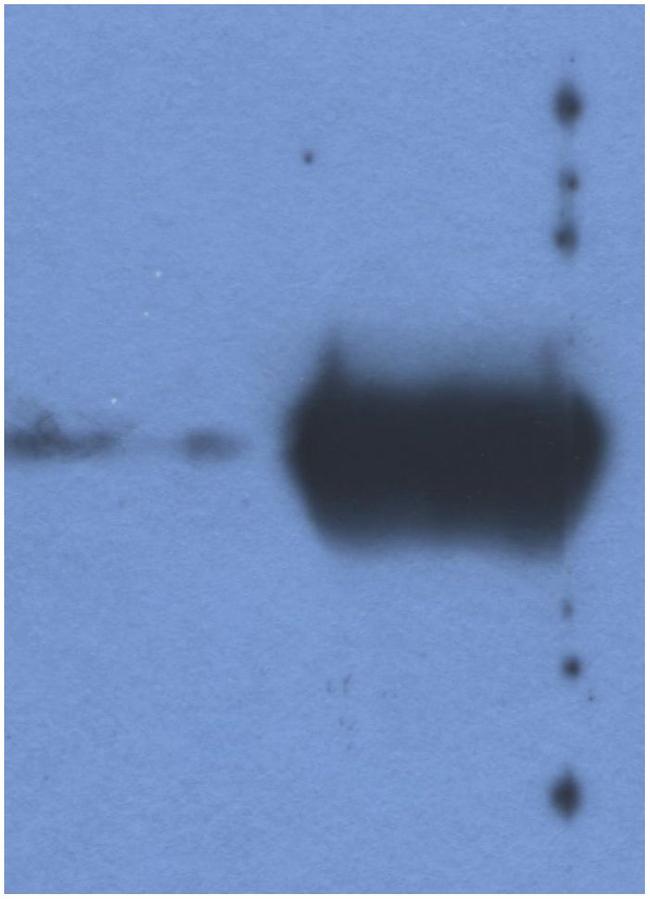
图: 1 / 3
Bovine Ig (Light chain) Secondary Antibody (MA1-19384) in WB
Western blotting detection of IgG light chain in reduced samples of Fetal Calf Serum (left lane) and Bovine Serum (right lane) by IVA285-1 Monoclonal antibody (Product # MA1-19384). This antibody is a suitable tool for in-house quality controls of Fetal Calf Serum (Hybridoma Cell Culture grade).
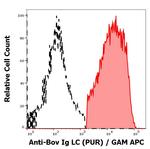
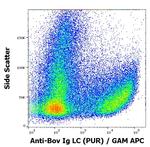
Please note: We are reviewing Western blot images included in the antibody testing data in our catalog, including those provided by third parties. Unless expressly labeled or annotated as “raw-unedited”, Western blot images included in the antibody testing data in our catalog may have been edited, optimized or otherwise adjusted for presentation.


产品信息
MA1-19384
应用
建议稀释比
免疫印迹 (WB)
0.5-1 µg/mL
免疫组化(冰冻) (IHC (F))
Assay-dependent
流式细胞分析 (Flow)
1-4 µg/mL
产品规格
种属反应
Bovine,
Sheep
宿主/亚型
Mouse
/ IgG1
分类
Monoclonal
类型
Secondary Antibody
克隆号
IVA285-1
抗原
Fraction of bovine immunoglobulin.
偶联物
Unconjugated
Unconjugated
Unconjugated
形式
Liquid
浓度
1 mg/mL
规格
100 µg
纯化类型
Protein A
保存液
PBS, pH 7.4
内含物
15mM sodium azide
保存条件
4°C, do not freeze
运输条件
Ambient (domestic); Wet ice (international)
RRID
靶标
Ig (Light chain)
抗体形式
Whole Antibody
产品详细信息
This antibody reacts with bovine Ig (light chains). Ig light chains (kappa and lambda types) consist of a variable region and a constant region and can easily be differentiated by the antigenic properties of the constant region.
Western Blot: Overnight at 4°C. Sample preparation: bovine serum, dilution 1:50 in Laemmli reducing buffer, boiled in water bath for 3 min. Reducing conditions, 12% separating gel. The antibody strongly reacts with bovine IgG light chains, weakly reacts with IgM.
靶标信息
Anti-Bovine secondary antibodies are affinity-purified antibodies with well-characterized specificity for bovine (cow, ox) immunoglobulins and are useful in the detection, sorting or purification of its specified target. Secondary antibodies offer increased versatility enabling users to use many detection systems (e.g. HRP, AP, fluorescence). They can also provide greater sensitivity through signal amplification as multiple secondary antibodies can bind to a single primary antibody. Most commonly, secondary antibodies are generated by immunizing the host animal with a pooled population of immunoglobulins from the target species and can be further purified and modified (i.e. immunoaffinity chromatography, antibody fragmentation, label conjugation, etc.) to generate highly specific reagents.
仅用于科研。不用于诊断过程。未经明确授权不得转售。
Disclaimer

Clicking the images or links will redirect you to a website hosted by BenchSci that provides third-party scientific content. Neither the content nor the BenchSci technology and processes for selection have been evaluated by us; we are providing them as-is and without warranty of any kind, including for use or application of the Thermo Fisher Scientific products presented.

