Search
Agrisera
NR/Nitrate reductase, assimilatory Polyclonal Antibody
{{$productOrderCtrl.translations['antibody.pdp.commerceCard.promotion.promotions']}}
{{$productOrderCtrl.translations['antibody.pdp.commerceCard.promotion.viewpromo']}}
{{$productOrderCtrl.translations['antibody.pdp.commerceCard.promotion.promocode']}}: {{promo.promoCode}} {{promo.promoTitle}} {{promo.promoDescription}}. {{$productOrderCtrl.translations['antibody.pdp.commerceCard.promotion.learnmore']}}
Additional Information:
{{banner.description}}
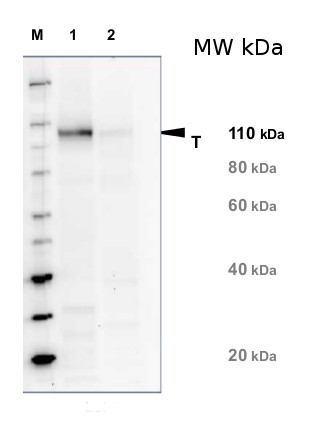
图: 1 / 1
NR/Nitrate reductase, assimilatory Antibody (AS08-310) in WB
20 µg of total protein from Arabidopsis thaliana leaf (1) and Hordeum vulgare leaf (2) were extracted with Protein Extraction Buffer PEB (AS08 300). Samples were diluted with 1 X sample buffer (Nu PAGE LDS sample buffer (Invitrogen) supplemented with 50 m M DTT and heat at 70°C for 5 min and kept on ice before loading. Protein samples were separated on 4-12% Bolt Plus gels, LDS-PAGE and blotted for 70 minut... View More
Please note: We are reviewing Western blot images included in the antibody testing data in our catalog, including those provided by third parties. Unless expressly labeled or annotated as “raw-unedited”, Western blot images included in the antibody testing data in our catalog may have been edited, optimized or otherwise adjusted for presentation.

产品信息
AS08-310
产品规格
种属反应
Algae,
Plant
宿主/亚型
Rabbit
分类
Polyclonal
类型
Antibody
抗原
KLH-conjugated synthetic peptide derived from conserved domain in NADH-NR protein sequences including A.thaliana NR1 and NR2.
偶联物
Unconjugated
Unconjugated
Unconjugated
形式
Lyophilized
规格
100 µg
纯化类型
Antigen affinity chromatography
保存液
PBS, pH 7.4
内含物
no preservative
保存条件
-20°C, Avoid Freeze/Thaw Cycles
运输条件
Ambient (domestic); Wet ice (international)
产品详细信息
Store lyophilized/reconstituted at -20°C; once reconstituted make aliquots to avoid repeated freeze-thaw cycles. Please remember to spin the tubes briefly prior to opening them to avoid any losses that might occur from material adhering to the cap or sides of the tube.
For reconstitution add 50 µL of sterile water.
Specific Species Reactivity: Arabidopsis thaliana, Chlamydomonas reinardtii, red alga Gracilaria gracilis, Hordeum vulgare, Leptodictyum riparium (Hedw.) Warnst (moss), Medicago sativa, Phaeodactylum tricornutum Bohlin accession Pt1 8.6, Panax notoginseng, Populus yunanensis Dode, Solanum lycopersicum, Solanum tuberosum, Thalassiosira sp. (diatom), Trebouxia sp., Vigna radiata, Vitis vinigera
靶标信息
Nitrate reductase is a molybdenum cofactor-dependent oxidoreductase that reduces nitrate to nitrite and occurs in distinct cellular locations depending on the biological context: in many bacteria, the major respiratory nitrate reductase is a cytoplasmic membrane-anchored complex with nitrate reduced at a cytoplasmically oriented catalytic site while electrons are supplied from the membrane quinol pool, whereas in plants the assimilatory NAD(P)H-dependent nitrate reductase is a soluble cytosolic enzyme that channels electrons from NAD(P)H to nitrate. Structurally, the bacterial respiratory enzyme is typically organized as a multisubunit NarGHI complex in which the extrinsic catalytic subunits (NarG and NarH) are attached to an integral membrane anchor (NarI); NarG houses the nitrate-reducing active site containing a Mo-bis(molybdopterin guanine dinucleotide) cofactor, NarH contains multiple iron-sulfur clusters that relay electrons, and NarI is a diheme b cytochrome that provides the quinol oxidation site and a conduit for electron transfer across the membrane. In contrast, eukaryotic assimilatory nitrate reductase is generally a homodimeric ~100 kDa-per-subunit enzyme composed of discrete redox domains binding FAD, a b-type heme, and a molybdenum-molybdopterin center, enabling intramolecular electron transfer from NAD(P)H via FAD and heme to the Mo active site. Functionally, these enzymes connect nitrate availability to cellular metabolism: bacterial membrane-bound nitrate reductase supports anaerobic respiration and can contribute to proton motive force generation via spatial separation of quinol oxidation and nitrate reduction, while cytosolic plant nitrate reductase catalyzes the first committed step of nitrate assimilation, governing flux into reduced nitrogen metabolism.
仅用于科研。不用于诊断过程。未经明确授权不得转售。
篇参考文献 (0)
您是否在文献中引用过该产品?请点击下方按钮邮件告知我们。
生物信息学
蛋白别名: GNR1; NIA1; NIA2; NITRATE REDUCTASE; nitrate reductase 1; NR; NR1; T32E8.9; T32E8_9
Disclaimer

Clicking the images or links will redirect you to a website hosted by BenchSci that provides third-party scientific content. Neither the content nor the BenchSci technology and processes for selection have been evaluated by us; we are providing them as-is and without warranty of any kind, including for use or application of the Thermo Fisher Scientific products presented.

